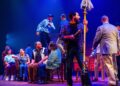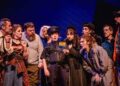


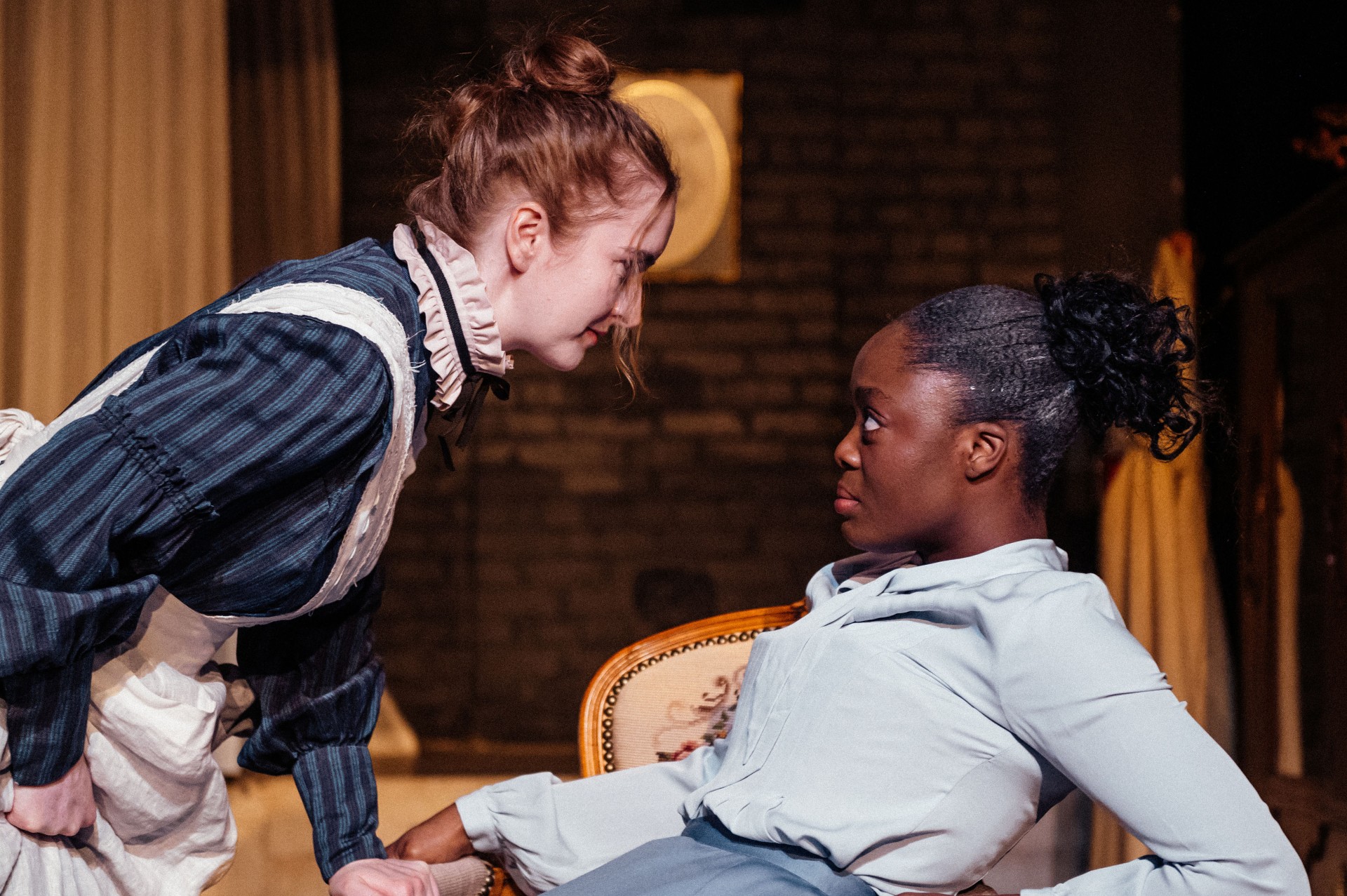
Set in Victorian England, The Moors unfolds in a remote, desolate manor in the dank English countryside where two spinster sisters pass their days in isolation. Agatha (Raquel Duffy), the domineering and no-nonsense elder, micromanages the household, while Huldey (Lindsey Middleton), her emotionally needy sister, pours herself into a diary, fantasizing about literary fame despite having no audience. Their exchanges—delivered in modern American accents—are quick and witty, occasionally evoking the sharp comedic tone of Arsenic and Old Lace or The Importance of Being Earnest.
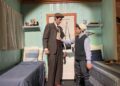
From the outset, however, something feels off. The maid, Marjorie (Erin Humphry), shifts identities depending on the room she occupies—pregnant in one moment, terminally ill in another. The arrival of Emilie (Blessing Adedijo), a naïve governess lured by correspondence with the unseen Mr. Bramwell, introduces a gothic mystery that never quite resolves. (Notably, Bramwell was the real-life brother of the Brontë sisters, a clear nod to Wuthering Heights and its bleak, windswept sensibility.)
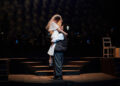
The production quickly tips from intriguing to outright surreal. A mastiff (Jack Copland), played by a man in a handsome Victorian suit, delivers solemn monologues about love and loneliness, to himself and later alongside a humanized moor-hen (Heeyun Park) who quite literally flies into his life. Meanwhile, the manor behaves like a funhouse: every room looks the same, entrances and exits defy logic, and space becomes increasingly disorienting—not in a thrilling way, but in a frustrating one.
Jen Silverman’s script deliberately blends gothic melodrama, farce, black comedy and absurdist humour, but in director Kennedy’s version, the balance never quite lands. What begins as an intriguing mystery is quickly buried under staccato, overly stylized dialogue that feels more forced than clever. The humour, clearly intended to be dark and deadpan, rarely earns more than a polite chuckle.
Visually, the production is equally conflicted. Madeline Ius’s costumes are richly textured and convincingly period—until they’re not. Why is the dog in a man’s suit while the moor-hen wears a ruffled skirt that mimics feathers? Additionally, modern plastic see-through raincoats, glittery diaries, and conspicuously modern accessories – like a pink, distinctly phallic furry pen – clash with the Victorian setting in ways that feel less intentional than distracting, constantly pulling the audience out of the world rather than adding to its surrealism.
The staging does little to help. The parlour, with its settee and twin chairs, serves as a stand-in for multiple rooms. But it creates more confusion than cohesion, with little to distinguish one space from another, particularly the mansion’s exterior. Franco Pang’s lighting further muddies the picture: parts of the unused set are not dimmed, warm amber tones drain the moors of any sense of cold or menace, and shadowy areas around the perimeter mask actors who should be the focus.
Performance-wise, the results are uneven. Raquel Duffy is the clear standout, bringing control and nuance to Agatha and hinting at the emptiness beneath her rigid exterior. There’s definitely more to this woman than meets the eye. Lindsey Middleton’s Huldey has solid comedic instincts, but her performance rarely comes down from its heightened pitch. She’s exhausting to watch. Erin Humphry finds some dry humour as the ever-shifting maid—Marjorie, Mallory, or whoever she is in the moment—but the characterization lacks enough variation to fully land. Blessing Adedijo is charming as Emilie, though she often feels disconnected from the rest of the cast, particularly in scenes with Agatha that should carry more tension.
The animal figures—Copland’s mastiff and Park’s moor-hen—strangely offer the most grounded moments of the evening, though their repetitive, melancholic exchanges feel like they belong in an entirely different play.
Ultimately, The Moors is less a cohesive production than a collection of competing ideas. It toys with gothic conventions only to dismantle them, layering absurdity over atmosphere without a clear sense of purpose. While its central theme—human longing for connection—does come through, it’s buried beneath so much stylistic noise that it didn’t resonate for me.
There are flashes of insight and originality here, but the production struggles to unify its many ideas of the human condition. The result is a work that is undeniably ambitious, occasionally intriguing, but ultimately more puzzling than profound.
But maybe that’s the point?
Running time: approximately 110 minutes with no intermission.
The production runs until April 19 at The BMO Incubator, The Theatre Centre, 1115 Queen St. West, Toronto. For tickets, call 416-538-0988 or email info@theatrecentre.org
The Moors by Jen Silverman
Presented by Riot King at The Theatre Centre
Producers: Brendan Kinnon, Katherine Cappellacci, Lindsey Middleton
Directed by Bryn Kennedy
Costumes by Madeline Ius
Lighting Designer: Franco Pang
Sound Designer: Ian Ottis Goff
Set Design: Bryn Kennedy
Stage Manager: Liam Cox
Performers: Blessing Adedijo, Jack Copland, Raquel Duffy, Erin Humphry, Lindsey Middleton, Heeyun Park 박희윤