

Mohsin Zaidi’s The Surrogate offers a bold and unsettling look at the emotional, ethical, and legal issues surrounding commercial surrogacy. Directed with sharp precision by Christopher Manousos, the production puts audiences at the heart of a deeply personal and emotionally charged debate about family, faith, gender identity, and responsibility.
Set at Hammond General Hospital in Louisiana, Sameer (Fuad Ahmed), a Muslim lawyer, and his husband Jake (Thom Nyhus), a writer, have entered into a surrogacy agreement with Marya (Sarena Parmar), a Muslim woman who agrees to carry their child. Since the arrangement is legally established in Texas, where surrogacy is allowed, the contract exists in a grey area because Louisiana prohibits commercial surrogacy. Interestingly, Canada prohibits it too.
For Sameer, the desire for a child is closely linked to family expectations tied to his Muslim faith. He wants to give his mother a grandchild and to strengthen Jake’s acceptance within his traditional family, who are not keen on recognizing the same-sex union. The two men assume financial responsibility for Marya’s medical expenses and care. That amount has risen into thousands of dollars.
Marya faces her own struggles within her immediate family. Her husband is ill. Initially, she believes she’s helping Sameer and Jake, as there’s a promise that the child will be raised Muslim. Now, Marya begins to second-guess her decision to follow the contract. This doubt deepens when medical complications send her to the hospital, and her uncertainty grows. Overworked nurse Christina (Antonette Rudder) is responsible for providing the best care for both mother and unborn child.
The situation becomes even more complex when Marya’s eighteen-year-old son, Qasim (Siddharth Sharma), arrives from the Louisiana school where he is studying. As the medical crisis worsens, he unexpectedly finds himself holding the authority to decide what will happen to his mother and her baby after a serious turn of events, rather than Sameer and Jake, who thought their parental rights were secure.
The cast offers a compelling ensemble performance. Fuad Ahmed plays Sameer with initial composure and authority that he asserts over Thom Nyhus’s Jake, who appears more anxious and submissive when the audience first meets him. Sameer’s privilege and confidence gradually reveal cracks as the story progresses. By the end, the power balance between the two expectant fathers shifts dramatically in building towards the play’s climax. All is not well in the relationship between Sameer and Jake.
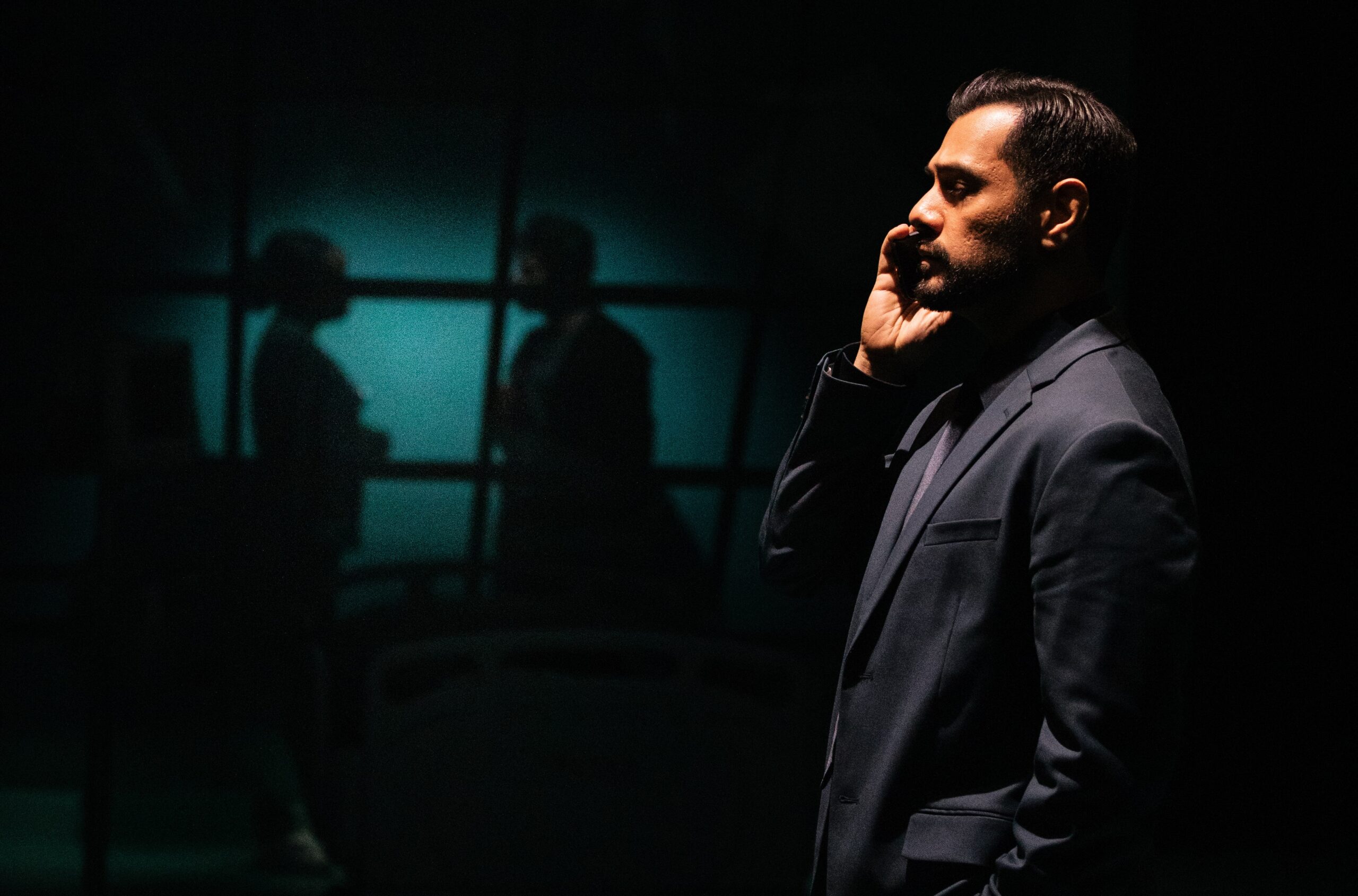
Antonette Rudder gives a grounded performance as nurse Christina. Her no-nonsense and pragmatic honesty cut through the tension. Unafraid to challenge Sameer and Jake, Christina questions their assumptions about parenthood boldly and stresses the importance of maternal influence. When Christina speaks to an unnamed person on her cell phone—presumably her husband—the audience witnesses added emotional depth to the situation between husband and wife, which rings genuine. Rudder keeps her performance realistic without overacting.
Sarena Parmar’s Marya evokes deep sympathy as a woman caught between faith, financial hardship, and moral uncertainty. Her difficulties during recovery are particularly moving. Siddharth Sharma delivers a compelling portrayal of Qasim, whose confrontation with the two men after a sudden plot twist becomes one of the play’s most impactful moments.
The production’s design elements heighten the sense of pressure, almost to the point of an explosion within the hospital setting. Scott Penner’s minimalist set places the audience in a three-quarter theatre-in-the-round. There’s a hospital bed, a stark institutional chair to the right, and a medical monitor and gauge to the left, beneath a large tilted mirror. Just upstage from the set is the waiting area and corridor outside Marya’s hospital room, which also functions as the hospital reception.
Audience members are just feet away from the intense, tangible action. We are fully absorbed in sitting so close to the action – most notably, Manousos’s blocking of Ahmed and Nyhus, and their positions when conversations occur in the hospital room.
Harsh fluorescent lighting by Chris Malkowski flickers overhead at times, heightening the suspense. Maddie Bautista’s ambient hospital sounds—paging medical personnel and background noise—create a constant undercurrent of unease. Costumes by Andrew Broderick subtly reflect each character’s personality and social standing.
Staged in Crow’s Studio Theatre’s intimate setting, The Surrogate draws the audience close to the challenging questions it raises. Issues of faith, ethics, legality, and societal expectations clash as the characters grapple with what it truly takes to create a ‘conventional’ twenty-first-century family today.
Zaidi’s script offers no easy answers, much like the uncertainty of world events today. Instead, the play encourages viewers to confront uncomfortable perspectives on faith, LGBTQ+ identity, and reproductive rights without offering clear resolutions. Hopefully, there might be some audience talkbacks after certain performances.
At this particular show, the play did not end with applause immediately but with a momentary pause of a few seconds of silence, reflecting the weight of the issues presented, before the curtain call. In an era when debates around social justice and societal expectations often polarize along political lines, The Surrogate reminds audiences that theatre can serve as a space for reflection. Sometimes, the most powerful response is simply silence—and that, in itself, makes for compelling on-stage work.
The Surrogate runs approximately 95 minutes with no intermission and continues through April 5 at Crow’s in the Studio Theatre, 345 Carlaw Avenue, Toronto. For tickets: crowstheatre.com or call (647) 341-7390.
HERE FOR NOW THEATRE, CROW’S THEATRE, HOUSE + BODY, and b current Performing Arts present
The Surrogate by Mohsin Zaidi World Premiere
Directed by Christopher Manousos
Set Designer: Scott Penner
Lighting Designer: Chris Malkowski
Sound Designer: Maddie Bautista
Costume Designer: Andrew Broderick
Stage Manager: Nazerah Carlisle
Intimacy Director: Cara Rebecca
Performers: Fuad Ahmed, Thom Nyhus, Sarena Parmar, Antonette Rudder, Siddharth Sharma