

Even the most skeptical/hardened audience member may find it difficult to remain unmoved by the beautifully and harmoniously sung Act 2 finale, ‘Happiness Is,’ with its quietly resonant reflections on being alone every now and then, coming home again, morning and evening, daytime and nighttime. Its emotional clarity lingers well beyond the moment itself, and its gentle wisdom feels especially apt for the younger generations still learning how to make sense of the world.
Now on stage at Port Hope’s Capitol Theatre, ‘You’re a Good Man, Charlie Brown’ draws on Charles Schulz’s beloved Peanuts characters through a series of brief vignettes inspired by the comic strips and books that have endured for decades. What continues to make the musical effective is the dynamic identified by director and choreographer Rob Kempson in his Director’s Note: “We’ve aimed to explore the contrast between the ‘static’ feeling of the scenes – many of which are verbatim from the comics – and the explosive energy of the music in the show.”
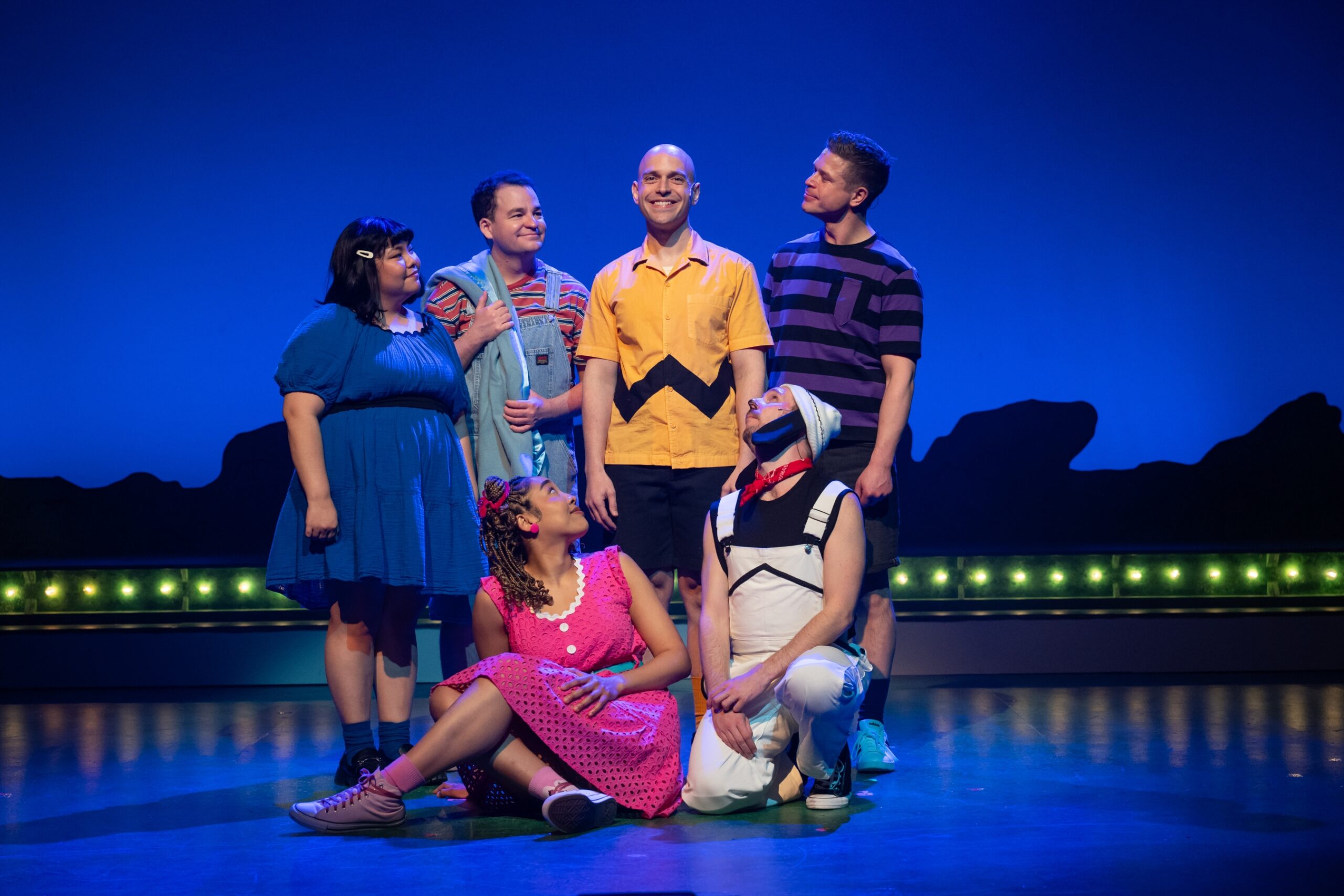
Joshua Quinlan’s three-dimensional, cartoon-inflected set makes an immediate impression, vividly evoking the blue-sky, cloud-strewn world of Schulz’s Peanuts. Snoopy’s doghouse is especially well-realized. Kirsten Watt’s warm, sunlit lighting for “The Baseball Game,” which closes Act 1, lends the scene a convincing outdoor vitality, as though one were watching children play on a summer field. Quinlan’s costumes are equally precise, capturing the comic strip’s visual identity with striking fidelity, from Charlie Brown’s signature zigzag shirt to Lucy’s dark blue dress and black Mary Jane shoes.
Kempson’s affection for Peanuts is unmistakable. His direction reflects a scrupulous attention to the details that have long endeared these characters to audiences. He honours the visual language of the comic strip in carefully chosen props and costume touches: the actors stand with their arms at their sides when speaking, just as the characters do on the page; Charlie Brown’s pitcher’s mound is persuasively realized in three dimensions; and the oversized baseball caps in the game sequence provide an especially apt flourish. Even Snoopy’s black floppy ears, worn by Matt Pilipiak, are rendered with charming precision.
Music Director Shane O’Regan manages the transitions from spoken dialogue to musical number with notable finesse, allowing the songs to emerge as an extension of the script’s brief, comic exchanges. Among the strongest moments are the opening title number and “Beethoven Day.” If there is a minor quibble, it lies in the balance between Emily Porter’s sound design and Justin Han’s instrumentation: at times, the music slightly overwhelms the text, causing some of the humour in “Book Report” to be lost. It is, however, a small issue and one that seems readily correctable.
The performances strike an engaging balance between childlike and understated intelligence, with a gently cerebral humour running beneath the production’s playful surface. One especially well-judged moment comes when a character matter-of-factly recounts what their family has eaten three times in the past week—a line delivered with timing and quiet wit.
Amir Haidar brings quiet assurance to the title role, capturing Charlie Brown’s decency and vulnerability with unaffected sincerity. His moments in “T-E-A-M,” along with a charming reference to his pen pal (wasn’t it pencil pal since his pen kept leaking ink in the comic strip?) drew audible affection from the audience. Matt Pilipiak, meanwhile, proves an equally winning Snoopy. His Act 2 entrance as the World War I Flying Ace, mounted on his faithful Sopwith Camel—here, of course, represented by the doghouse—is executed with flair and comic confidence.
As Sally, Charlie Brown’s younger sister, Jillian Mitsuko Cooper makes astute use of her height, lending the character’s newly adopted “Philosophy” an appealing blend of poise and comic self-possession. AP Bautista brings bracing bravado to Lucy Van Pelt, capturing the character’s crabby, controlling spirit to fine effect in “Glee Club.” Ben Kopp offers a sweetly lisping, blanket-toting Linus whose apparent innocence is matched by an air of wisdom beyond his years. As the Beethoven-devoted Schroeder, Kyle Golemba provides an understated counterpoint to Bautista’s formidable Lucy, meeting her declarations of love with a perfectly judged, silent reserve.
What, precisely, allows the Peanuts characters to continue speaking so directly to older audiences?
Perhaps it is because, even in later life, many of us still feel slightly out of step with the demands and bewilderments of the twenty-first century. In that sense, there is something quietly reassuring in a musical that acknowledges the awkwardness of being human while gently insisting on our essential goodness.
The Capitol’s You’re a Good Man, Charlie Brown remains, in every essential respect, a production to be experienced live.
Please see it.
Running time: approximately two hours with one intermission.
The production runs to May 31 at Port Hope’s Capitol Theatre, 20 Queen Street. For tickets: www.capitoltheatre.com or call (905) 885-1071.
CAPITOL THEATRE MAINSTAGE presents
You’re a Good Man, Charlie Brown Book, Music and Lyrics by Clark Gesner; Additional Dialogue by Michael Mayer;Additional Music and Lyrics by Andrew Lippa
Directed and Choreographed by Rob Kempson
Music Direction by Shane O’Regan
Movement Coach: Yunike Soedarmasto
Sound Designer: Emily Porter
Set and Costume Designer: Joshua Quinlan
Lighting Designer: Kirsten Watt
Stage Manager: Hannah MacMillan
Assistant Stage Manager: Jess Gordon
Assistant Director: Matt Lacas
Musician: Justin Han
Performers: Amir Haidir, Ben Kopp, Kyle Golemba, Jillian Mitsuoko Cooper, AP Bautista, Matt Pilipiak