

(Please note: I saw the preview performance. There may be changes going forward when the show opens May 21.)
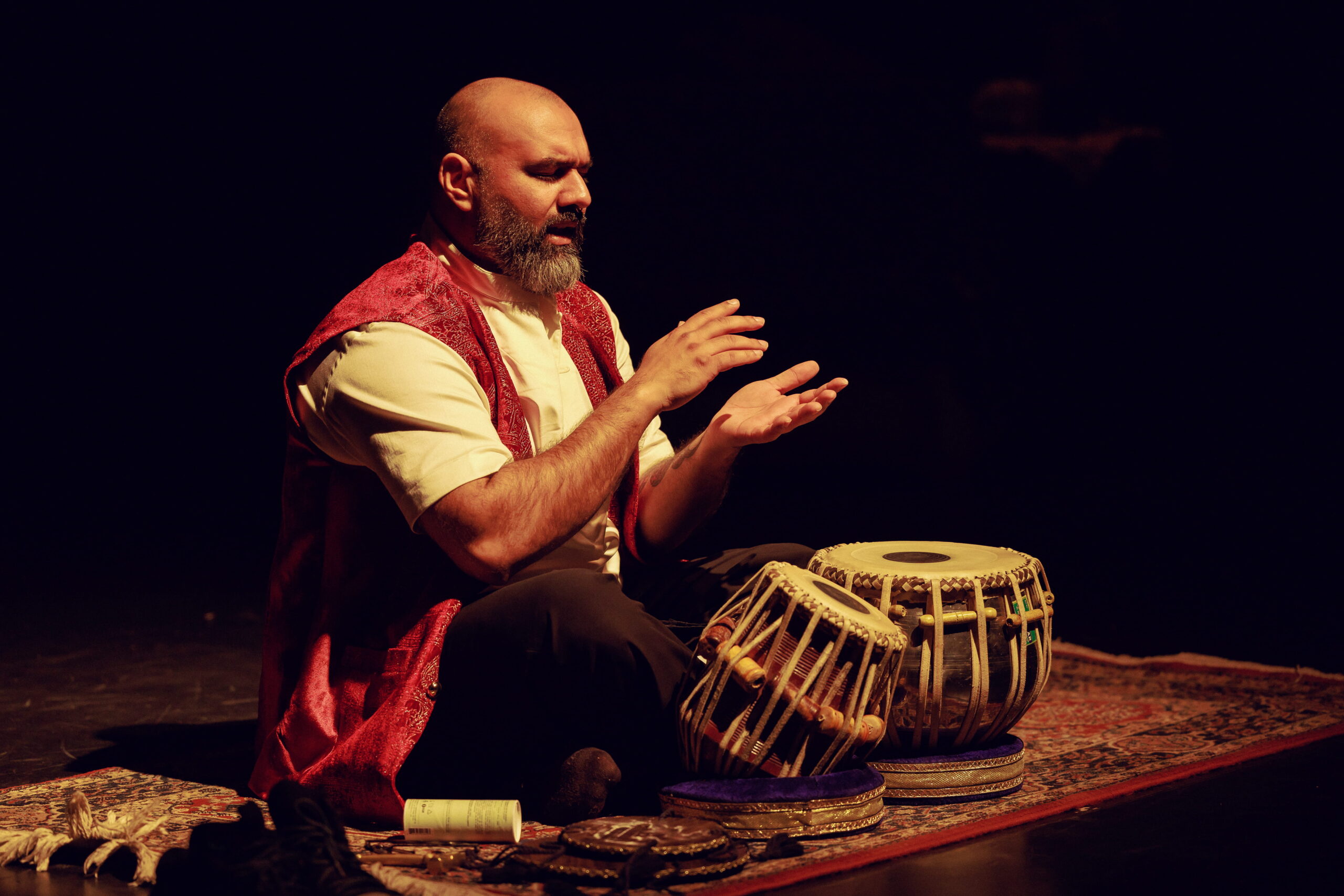
bol, brown boy, bol becomes a story about watching and experiencing a young man proudly reclaiming his Indian voice and cultural inheritance. The play becomes more than just mere entertainment. Nawazz Makhani’s performance becomes spiritually unique. There’s a sacredness between him, the tabla (a northern Indian percussion instrument) and the audience. Nawazz breaks the fourth wall at the top of the show. As he spoke to the audience for a few minutes, I felt trusting to go on a journey with him from Richmond Hill to Scarborough and overseas, spanning his youth, teenage years, twenties, and thirties, ending in the present day.
To understand the play’s context, important information was shared in the press release. ‘bol’ is a Hindi word that means ‘speak’. In tabla, ‘bol’ refers to the spoken syllables used to learn and practise rhythms. The dual meaning behind the title: “Learning to speak through music and about finding your voice.”
Co-directed by Makhani and Tiffany Wu with gentleness (even in moments that turn ugly with racism, so be advised), the story moves back and forth in time across three distinct playing spaces, each containing important props Nawazz will use to tell his story. Great care has been taken to ensure a genuine sense of realism in the props and set pieces, through the appropriate selection of pre-show music, and the tabla music he plays throughout the show.
Wu and Makhani maintain a fluid pace throughout the production. There were a couple of moments when Nawazz was in the shadows of Lindsay Murray’s bright, focused lighting, so he’ll need to pay close attention as the show continues to find his light.
Makhani has quite a task in this solo touring performance. The tone shifts briskly between comedy and drama at a few points. He appears comfortable with these quick changes, playing a variety of characters (his work as his older sister had me smiling), from the schoolyard bully to the guruji (teacher) who influenced his life spiritually in Kolkata, India. He’s believable in each role and maintains that quality consistently throughout. There’s a respectful humanity behind Nawazz’s portrayal of his Gulima (grandmother), and it remains quite touching throughout.
Nawaaz also understands the importance of comic timing and never overplays the funny bits, as is most evident when he writes a letter to his Bollywood film-star idol, Salman Khan, at age eight. His wide-eyed enthusiasm in his letter-writing is one of the show’s highlights. This puerile joy takes a turn later when Nawaaz discovers the truth about Khan, and that dramatic moment hits home.
The play’s conclusion is rather poignant when Nawazz shares with the audience where he is at this point in his adult life. He’s made choices and wonders whether he did the right thing regarding his career (we’ve all been there at one point).
bol, brown boy, bol is important because there’s a moment that still resonates with me the next day. At one point, Nawazz is on a field trip to Cairo when a market vendor calls out, assuming he’s Indian. He snaps back: “I’m not Indian, I’m Canadian.”
By the end of the play, Nawazz wants the audience to know that while he is confidently Indian, he’s also proud to be Canadian.
That’s the kind of story we need to see right now in so much world turmoil.
Running time: approximately one hour with no intermission.
The production runs to May 24 at Native Earth’s Aki Studio, 585 Dundas Street East, Toronto. For tickets: https://ca.patronbase.com/_NativeEarthPerformingArts/Productions/BB/Performances
CQC Arts presents
bol, brown boy, bol in association with Blemme Fatate Productions
Creator, performer and co-director: Nawaaz Makhani
Co-director and Creative Director: Tiffany Wu
Producer: Robin McNaughton
Musical Direction: Chiranjit Mukherjee & Nawaaz Makhani
Lighting Designer: Lindsay Murray
Sound Designer: Christine Wu