

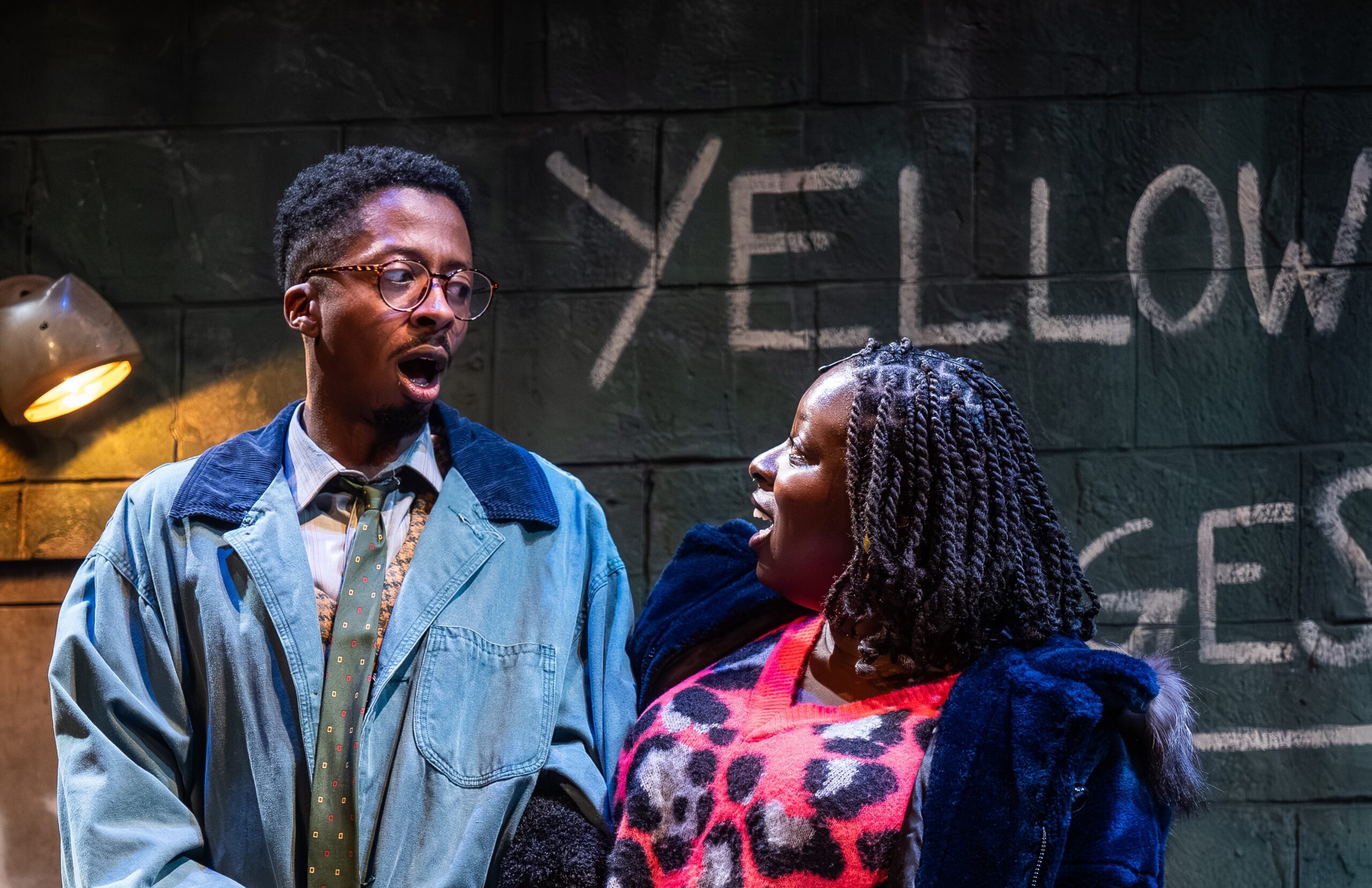
Mouldy walls, graffiti tags, and electrical wiring. Tufts of grass sprouting through cracks in the concrete. There is even a manhole. Julie Fox’s meticulous set offers a beautiful, hyper-realistic glimpse of a run-of-the-mill suburb in Rochester, New York. There lives Kenneth, 38, once a bookstore keeper, now a banker. When he’s not working, he is probably drinking Mai Tais – plural – with his best friend Bert at their favourite local spot, Wally’s. Just a dull, ordinary life. Bert is the coping mechanism through which Kenneth tries to survive his loneliness and to stave off his yearning for connection.
It is easy to see why Eboni Booth’s Primary Trust earned the Pulitzer Prize in 2024. Its mundane premise conceals an intriguing, surrealistic edge. Its framing hopscotches through routine and fantasy. And there is real intelligence in the writing – at its best when witty comic beats cut through the tragic material, keeping the play from slipping into sentimentality. Yet what works on the page does not always translate to the stage with the same ease. Here, the lack of tension becomes harder to ignore.
Kenneth’s life is so mundane that it keeps the play from generating real dramatic conflict. Sure, he has delusions and visions, but he is largely self-aware, choosing to indulge them on his own terms. Sure, he loses the bookshop job he has held for 20 years, but as soon as he enters the job market, he promptly finds a new position at one of the city’s two banks – the show’s namesake, Primary Trust. He is never really pushed to the brink. The other characters – largely underwritten and in service to Kenneth’s story – tend to accommodate and coddle him. Even when he breaks down at work, his bravado-filled boss drags himself to Wally’s just to check in on him.
It is a shame this unwieldy script never quite rises to its own stakes, especially since Crow’s Theatre and the Grand Theatre have given it such a witty, talented production. Cherissa Richards’s direction is smooth and gracefully deft, constantly tensing the wire between realism and surrealism. Transitions between scenes are nimble and rhythmically assured, sweeping Kenneth through the ordinary spaces of his everyday life.
But Richards never lets the story’s uncanny undertow slip out of view. The recurrent ringing of a reception bell keeps interrupting the linear logic of the protagonist’s ordinary life. With each sharp, irritating chime, the action freezes into distilled, cartoonish snapshots: individual actors caught in spotlit, excessive expressions.
That uneasy relationship between what’s real and what’s not is also kept in view through the clash between Fox’s beautifully scrupulous set design – down to the strip of grey tape repairing a torn seam in one of Wally’s booths – and the production’s over-the-top acting style.
Durae McFarlane gives a fragile, affecting performance. Nerdy and socially awkward, his Kenneth moves with tense shoulders and locked knees, infusing the character with a frightened-child quality that creates a mixture of compassion and tenderness in the audience. Kenneth lives in fear of reality, retreating into his delusions and closing himself protectively against the outside world.
That world is brought on stage by the high-voltage Ryan Hollyman and Khadijah Roberts-Abdullah. Shifting accents and physical postures with restless precision, they move through a diorama of characters, ages and social types, from bank customers to passersby and servers. Their portraits are sharply exaggerated: eyes pop, smiles freeze, bodies snap into stylized poses.
As waiter Corrina, Roberts-Abdullah gives the production some of its purest moments of tenderness. Hollyman, meanwhile, shines as Clay, the manager of Primary Trust. Manspreading in a beautiful translucent blue suit by Rachel Forbes, he gives the character a puffed-up, sports-bro swagger, his line readings full of shouty, overperformed masculinity. It can feel like too much, but it also injects a welcome jolt of verve into an otherwise static script.
The creative and performance teams do their best with the material, building a smooth, well-oiled theatrical machine that still manages to land a few warm-hearted moments. Kenneth began talking to Bert after a friendship failed him. From there, he withdrew into a protective fantasy, one where everything feels assured and immune to disappointment. The “primary” instinct suggested by the play’s title may be the risky trust we place in other people, knowing they will eventually let us down. Better, perhaps, to remain inside the chrysalis. Except that may not be living at all.
Running from May 26 to June 21, 2026, at Crow’s Theatre, 345 Carlaw Avenue, Toronto. Tickets: crowstheatre.com or call (647) 341-7390.
Running time: 90 minutes with no intermission.
Credits: Durae McFarlane as Kenneth; Peter N. Bailey as Bert; Khadijah Roberts-Abdullah as Corrina; Ryan Hollyman as Clay/Sam; Danilo Reyes as Musician. Written by Eboni Booth; directed by Cherissa Richards; set design by Julie Fox; costume design by Rachel Forbes; sound design by Thomas Ryder Payne; lighting design by Imogen Wilson; associate lighting design by Christian Horoszczak; stage managed by Kai-Yueh Chen 陳楷岳; assistant stage managed by Emma Jo Conlin.