

In her programme note, director Molly Atkinson offers a succinct key to Samuel Beckett’s masterpiece: “There are two absolute certainties in life. We are born. We will die. It’s what we do in between — the waiting — that matters.” That idea hangs over Stratford’s opening-night production. It’s a staging that treats waiting as the essential condition of being human.
The result is a production that remains enigmatic, often bleak, and consistently absorbing.
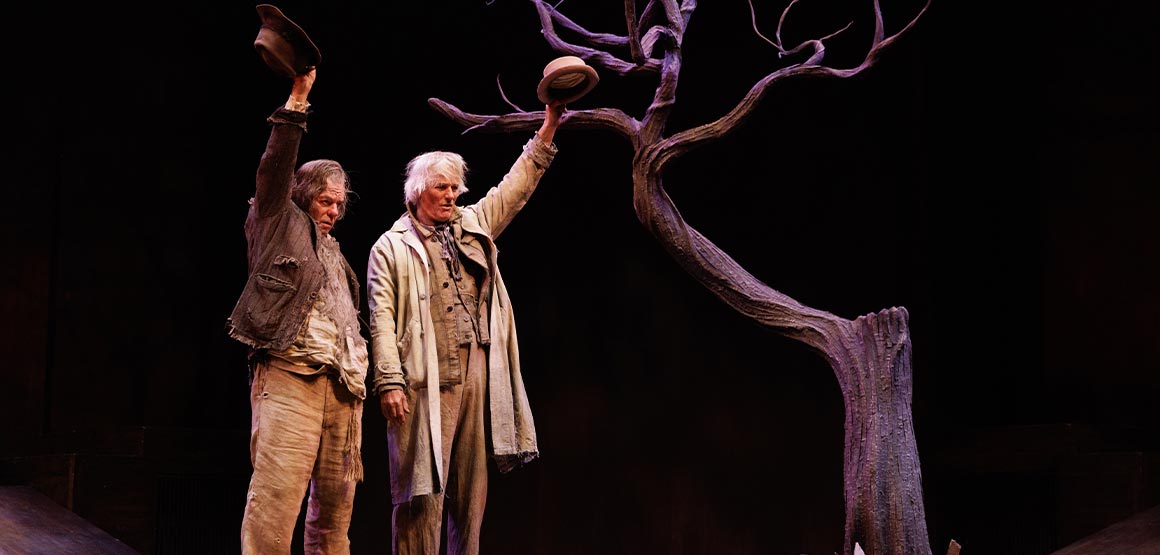
Save for a lone, lifeless tree — one that sprouts a single leaf in Act 2 — Cory Sincennes’s barren Festival stage set suggests a world stripped to its essentials. Jareth Li’s severe lighting reinforces that austerity, creating a landscape in which even daylight offers little comfort.
Within that desolate frame, Estragon (Tom McCamus) and Vladimir (Paul Gross) wait for the mysterious Godot, convinced his arrival will alter their fortunes. Sincennes dresses them in drab, colourless costumes that speak volumes: Estragon’s shoes are worn to ruin, and at times McCamus goes barefoot; Gross’s Vladimir appears only marginally more put together, a faint gesture toward dignity in an otherwise depleted world.
To fill the hours, the pair trade pet names — Didi and Gogo — and circle through jokes, fragments of philosophy and half-finished thoughts. Beckett’s dialogue can sound disarmingly simple, but here it lands with wit and ache, revealing how much these men cannot quite say to one another.
They repeatedly threaten to part, only to remain where they are, sustained by the promise that Godot may yet appear. Even the arrival of a boy (Gordon Paul Miller, at this performance), bearing the familiar message that Godot will not come today but surely tomorrow, is enough to renew their hope. Repetition is the point, and Atkinson allows it to accrue both comedy and quiet despair.
In Act 1, they are joined by Pozzo (Jonathan Goad) and his silent servant, Lucky (David W. Keeley), en route to market, where Pozzo intends to sell him. Lucky, tethered by a rope, lugs heavy bags while enduring Pozzo’s casual cruelty, a relationship Beckett presents as both a grotesque spectacle and a grim social parable. Sincennes dresses Goad’s Pozzo entirely in red – a satirical and comical visual look at a cruel man who loses it all in Act 2.
There are plenty of laughs in this production, but Atkinson never allows the play’s humour to blunt its loneliness. Vladimir and Estragon’s clipped exchanges often seem on the verge of revelation before collapsing back into delay, a rhythm the cast handles with precision.
Waiting for Godot remains a play that resists final explanation. It can feel absurd one moment and piercingly persuasive the next, and that tension is part of its enduring power. Atkinson wisely resists over-explaining the play’s mysteries. Instead, she trusts Beckett’s language and the audience’s patience, inviting us to experience the journey rather than decode it.
Under her carefully measured direction, the production’s chief pleasure lies in hearing this cast speak Beckett’s lines with clarity, weight and relish. The ensemble understands the value of stillness as much as speech, using pauses, movement and silence with uncommon discipline.
Miller’s boy is spare and self-possessed, bringing quiet gravity to his brief appearance. Goad makes Pozzo imperious without flattening him into caricature, while Keeley’s largely silent Lucky becomes unforgettable when finally commanded to speak, unleashing a torrent of language that is both comic and unsettling.
The evening belongs, however, to McCamus and Gross. Their performances are funny, melancholy and quietly tender — and they make Estragon and Vladimir’s endless postponement feel less like an abstract idea than a deeply recognizable human habit. Together, they anchor the production with wit, rhythm and emotional credibility.
One reservation concerns the miking of the actors. In a venue the size of the Festival Theatre, audibility matters. From my seat, some lines were lost whenever McCamus or Gross turned away while speaking across the stage and their backs to certain parts of the audience. In a play so dependent on language, that is more than a minor inconvenience.
Even so, Stratford’s Waiting for Godot is a production well worth seeing: intelligent, handsomely acted and fully alert to the play’s strange, stubborn beauty.
Running time: approximately two hours and 30 minutes with one interval/intermission.
The production runs to July 31 at the Festival Theatre, 55 Queen Street, Stratford. For tickets: stratfordfestival.com or call 1-800-567-1600
STRATFORD FESTIVAL presents
Waiting for Godot by Samuel Beckett
Directed by Molly Atkinson
Set and Costume Designer: Cory Sincennes
Lighting Designer: Jareth Li
Composer and Sound Designer: Alessandro Juliani
Stage Manager: Maxwell T. Wilson
Performers: Tom McCamus as Estragon; Paul Gross as Vladimir; Jonathan Goad as Pozzo; David W. Keeley as Lucky; Gordon Paul Miller as Boy (at the opening night performance).