


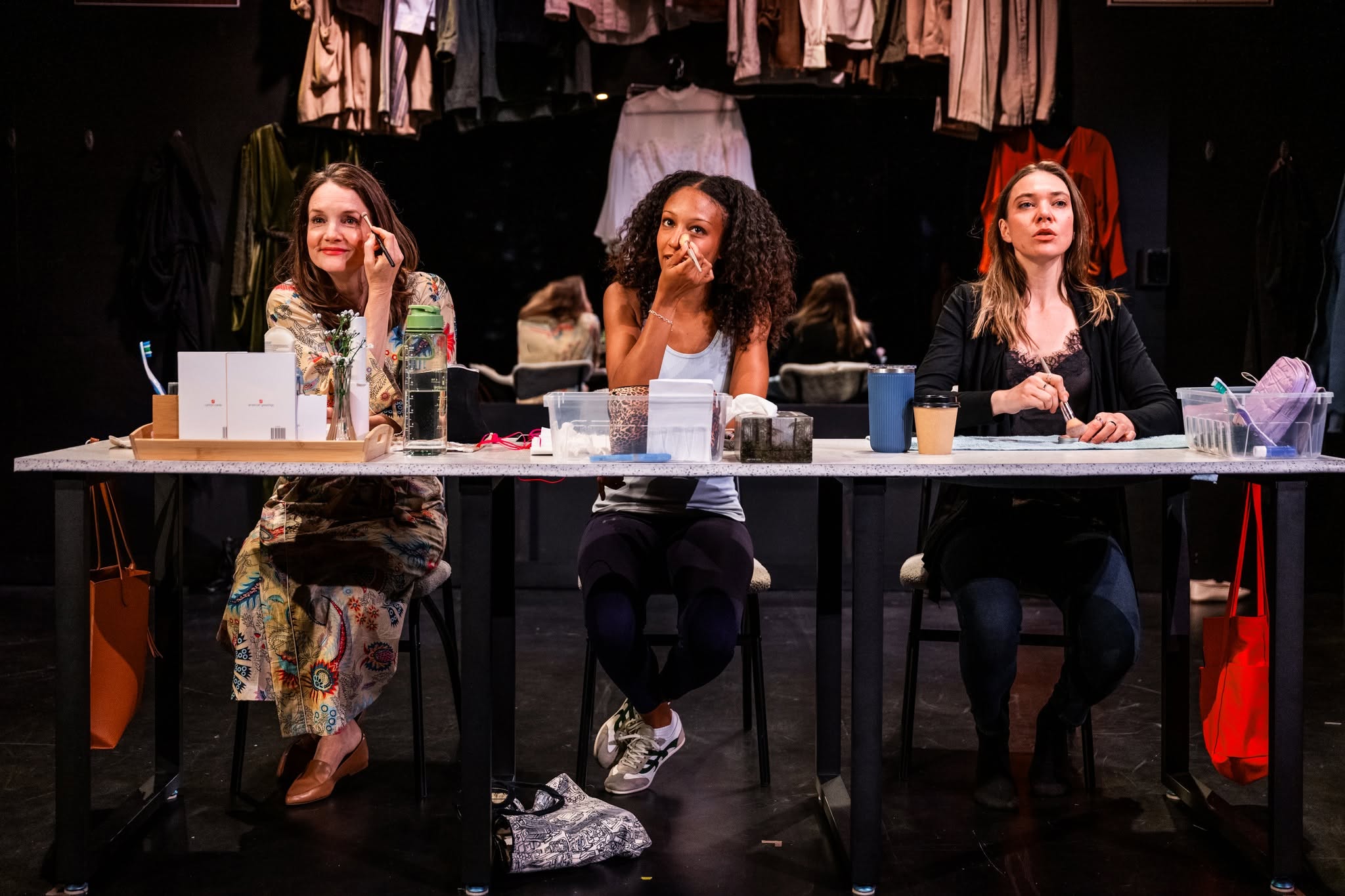
Set in the early autumn of 2016, Love Us Most opens on the sort of backstage space rarely granted centre stage. Ariel Slack’s set is a meticulously ordered dressing room in an operational, unnamed theatre company: makeup stations at the ready, costumes hanging above, and a distorted mirror that quietly suggests the warped reflections soon to come. Darren Burkett’s lighting captures the practical glare of a working dressing room, lending the production an immediate, lived-in authenticity.
The company is preparing for that evening’s performance of King Lear. While Farb’s play showcases Jennie Wonnacott’s beautiful-looking costume designs for the daughters, Love Us Most is less interested in Shakespearean grandeur than in what happens before the curtain rises.
First to arrive is The One Who Plays Goneril (Shannon Taylor), fielding a call about a possible audition for Isabella in Measure for Measure. Soon after, The One Who Plays Cordelia (Jasmine Case) enters wearing headphones, and the two settle into the familiar rituals of actors before a show: makeup, costumes, gossip, professional envy, and the uneasy calculations of careers built in the theatre industry.
The audience learns that the coveted role of Isabella hovers over the room as the two are vying for it, exposing differences in age, status, and opportunity.
At the half-hour call, The One Who Plays Regan (Zara Jestadt) arrives just in time, her lateness apparently not a first offence. The trio’s banter initially has the crackle of backstage comedy, sharpened by the small indignities of shared space and scarce opportunity.
As they dress in Jennie Wonnacott’s vivid costumes, the women circle questions familiar to many artists: how long a career can last, who gets to be seen, and what must be swallowed in order to keep working. Farb lets the conversation move with deceptive ease, allowing jokes and irritations to accumulate into something more volatile.
The room’s broken toilet becomes more than a practical inconvenience. While the principal male actors enjoy private dressing rooms in this offstage King Lear, these women are left to share a malfunctioning space. The inequity has clearly touched a nerve that never fully healed.
Then, just before places are called, the play darkens. One of the women reveals that Julian Jeffrey (Kevin Bundy), the actor playing Lear, has subjected her to unwanted, inappropriate comments and sexual innuendo. What becomes even darker – one of those women knows far more than she initially lets on. It’s also revealed that she is romantically involved with Julian.
From there, Farb’s incisive play lands its blows. Love Us Most examines sexism, racism and ageism in the theatre with a sting that is both necessary and deeply uncomfortable.
Sabryn Rock’s direction is unsparing without becoming sensational. She gives the actors room to reveal how silence is learned, enforced and finally challenged. In her program note, Rock writes, “Stand in your power, speak up, take your space. We need you more than ever.” The production honours that charge.
Case, Jestadt and Taylor respond with performances of notable precision and force. They listen as keenly as they speak, and that attentiveness gives the production much of its tension. The audience watches not only what is said but also what is resisted, deferred, or silently understood.
The early comic notes are well judged. The women’s professional rivalries over Isabella — one convinced the part was promised, another sensing the theatre may want a new direction, a third wondering why she was not even invited to audition — create laughter edged with recognition.
Love Us Most quickly pushes past the joke. What emerges is a portrait of women who have had to absorb sexism, intimidation, assault and bullying as the hidden cost of remaining employable.
Bundy’s Julian Jeffrey is chillingly plausible: genial, entitled, performatively charming and predatory when the room allows it. His entrance, drink in hand, shifts the atmosphere; his manipulation is gradual, practiced and even more unsettling for its ordinariness.
The question the play leaves hanging is not simply what happened in this room, but how many such rooms have protected similar behaviour and the horrifying fact that it may still be ongoing.
On opening night, the play inevitably calls to mind the four courageous ladies from 2020, prominent Canadian artists who came forward about abuses of power in a Toronto theatre company. Recently, I also learned of a male actor who suffered the same atrocity at another Toronto theatre company. Farb and Rock do not exploit these contexts. Instead, they allow these contexts to press against the drama of the play, reminding us that the stage has too often asked its artists to perform daring while denying them safety.
The title is pointed. Echoing Lear’s cruel demand that his daughters prove their love, Love Us Most becomes a plea and an indictment: believe those who risk everything to tell the truth, and love them most for surviving what they should never have had to endure.
It is a sharp, necessary and powerfully acted production. Love Us Most turns a backstage dressing room into a reckoning with power, silence and survival in the theatre.
Please see it.
Running time: approximately 75 minutes with no intermission.
The production runs to July 1 in the Rose McQueen Theatre at Stratford’s Here for Now Theatre, 24 St. Andrew Street. For tickets: herefornowtheatre.com or call (519) 272-4368.
HERE FOR NOW THEATRE presents
The World Premiere
Love Us Most by Sara Farb
Directed by Sabryn Rock
Set Designer: Ariel Slack
Lighting Designer: Darren Burkett
Sound Designer: Thomas Ryder Payne
Costume Designer: Jennie Wonnacott
Stage Manager: Sam Snyders
Performers: Kevin Bundy, Jasmine Case, Zara Jestadt, Shannon Taylor