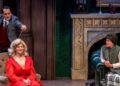


At the performance I attended, there was a delicious irony in watching Antonio Salieri rage against mediocrity while I was sitting through a production that served up a generous helping of it.
The Shaw Festival’s Amadeus is a diminished staging of Peter Shaffer’s four-time Tony Award-winning play. It is conspicuously short on Mozart’s music, yet remarkably well supplied with banality. What should be a sharp, theatrical account of genius and envy instead proves curiously flat, restrained, and unremarkable.
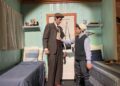
Amadeus is a fictionalized account of the rivalry between Wolfgang Amadeus Mozart (a too-mature Michael Therriault) and the Italian court composer Antonio Salieri (a one-note Tom Rooney). Set mostly in 18th-century Vienna, it follows Salieri’s growing envy and resentment as he encounters Mozart’s extraordinary musical genius, which he believes is a cruel gift from God bestowed upon an irreverent and vulgar young man. As Salieri struggles with his own mediocrity, his admiration soon turns to obsession and revenge.
This is a complex play about human relationships, with themes of jealousy, irony, conflict with God, opulence, and the joy of music. Heady stuff to be sure.
Yet director Tim Carroll seems determined to make this Amadeus smaller than it is. There isn’t enough of anything: the opulence of the Viennese court, the ostentatious costuming, or even the emotional connection between most of the characters. Everything feels wafer-thin. It is too controlled and sterile, and the theatrical stakes are never high enough.
Most disappointing is the rivalry, which never seems to come to a boil. Salieri’s growing, corrosive envy and Mozart’s genius should feel uneasily omnipresent. The ideas are all there, but Carroll’s sterile treatment drains them of their theatrical bite.
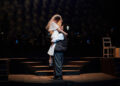
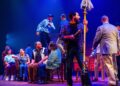
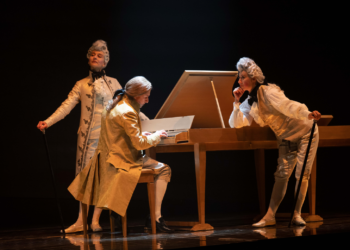
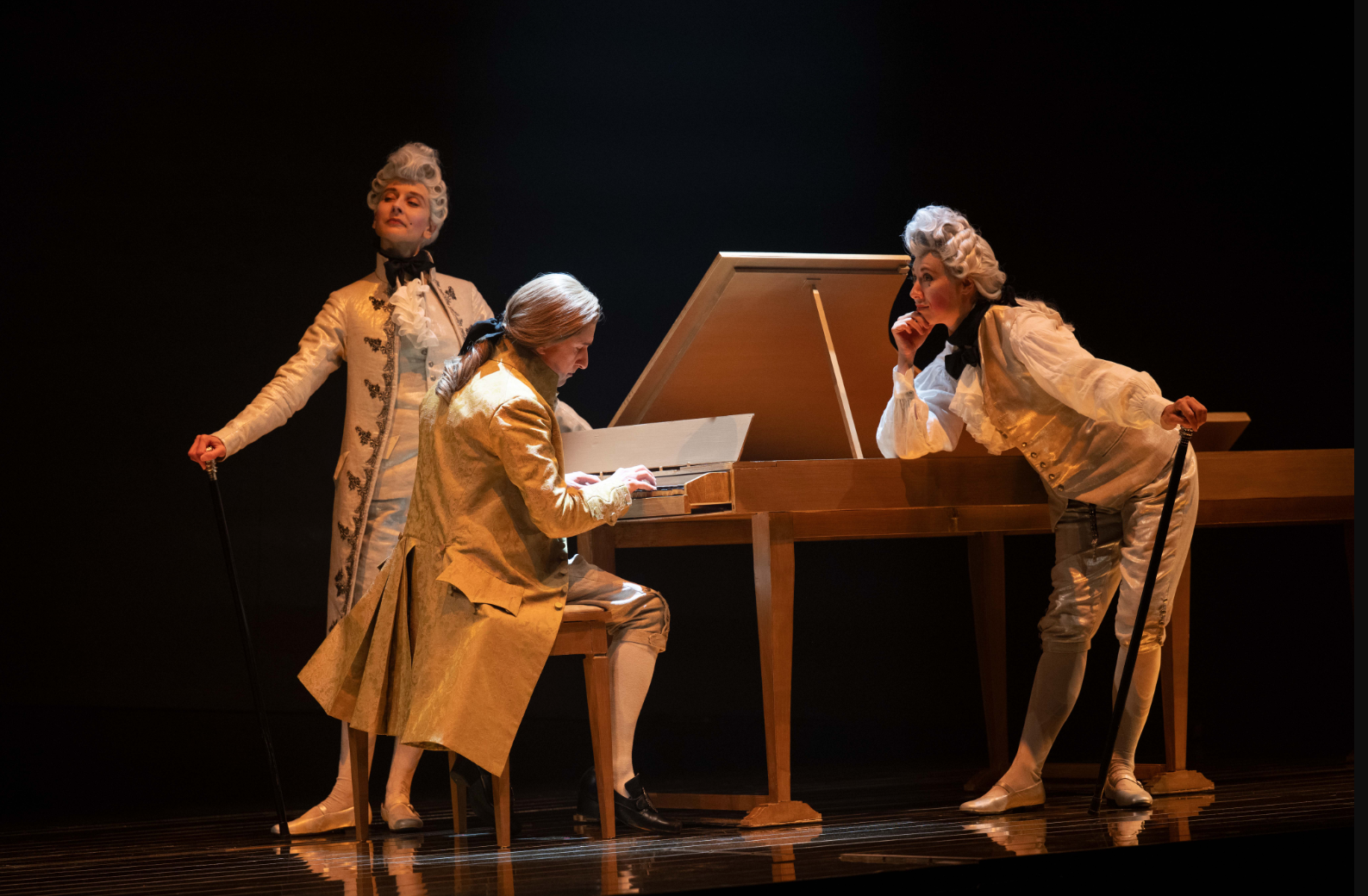
Judith Bowden’s set design, though thoughtful and visually distinctive, is too austere. Her deliberately stylized, spartan approach does little to convey the elaborate wealth of the 18th-century Viennese court. A scrim and raised platform at the rear allow different locations to be suggested, an effective theatrical device in principle. However, the steep, sloping stage, lined to resemble a musical staff, remains a mystery. Why such a skewed space? Perhaps it is meant to symbolize the contrasting lives of Salieri and Mozart—mediocrity versus genius, conventional ambition versus extraordinary talent. More importantly, though, the design seems to prioritize concept over the practical needs of the performers. What might have been an intriguing visual metaphor instead becomes a distraction for the audience and an obstacle that the actors must continually negotiate in chunky heels.
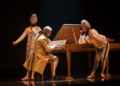
Bowden’s costumes are more successful. They capture the 18th-century court of Emperor Joseph II well enough, but their muted palette of gold and bronze and restrained visual richness falls short of conveying the full opulence, wealth, power, and status.
Kevin Lamotte’s lighting design fills the stage with a natural, candlelit dimness, while Paul Sportelli’s recordings of excerpts from Mozart’s operas and symphonies are far too brief to have much impact. Some of Salieri’s works might have been used to contrast his music with that of the young genius. For a play with music at its heart, there simply isn’t enough of it.
The performances run the gamut. Julia Course and Sochi Fried are a delight as the witty Venticelli. Their fast-paced repartee and stylized, synchronous movements elevate every scene they’re in. As the pompous and imperious Emperor, Graeme Somerville has fun delivering “Well, there it is,” but that is about all that makes him memorable. Allan Louis is fine as the deviously foppish Count Orsini-Rosenberg, while Savion Roach is rather droll as the aristocrat Gottfried van Swieten.
But it’s Therriault and Rooney who unfortunately never quite reach the genuine emotional heights these roles demand.
That’s disappointing.
Very early in the play, Salieri realizes that although Mozart appears to be a childish, crass, vulgar imp, he can effortlessly compose in seconds what would take Salieri weeks. From the moment Salieri is introduced to Mozart through their final scenes together, there is a lack of compelling intensity between them. Instead, it’s a rather flat Rooney, occasionally fishing for lines, who doesn’t fully land Salieri’s anger and jealousy. He doesn’t delve deeply enough into the darker side of his psyche. His physicality and voice barely change as he moves between the older and younger versions of Salieri.
Therriault is energetic enough, but he isn’t boyishly impetuous. He does his best to bring youthful exuberance to the 25-year-old Mozart, but he comes across as too mature rather than as the volatile young genius who poses such an existential threat to Salieri.
Kristi Frank’s flaky portrayal of Constanze seems too affected at first; however, she quickly reveals the character’s affection and vulnerability as she attempts to manage both Salieri and Amadeus. Some of her better scenes come in Act II, particularly when she struggles with poverty and impending motherhood.
In the end, this production I saw takes a play about enormous genius, jealousy, power, God, and artistic ambition on a scale that feels too small, restrained, and emotionally safe.
A significant amount of theatrical force has been excised in the process. What remains may communicate what Amadeus means; it just doesn’t explain why it matters.
Running time: approx. 3 hours with one intermission.
The production runs until October 4 at the Festival Theatre, 10 Queen’s Parade, Niagara-on-the-Lake. For tickets, call the Box Office at 1-800-511-7429 or visit shawfest.com
The Shaw Festival presents “Amadeus” by Peter Shaffer
Directed by Tim Carroll
Set and costumes designed by Judith Bowden
Lighting designed by Kevin Lamotte
Music supervised by Paul Sportelli
With: Tom Rooney, Michael Therriault, Kristi Frank, Sochi Fried, Andrew Broderick, Julia Course, Cosette Derome, Allison Edwards-Crewe, Allan Louis, Andrew Reid, Savion Roach, Graeme Somerville.