

Tawiah M’Carthy’s direction combines disciplined ensemble performances with a 1970s setting that underscores Pinter’s study of intimacy and deception.
Harold Pinter’s Betrayal depends as much on what its characters withhold as on what they say. At Victoria’s Belfry Theatre, director Tawiah M’Carthy gives those silences room to register in a production marked by clear dialogue and restrained performances. The 1978 play centres on a seven-year affair between Emma (Yanna McIntosh) and Jerry (Matthew MacFadzean), her husband Robert’s (Jonathan Watton) best friend. Jerry is married to the unseen Judith. The shifting balance of knowledge among the three central characters complicates both their marriages and their friendship. Angelo Rosso plays the Waiter and helps carry the production through its scene transitions.
The story moves backwards and forward through time throughout much of the affair, requiring the audience to reassess earlier encounters in light of subsequent revelations. Betrayal extends beyond marital infidelity: friendship, confidences and the characters’ accounts of their own behaviour are also at stake.
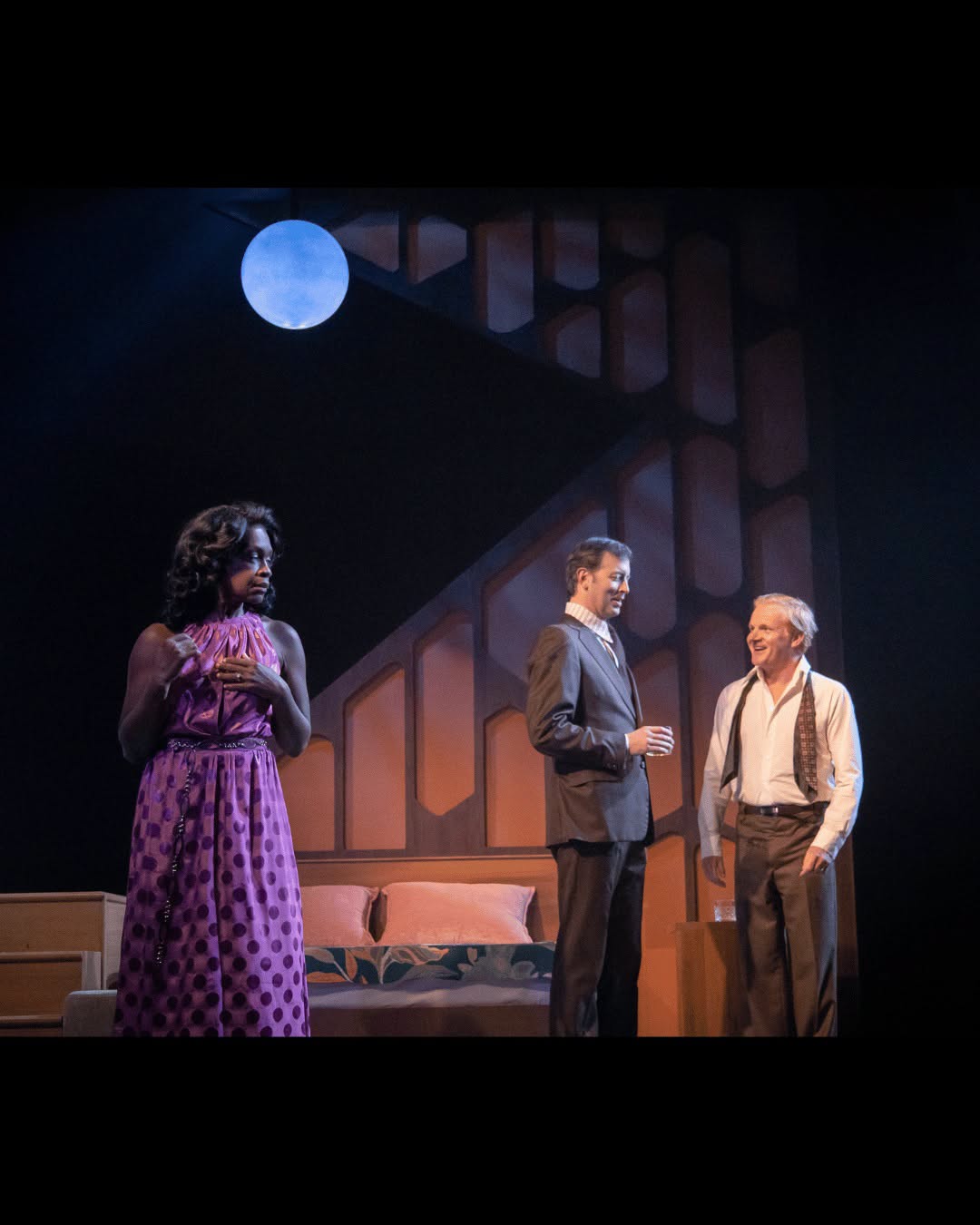
The production’s mid-to-late-1970s setting is established through Tobin Stokes’ preshow and scene-change music and Arianna Lilith Moodie’s costumes. Emma’s flowing, sheer fabrics and pastel colours contrast with the men’s fitted shirts and trousers; Jerry’s turtleneck adds another period detail. Nic Vincent’s lighting distinguishes the emotional atmosphere of the scenes. Jawon Kang’s semicircular, multilevel set uses stairs and movable furniture to establish changes of time and place. Props remain within easy reach, and the actors use the entrances and exits throughout. A bed that slides in and out marks one of the spaces Emma and Jerry share.
Director Tawiah M’Carthy keeps the dialogue crisp while allowing veiled motives and conflicting accounts to emerge beneath it. The Pinter pauses are purposeful rather than decorative, serving at different moments as sources of humour, character revelation and suspense. The ensemble’s controlled movement supports that approach. The actors remain still when an exchange needs time to build, then move with clear purpose. Their performances bring out the characters’ self-interest, sexual desire and defensiveness without relying on exaggerated gestures.
Rosso’s contribution extends beyond the Waiter’s appearance during Robert and Jerry’s liquid lunch. He sets tables and moves furniture between scenes, occasionally snapping his fingers to the 1970s music. These touches provide brief comic relief without interrupting the transitions. More striking are the moments when Rosso enters after a tense exchange and makes silent eye contact with the actor who remains. Before the furniture moves, the encounter suggests an awareness of what has passed between the characters, sustaining the unease beyond the scene itself.
Watton and MacFadzean deliver the period’s misogynistic exchanges with humour that can turn uncomfortable. As Robert absorbs the truth about Emma’s affair when she admits it in Italy, Watton holds a stillness that leaves his response uncertain and quietly unsettling.
McIntosh’s Emma is assured in her dealings with both men. She attempts to maintain emotional control over them. In the first scene, MacFadzean’s Jerry initially projects a comic swagger, believing Emma is still attracted to him and wants him. McIntosh sees right through that veneer of bravado and seems tired of it. Later, when Emma leaves Jerry and the flat they share, she tries to remove the key from her chain and give it to him. Having trouble in doing so, McIntosh throws the entire chain at Jerry and orders him to remove it instead. It’s a moment when she wants to rid herself of any reminder of the affair, and the look of stupefied rejection in MacFadzean’s eyes signals the play’s shifting loyalties.
While the Belfry’s opening night production allows moments of levity, an atmosphere of impending conflict persists. Vincent’s lighting contributes to that impression, with a haze-like effect above the stage suggesting a gathering dust storm.
The Belfry’s Betrayal is strongest in its attention to the tensions beneath ordinary conversation. M’Carthy’s measured direction and the ensemble’s restraint make the shifting relationships legible while leaving the characters’ motives open to scrutiny.
Running time: approximately 75 minutes with no interval/intermission.
Betrayal runs to November 22 at the Belfry Theatre, 1291 Gladstone Avenue, Victoria, British Columbia. For tickets: belfry.bc.ca, call (250) 385-6815 or email hello@belfry.bc.ca
THE BELFRY THEATRE presents
Betrayal by Harold Pinter
Directed by Tawiah M’Carthy
Set Designer: Jawon Kang
Costume Designer: Arianna Lilith Moodie
Lighting Designer: Nic Vincent
Sound Designer: Tobin Stokes
Intimacy Director: Treena Stubel
Stage Manager: Jasmin Sandhu
Performers: Matthew MacFadzean, Yanna McIntosh, Jonathan Watton, Angelo Rosso