

Review by East Coast Guest writer Chris Coculuzzi
(Chris has been involved in independent and community theatre for more than thirty years as a producer, director, performer, and playwright. He is also an educator, helping hundreds of students over the last twenty-five years bring their own creative expressions to life on stage. Chris resides in Cole Harbour, Nova Scotia and is a member of the Playwrights Atlantic Resource Centre and a Drama Teacher for the Halifax Regional Centre for Education)
At the heart of Dan Bray’s Deepwater is a mystery (or is it a riddle?) about a missing persons case. Questa (Liliona Quarmyne) is an RCMP investigator digging into a cold case about May (Amy Reitsma) and Casper’s (Chris George) young daughter Lucy, who disappeared one January evening in a snowstorm in the Kempt Shore region of Nova Scotia under suspicious circumstances.
The play opens with Questa meeting May in her previous home and reassuring her that this will be a conversation and not an interrogation. She encourages May to divulge and go deeper, reminding her that “the only way out is through,” evoking the guiding phrase of AA as a means to face pain; however, the only vice in this story is not a bottle (except the ones carrying messages) but a vape pen.
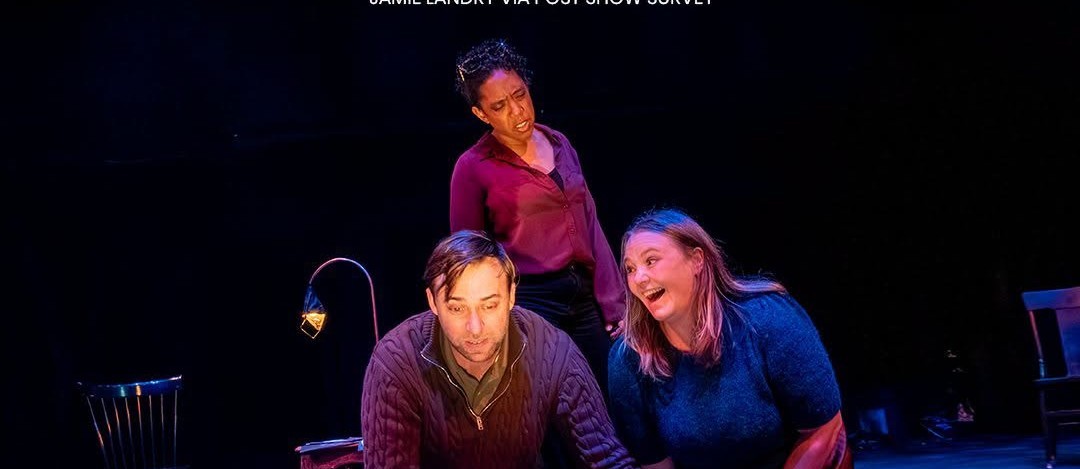
Katrin Whitehead’s scenic design appropriately evokes the title of the play as the Scotiabank Studio Theatre is transformed into the bottom of some kind of body of water, complete with various pieces of debris such as bags, discarded photo albums, scraps of paper, and ultimately even bodies, complete with a charming lamp dead centre to suggest an anglerfish. The lighting design by Jess Lewis works in tandem with the motif of watery depth, using highly focused beams where only wisps of light penetrate the suggested deep darkness.
Jackson Fairfax-Perry’s sound design is an ethereal, haunting score that is wonderfully subtle, including key sound effects, especially the baby cries that connect us to the missing child. Mackenzie Cornfield’s video projections of texts and shadows were ephemeral as waves and provided a shimmering, minimalist complement.
Noella Murphy’s costumes appeared, on the one hand, relatively rudimentary for the contemporary time period, yet raised questions: was Questa’s attire too informal, or was it foreshadowing her own quest? Was May’s outfit a symbolic expression of earth and water or the most practical and comfortable option for a birthing sequence choreographed to a cephalopod monologue? Perhaps a little of both.
Like the costumes, the performances move from functional to challenging our expectations. Qaurmyne as the probing investigator is supportive and also no-nonsense. We definitely root for her to solve the riddle. George’s portrayal of the love interest is endearing in the courting scene, then frustrating in his absent, backseat-parenting critiques.
It’s uncomfortable to watch Reitsma’s May as the obsessed deepwater scientist who seems to lack mothering instincts. It’s a bold move for Bray to write such a female character, and for director Burgandy Code to make us reckon with it in often stark ways. Every instinct wants us to feel sympathy for this mother who has lost her child, but we are not given this easy release. Code balances the stage work from the circular, main playing space to the hidden-behind-scrim, rectangular lab with deft elegance.
Bray’s script tries to balance and complement didactic monologues on marine biology with the joy and pain of human relationships, especially mothers and daughters, and how all relationships have their light and dark sides.
However, for a story that centres on the missing Lucy, other than as a baby, her presence is noticeably lacking in the first half of the play in a way that isn’t for the other necessary offstage character, May’s mother Christine. Lucy ends up being more like one of the many projected shadows of children on the backdrop. Unfortunately, in a post-Simpsons culture, the other child Questa doesn’t evoke the necessary pathos because his name is shared with that famous yellow family’s son.
But for Haligonians who boast one of the largest and deepest ice-free harbours in the world, Deepwater definitely resonates. Bray does succeed in giving us biological exposition while waxing philosophically and thematically about sources of life, light and dark, and even life in death. He reminds us that as humans we desperately want to solve every riddle, but like the depths, there are mysteries about us that can’t be answered.
The Villains Theatre’s Production of Dan Bray’s Deepwater
Running until November 1st at Neptune’s ScotiaBank Studio Theatre
Directed by Burgandy Code
Assistant Direction & Production Management by Colleen Arcturus MacIsaac
Costume Design by Noella Murphy
Scenic Design by Katrin Whitehead
Assistant Scenic Design by Eden Reshef
Lighting Design by Jess Lewis
Sound Design by Jackson Fairfax-Perry
Video/Projection Design by MacKenzie Cornfield
Production Assistance by Laura Spencer
Stage Managed by Virginia Iredale
Technical Direction by Evan Brown
Performers: Amy Reitsma as May; Liliona Quarmyne as Questa; Chris George as Casper