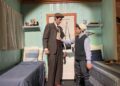



A recent Zoom call with Outside the March’s Artistic Director, Mitchell Cushman, who is directing the Canadian premiere of Eureka Day (now on stage at Toronto’s Coal Mine Theatre), made me appreciate even more playwright Jonathan Spector’s social and satirical jab at how we navigate the breakdown of trust in medical professionals and in the very notion of truth, which is unknowable.
Sounds familiar, doesn’t it, from six years ago and how Canadians dealt with COVID-19.
What’s also alarming is the recent measles outbreak in several Toronto schools and the parental response to whether to have their children vaccinated.
The gloves came off during COVID-19 regarding vaccines, as I’m sure we all remember. I’m sure they’ve come off at various school board meetings across Toronto.
The gloves come off in Eureka Day.
Calling the play a special one for him, Cushman calls it a timely show. While it’s an American play being performed in a Canadian context, the fear is that it will be received as “Oh, those silly Americans,” rather than as an invitation to look more deeply within ourselves. Canadians are not free from the polarizing forces that are at work down south.
The vaccination element becomes a metaphor and a stand-in for a whole host of issues. It’s miraculous that it was written in 2017 because:
“[It] is so prophetic in what we all experienced during the pandemic, especially the schisms. Beyond that, when we think of our present moment, the characters advocating for faith in vaccines and faith in the system are presented as quite a reasonable position.”
A big part of the characters’ argument is that we need to have faith and trust in scientific and government systems like the CDC (Atlanta’s Centre for Disease Control). That is now in the hands and belief system of someone like a person in the play who doesn’t trust vaccines. (Cushman makes an indirect reference to Robert F. Kennedy Jr. here).
Cushman feels playwright Spector accurately predicted a great deal in Eureka Day.
“The play takes anxieties we all have,” says Cushman, “and weaves them into wondrous comedy, and not comedy at the expense of any of these positions [listed above]. It does a great job of not necessarily siding with any of the characters but really fulsomely showing how each character arrived at the position that they do.”
Cushman says none of the characters are sent up or judged. The decision was made not to use American accents; instead, the actors used their own voices. The characters are all people we can interact with in any context.
He says humour is the only tool we have to deal with the absurd. Mitchell hopes audiences will laugh all the way through the play and leave with a lot to think about.
No argument from me there. There was so much laughter on the night I saw the show, and yes, I’m still considering the play’s influence nearly a week and a half later.
As a 33-year retired Catholic school teacher, I kept smiling while remembering the correct edubabble buzzwords the characters use in the first scene of the play. Cushman shared that many of the buzzwords in the script (Holding Space and Being Heard are just two) are capitalized. Mitchell also shared that his brother is a Grade One/Two teacher and that the students we hear at the top of the show are from his brother’s class.
When the children’s voice recordings were brought into the rehearsal room, it helped all the actors and Mitchell understand the play more deeply. Children are absent from the play, even though they are what is at stake. The cast and crew wanted to dedicate really successful teamwork at a young age before all those barriers that divide us start emerging.
While audiences might not be aware of what was being done, the creative team named the voices of the two children in the announcements after the kids of the two chief antagonists of the play, who are at loggerheads over the subject. For Cushman, that felt apropos.
The rehearsal process was fast and furious. What’s fortunate about working at Coal Mine? The actors rehearse on the set right on the stage, which was constructed a week before they came to work. That’s a big difference and a plus for any actor working at Coal Mine.
There was only a two-week rehearsal plus tech. Spector’s text is written in such a way that the creative team has to know it inside out in order to take it at the pace it requires, according to Mitchell. For him:
“It’s very musically scored in the script. The one Skype scene where the characters hold the Town Hall meeting with the other parents, and the comments are also written in the script. The timing is really specific, and there are quite a few notes to ensure the comedy comes off.”
Which it does.
It has been a long time since I’ve heard an audience laugh raucously loud and long. The actors came prepared and ready to work, and everyone was on their A game. It was all about the work, and that makes Cushman very happy.
Mitchell was headed away on holiday the next day after our Zoom call.
What’s next for him when he returns?
He goes to Mexico for a week. He’s then off to the United Kingdom for three weeks, directing playwright and performer Haley McGee’s Age Is A Feeling once again at Soho Theatre in Walthamstow.
To purchase tickets for Eureka Day: https://tickets.coalminetheatre.com/event/330:20/
To read my review: www.ourtheatrevoice.com and click the link for the production.