


Love, legacy and creation collide in this fine production dissecting relationships and connection, Black feminist thought, queer love, and the weight of artistic legacy.
I’ll admit, I’ve never reviewed a play rooted in the underheard voice of queer Black feminism. I’m happy to report that How to Catch Creation is a clever and resonant commentary on the universal need to create, suggesting that we are all part of a larger, ongoing act of creation.
Set in California, the play moves concurrently between 2014 and the 1960s, weaving together the lives of two couples across generations. In the present, Griffin (Daren H. Herbert) is rebuilding his life after being wrongfully imprisoned for 25 years. Determined to move forward, he longs to become a father—but his past makes him an “undesirable” candidate in the eyes of adoption and surrogacy agencies.
His friend Tami (Amanda Cordner), a professor and visual artist, is grappling with her own creative paralysis, rooted in a painful past relationship that continues to block both her artistic voice and her ability to connect.
Meanwhile, Stokes (Danté Prince), a young visual artist, reels from yet another rejection—his 13th—from art school programs. Consumed by self-doubt, he struggles to find direction, both creatively and personally. He lives with his girlfriend Riley (Germaine Konji), who works in tech repair and is equally uncertain about her own identity and future.
The lives of these two couples begin to intertwine, sparked by Riley’s selfless act to support Stokes. As their relationships deepen, the play reveals that not everything—or everyone—is as it first appears.
Interwoven with their story is a third couple from the 1960s: G.K. Marche (Khadijah Roberts-Abdullah), a queer Black feminist writer, and her partner Natalie (Shakura Dickson), a seamstress. Their voices from the past echo powerfully into the present, illustrating how art and literature transcend time—and how marginalized voices, even when overlooked, can shape the future.
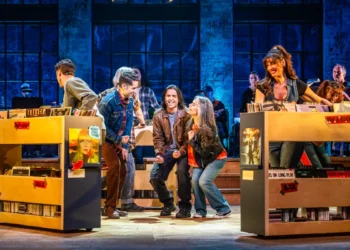
Director Mumbi Tindyebwa Otu handles this layered narrative with care and creativity. The staging is minimal: modular cubes serve as furniture, while a simple table anchors the space. Through precise choreography, the cast moves a few simple props to transform the stage into multiple locations—a modern apartment, a 1960s flat, a university office, a tech repair depot, even a restaurant. Effective visual conventions are at play.
Much of the present-day action unfolds stage right, while G.K.’s 1960s writing desk sits stage left. However, this spatial logic isn’t always maintained. Moments like contemporary Griffin placing a drink on 60’s era G.K.’s desk, or Natalie crossing through the modern set to access her 60s scene, disrupt the carefully established visual language. A further note that I’ve never been a fan of actors miming driving with a detached steering wheel. The car scenes challenge our suspension of disbelief.
Act one had wonderful pacing, but things slowed down considerably in act two. A quicker resolution to things would significantly reduce the almost two-and-a-half-hour runtime. But that could be seen as a transgression of the playwright.
Teresa Przybylski’s set design is conceptually smart but inconsistent in execution. While the reuse of Ikea-looking soft blocks as chairs and sofas is inventive, I was puzzled at the tall, multicoloured geodesic structures that linger in the background. Occasionally, they suggest rooms or environments; they mostly stand as ambiguous visual elements that draw attention without a clear purpose. They feel symbolic, but their meaning remains frustratingly elusive.
In contrast, Andre du Toit’s lighting design provides much-needed clarity. With crisp edges and a consistent colour palette—cool tones for the present, warm ambers for the 1960s—the lighting cleanly delineates time and place, guiding the audience’s focus with precision.
Ming Wong’s costumes strike a nice balance between contemporary and period detail, with subtle retro touches—particularly in G.K.’s flower-powered aesthetic—adding texture without overwhelming the production.
Performances across the board are strong. Amanda Cordner commands the stage as Tami, balancing playfulness with emotional depth as she navigates unresolved trauma and new possibilities. Her vocal clarity is especially notable in the intimate space.
Daren H. Herbert brings sincerity and quiet strength to Griffin, portraying a man seeking redemption and purpose through Black feminist literature. His journey is both moving and bittersweet, making it easy to root for his happiness, even if some lines are lost when he turns upstage.
Danté Prince delivers a nuanced performance as Stokes, capturing the vulnerability of an artist in crisis. His gradual shift from visual artist to writer feels organic, particularly as he becomes drawn to G.K.’s work. Germaine Konji brings charm to Riley, effectively conveying her internal conflict, though her tendency to drop her voice at times makes some lines hard to catch. Together, their chemistry feels authentic, grounded in the tension between their personal growth and shared connection.
Khadijah Roberts-Abdullah is a standout as G.K. Marche, serving as both a narrative anchor and thematic catalyst. Her presence is commanding, her stillness powerful. She embodies a woman committed to preserving marginalized voices. Shakura Dickson complements her beautifully as Natalie, capturing both intimacy and the social pressures of the 1960s with emotional weight.
How to Catch Creation is rich with thought-provoking ideas. It positions creation as an act of resistance, memory, and connection, while demonstrating how art can ripple across generations. Despite some uneven design choices, the strength of its performances and the depth of its themes make it a compelling and worthwhile production that sticks with you well after you leave the theatre.
Running time: approx. two hours and twenty minutes with one intermission.
The production runs until May 17 at Soulpepper Theatre, 50 Tank House Lane, Toronto.
For tickets, call the Box Office at 416-866-8666 or email: boxoffice@soulpepper.ca
Soulpepper, Nightwood Theatre and Obsidian Theatre present
How to Catch Creation by Christina Anderson
Directed by Mumbi Tindyebwa Out
Set design by Teresa Przybylski
Costumes by Ming Wong
Lighting designed by Andre du Toit
With: Amanda Gardner, Shakura Dickson, Daren A. Herbert, Germaine Konji, Danté Prince, Khadijah Roberts-Abdullah