

There is a strong sense of both theatrical and educational fulfillment in seeing Goblin:Macbeth once again. Clever, inventive, and consistently surprising, the production proves well worth another trip to Montreal.
All three productions have featured the lovable, mischievous, pointy-eared trio—Wug, Kragva, and Moog. One of the joys of the experience is that it becomes easy to forget about who may be behind the masks. Instead, attention shifts to Shakespeare’s language and to the inventive visual and auditory details that make the production so engaging. Revealing too many of those details would spoil the surprises that await future audiences.
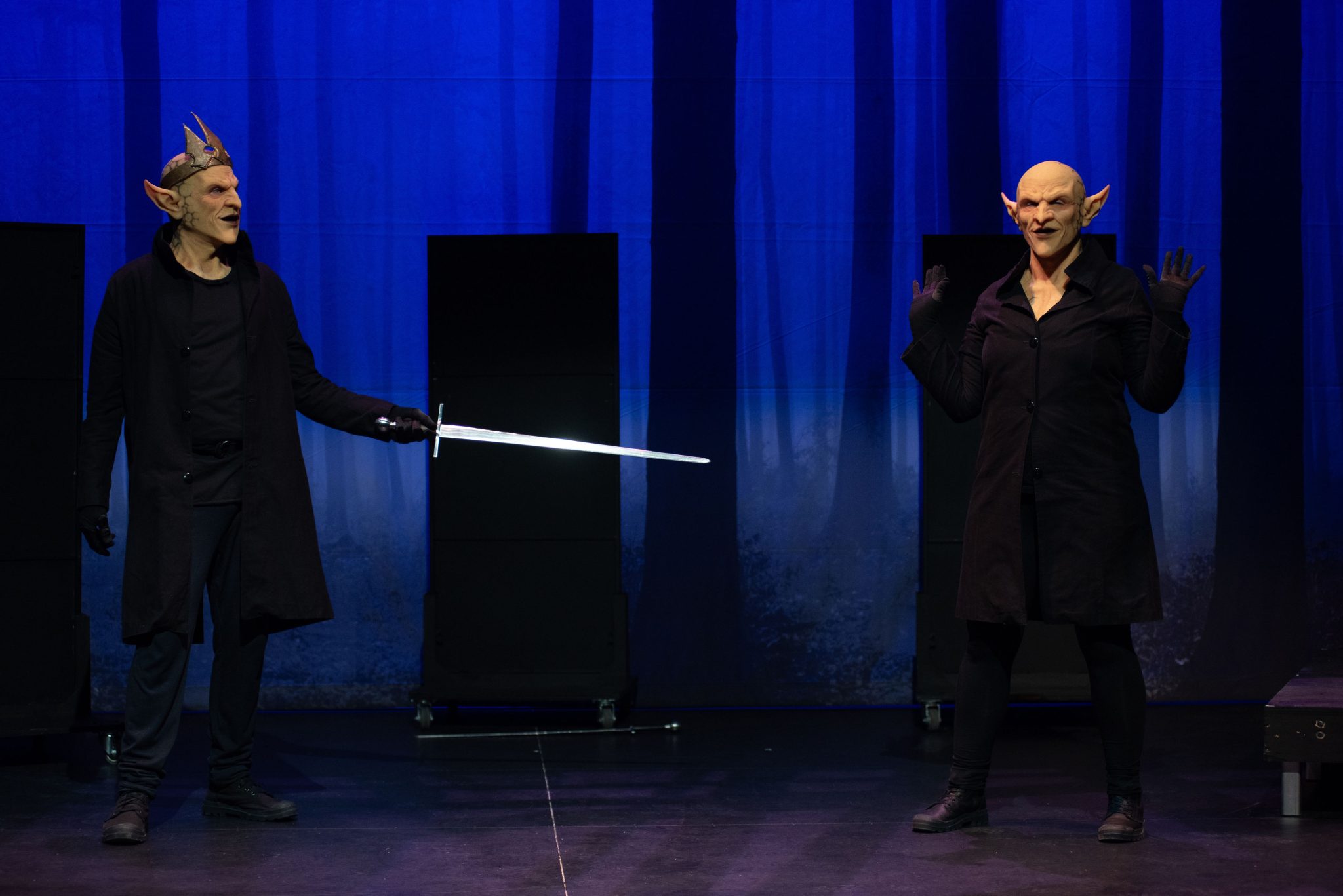
Wearing impressive masks by Composite Effects and sleek black costumes and trench coats designed by Philip Edwards, the Goblins’ playful, sometimes bawdy improvisation—both before and during the performance—provokes uproarious laughter. At the same time, the trio demonstrates a genuine understanding of Shakespeare’s language. Their delivery of key soliloquies and dramatic moments deepens appreciation of the text rather than parodying it.
The three Goblins have discovered a copy of The Complete Works of William Shakespeare and inform the audience that they have read it from cover to cover. Curious about a human who appears to know so much about witches, fairies, and other non-human creatures like themselves, they decide to stage Macbeth, one of his shortest tragedies. With some coaxing from the audience—and the reluctant tolerance of stage manager Craig Francis and his team—Wug, Kragva, and Moog take over the theatre to present the play. It is a bloody tale, though perhaps not quite as gruesome as Titus Andronicus.
The stage remains divided into three distinct areas that contain boxes and assorted props, all within easy reach for the goblins to use at a moment’s notice.
Even the pre-show adds to the fun. A playlist of 1970s music, including the Stampeders’ Canadian classic “Sweet City Woman,” sets a playful tone. The goblins’ kibitzing with audience members is instantly disarming. One memorable moment came when a front-row patron was declared a witch—in the most celebratory fashion possible.
The pacing remains brisk and efficient. Much as Shakespeare himself used humour to heighten dramatic tension, the Goblins move seamlessly from comic improvisation to darker moments of psychological intensity. Anton DeGroot’s evocative, shadow-laden lighting design proves especially effective in establishing the play’s ominous atmosphere.
Each Goblin also voices multiple supporting roles. Wug takes on the title role with surprising dramatic flair. His encounter with the floating dagger and his chilling delivery of the famous “Tomorrow, and tomorrow, and tomorrow” soliloquy are particularly memorable. Kragva’s Lady Macbeth is sharp, forceful, and piercing—especially when she undermines her husband’s sense of masculinity with cutting words. Meanwhile, Moog provides most of the production’s sound effects and musical accompaniment, including one subtle vocal moment that eerily underscores the play’s rising tension.
After seeing the production three times, do I want to know who is actually beneath the masks?
Perhaps not.
While I may have a suspicion about who is playing Kragva, the mystery is part of the fun. The programme contains the answers if one truly needs to know. To preserve the illusion seems far more satisfying.
Leaving the theatre after this third viewing—my first at Stratford, the second at Toronto’s Tarragon Theatre, and now the third at Montreal’s Centaur Theatre—I felt that same sense of theatrical delight. In a way, the journey has formed its own narrative: a beginning, a middle, and now an end.
Or perhaps not quite an end.
I would happily see these Goblins tackle other works together. I have already seen their Oedipus in Stratford and hope there are more classic productions to come.
In a recent interview with Rebecca Northan, artistic producer of Spontaneous Theatre and Macbeth, she was reluctant to reveal what the Goblins might do next. The only hint she offered was that they would soon enjoy a winter holiday.
Hmm.
In the meantime, audiences should make every effort to see Goblin:Macbeth before it closes at the Centaur Theatre.
Running time: approximately one hour and 50 minutes with no intermission (timing may vary due to improvisation).
Location: Centaur Theatre, 453 St-François-Xavier, Montreal
Runs until: March 22
Tickets: centaurtheatre.com or (514) 288-3161
Centaur Theatre presents
Goblin:Macbeth
A Spontaneous Theatre Creation
Featuring: Wug and Kragva
With music provided by Moog
Costume Designer: Philip Edwards
Lighting Designer: Anton DeGroot
Lighting Interpretation and Adaptation: Michael Tonus
Masks: Composite Effects
Stage Manager: Craig Francis