

Alastair Newton presents a visually striking stage design in this opulent theatrical production of Oscar Wilde’s The Importance of Being Earnest, now playing at London’s Grand Theatre. Still a witty and sharp satire of social manners, this Earnest continues to critique superficial Victorian social values and class distinctions; however, Newton expands on his directorial vision. It gets me thinking, and I’m still doing just that.
In a recent CBC interview, Newton states he transforms the play’s subtext into text. He reveals the play’s true message through subtle doublespeak and queer coding in language and situations. How does Newton make the subtext become text? He adds the character Lady Stella Clinton, played by Billy Lake. Some music and dancing also help.
It’s 1895. The story revolves around two upper-class rakes. Algernon Moncrieff (James Daly) waits for his friend John Worthing (Julien Galipeau). The latter is smitten with Algernon’s cousin, Gwendolen Fairfax (Kaylee Harwood), and plans to propose marriage to her.
These rakes partake in silly games to pass the time. Algernon plays a deceptive game called Bunburying, where he claims he’s going to visit a fictional, sickly friend named Bunbury when he wants to avoid social obligations.
In the countryside, Worthing goes by the name of John or Jack to serve as a role model for his ward and heiress, Cecily Cardew (Mirabella Sundar Singh). When in town, he uses the name Ernest, a fictional brother from the wrong side of the tracks. Algernon also becomes smitten with Cecily and joins in the game of pretending he’s also Ernest. There’s also an attraction between Cecily and Algernon.
The hilarious deception soon backfires. John and Algernon find themselves in awkward, silly social situations involving other eccentric characters, such as Gwendolen’s mother and Algernon’s aunt, Lady Bracknell (Claire Jullien), Cecily’s prissy governess Miss Prism (Deena Aziz), and the straight-laced Rev. Canon Chasuble (Ben Sanders), who (spoiler alert) has eyes for Miss Prism.
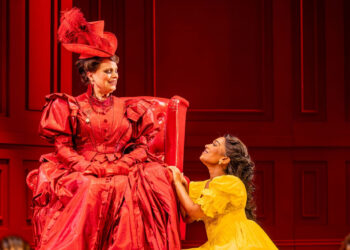
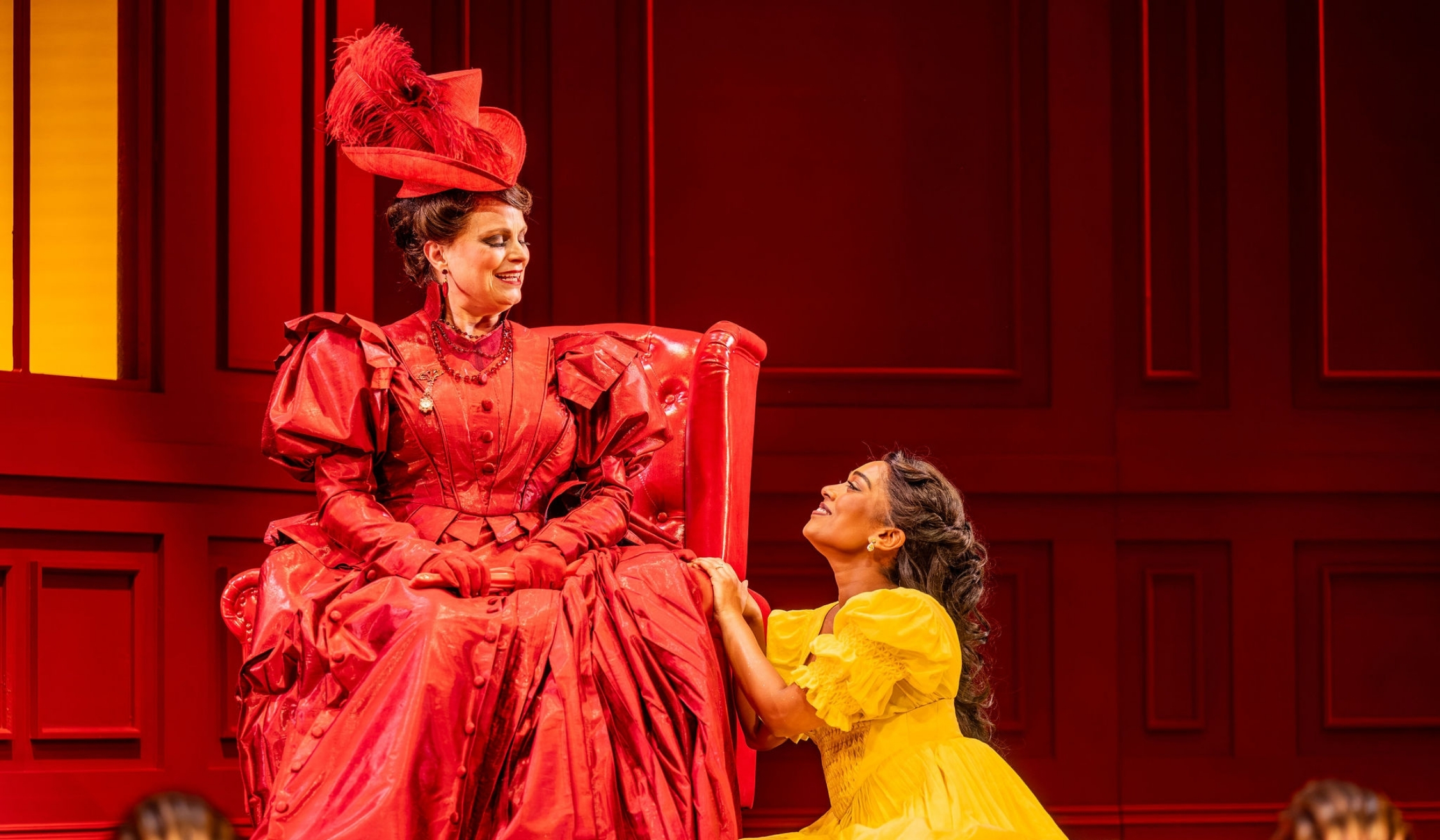
The lavish visual look remains stunning thanks to Judith Bowden’s gorgeous, colourful costumes, highlighted by Siobhán Sleath’s strikingly rich lighting designs against the fashion couture. Michelle Tracey’s set design also effectively conveys the grandeur and opulence of the city and the countryside. A nod of appreciation to Sound Designer Olivia Wheeler for the sound balance, which is well mixed and timed between the music and the performers.
Performances skillfully capture the characters’ diverse quirks with the elegance of Victorian style. Deena Aziz’s Miss Prism is a prim and proper governess to Cecily, insisting her pupil concentrate on her studies. Ben Sanders portrays Rev. Canon Chasuble with a similar upright, ramrod posture as Miss Prism. Claire Jullien is sharp as the meticulous and often pointed Lady Bracknell. Kaylee Harwood and Mirabella Sundar Singh charm as damsels fluctuating melodramatically between love and anger towards their respective suitors. At one point, in a delightful figurative catfight of wordplay and innuendo between the two ladies, Harwood and Sundar Singh engage in witty banter with flawless feminine wiles—fans snap and click to show their emotional states.
James Daly and Julien Galipeau shine as the charming rogues Algernon and John. Like Harwood and Sundar Singh, these gentlemen also clash through lively wordplay and occasionally petulant childish behaviour. The scene where they are having tea and muffins is perfectly timed and provides much amusement and laughter.
But there’s more to consider in this “Grand’ production. That’s what theatre is meant to do: make audiences think, challenge them, and encourage them to realize they shouldn’t be complacent about assuming things must be a certain way.
Newton even recognizes the importance of challenge in his Director’s Note: “Wilde’s plays have the potential to illuminate the 19th century in ways that challenge many…preconceptions, full as they are of secret codes, hidden symbols, and double entendres.”
I definitely found my preconceptions challenged. The Grand’s production doesn’t start with Algernon and John. Instead, it begins like a Victorian music hall performance, making it clear that we are seeing characters coming to life on stage rather than jumping straight into the play. The fourth wall is broken right at the top when Deena Aziz’s Miss Prism explains to the audience why fans were important during this time. While men might have used fans practically, women communicated with a specific language involving fans. At one point, a male character uses a fan to send a message— is this doublespeak? Is Wilde trying to hint at something about the male character’s personal life and choices?
The character Lady Stella Clinton, played by Billy Lake, serves as another reminder that the play is a music hall performance. Lake’s got the pipes to handle the vocal numbers with aplomb and walks with female assuredness, especially since bustles were common at the time.
I don’t want to spoil the fun of the triumvirate creative team of Newton, Music Director Stephen Ingram, and Choreographer George Absi. They also play with audience preconceptions in music and dance, inviting us to think further about other ‘what if’ scenarios.
Alastair Newton’s direction is meticulous, daring, and bold, and it pays off. His attention to detail in his vision for the story surely captivates the eyes and, interestingly enough, also the ears. He has made smart choices.
This classic theatrical chestnut still resonates with a twenty-first-century audience for the very reason it pushes boundaries in showing the play’s truest intent that might make some viewers uneasy.
And that’s why you should see it.
Running time: approximately two hours and 35 minutes with one intermission.
The production runs to April 12 on the Spriet Stage at London, Ontario’s Grand Theatre, 471 Richmond Street. For tickets: (519) 672-8800 or grandtheatre.com
THE GRAND THEATRE presents
The Importance of Being Earnest by Oscar Wilde
Additional Text, ‘On the Language of Fans’ by Alastair Newton
Directed by Alastair Newton
Music Director: Stephen Ingram
Choreographer: George Absi
Set Designer: Michelle Tracey
Costume Designer: Judith Bowden
Lighting Designer: Siobhán Sleath
Sound Designer: Olivia Wheeler
Stage Manager: Michael Hart
Performers: Deena Aziz, James Daly, Julien Galipeau, Kaylee Harwood, Claire Jullien, Billy Lake, Ben Sanders, Mirabella Sundar Singh