


New perspectives can bring renewed clarity to plays that already resonated strongly the first time around.
That is certainly the case with Judith Thompson’s Queen Maeve, which I first encountered during its world premiere at Stratford’s Here For Now Theatre in the summer of 2023. For the Toronto premiere at Tarragon Theatre, director Mike Payette carefully balances the humour and musicality of Thompson’s words with meticulous attention to character and emotional truth. He ensures the story’s themes of regret, love and letting go remain powerfully felt.
The play unfolds in the bedroom of Mrs. Nurmi (Clare Coulter), an elderly resident of a nursing home in Cornwall, Ontario. As she faces the end of her life, Mrs. Nurmi grapples with memories of the past while interacting with her daughter, Georgia (Sarah Orenstein), whose own struggles with mental health make their relationship fraught and complicated.
Orenstein delivers a credible, sensitive performance as a daughter doing her best to cope with circumstances that feel overwhelming. Georgia’s daily challenges are compounded by lingering family tensions and the difficulties she faces in raising her son, Jake (Ryan Bommarito). Her strained relationship with her mother only deepens that emotional burden.
Jake’s visit to the nursing home initially brings a brief moment of warmth, and Bommartio captures it with tenderness. When he affectionately calls his grandmother “Gan,” Coulter’s face lights up, matched by Bommarito’s genuine affection. For a moment, the audience sees the strong familial bond that once existed. I, for one, bought it completely.
Yet that bond quickly shifts. Jake arrives with an agenda, seeking something from his grandmother that she cannot — and will not — give. Bommarito plays the role with an effective mix of charm and calculation. His Jake is both disarming and quietly manipulative. This is probably not the first time he has approached his grandmother this way. That harsh reality carries a poignant sadness.
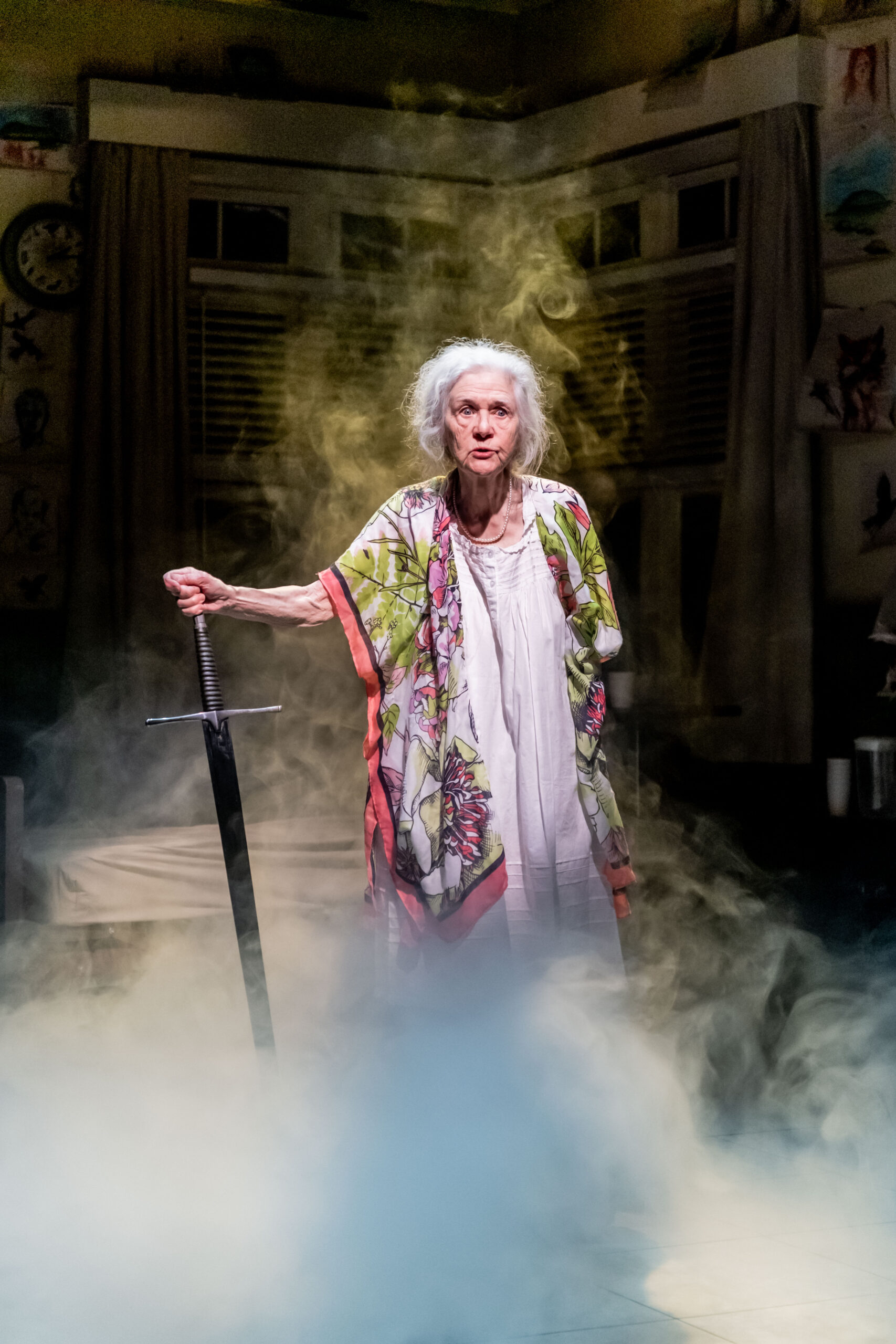
As Mrs. Nurmi reflects on the regrets and losses of her life, Thompson introduces an imaginative theatrical device. In moments when memory and emotion overwhelm her, Mrs. Nurmi’s mind transforms reality. She becomes the legendary Irish warrior Queen Maeve, summoning a strength she believes she lacks in her own life.
These moments blur the boundaries between reality and imagination, and visually, they look and sound terrific on the Mainstage. These moments also deepen Mrs. Nurmi’s relationship with Siobhan (Caroline Gillis), a compassionate personal support worker who provides both practical care and emotional reassurance as Mrs. Nurmi prepares for the final transition of life.
There are two tender moments near the end of the play to justify this, and they’re quite moving. One occurs as Gillis washes Coulter’s hair. The other is in the final moment of the play. I don’t want to spoil it here. There’s a hushed, respectful and heartfelt silence that hits right in the heart. During both periods, Gillis is present. It makes complete sense that she begins and concludes the play. She brings a quiet empathy in her performance, grounding the play’s blurring of reality and imagination with genuine humanity.
Remarkably, the entire story unfolds within a single day — a detail I did not fully connect with when I first saw the production in Stratford. Yet even without that realization at the time, Queen Maeve continues to resonate deeply.
The physical production also contributes significantly to the storytelling. At Here For Now, the simplicity of the tented performance space enhanced Coulter’s meditative transformation into the warrior queen. At Tarragon, designer Ken MacDonald presents a spacious nursing-home bedroom that fills the Mainstage. Lit by Jason Hand’s stark institutional lighting, the room feels both functional and slightly worn, suggesting a senior citizens’ home that could use updating. Drawings Mrs. Nurmi has completed during nursing-home art classes decorate the walls, quietly hinting at the life she continues to live within its confines.
MacDonald’s costume choices effectively define each character’s personality and social reality. One of Coulter’s dressing gowns even carries a faintly regal quality — an understated visual echo of the warrior queen who emerges from Mrs. Nurmi’s imagination.
Lighting by Jason Hand and sound design by John Gzowski help transport the audience into Mrs. Nurmi’s shifting perceptions. In moments when Queen Maeve emerges, bright lights and supernatural sounds surround the stage, creating the sense that the audience is entering another realm alongside the protagonist. Dean Farrell’s Gaelic coaching for Coulter adds further texture to the character’s otherworldly transformation.
At the centre of it all is Clare Coulter, delivering a tour-de-force and masterclass performance. As the frail Mrs. Nurmi, she moves slowly and cautiously, as though each step requires effort. But when the warrior queen takes hold, Coulter’s physicality changes completely. She stands taller, moves with certainty and purpose, and commands the stage with authority and grace.
Watch how she handles the sword she retrieves from its hiding place. In those moments, Coulter becomes undeniably regal — majestic even — embodying the strength Mrs. Nurmi believes she never possessed.
The performance remains engrossing from start to finish, and this Toronto premiere confirms once again the emotional power of Thompson’s play.
Running time: Approximately 90 minutes with no interval/intermission.
Queen Maeve runs until April 5 on the Mainstage at Tarragon Theatre, 30 Bridgman Avenue, Toronto. For tickets, visit tarragontheatre.com or call 416-531-1827.
TARRAGON THEATRE presents
Queen Maeve by Judith Thompson — Toronto Premiere
Directed by Mike Payette
Set and Costumes: Ken MacDonald
Lighting Design: Jason Hand
Sound Design: John Gzowski
Gaelic Coach: Dean Farrell
Stage Manager: Em Aubin
Performers: Clare Coulter, Caroline Gillis, Ryan Bommarito, Sarah Orenstein