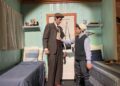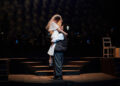


Set just before the outbreak of World War I in Glorious Hill, Mississippi, Tennessee Williams’ Summer and Smoke (1948) follows the story of Alma Winemiller (bahia watson), the sensitively repressed young daughter of the local minister (Beau Dixon). To help her father, Alma teaches singing and assists with church duties. Her mother (Amy Rutherford) cannot, as she is afflicted with a mental illness—she craves ice cream and has unwarranted outbursts.
Alma has been in love with John Buchanan Jr. (Dan Mousseau), a handsome, sometimes foolhardy son of the local doctor, John Buchanan (Stuart Hughes), since she was a young girl. Young John has returned to town after studying at Johns Hopkins. Although he’s not keen on it, the young man now practices medicine just like his father.
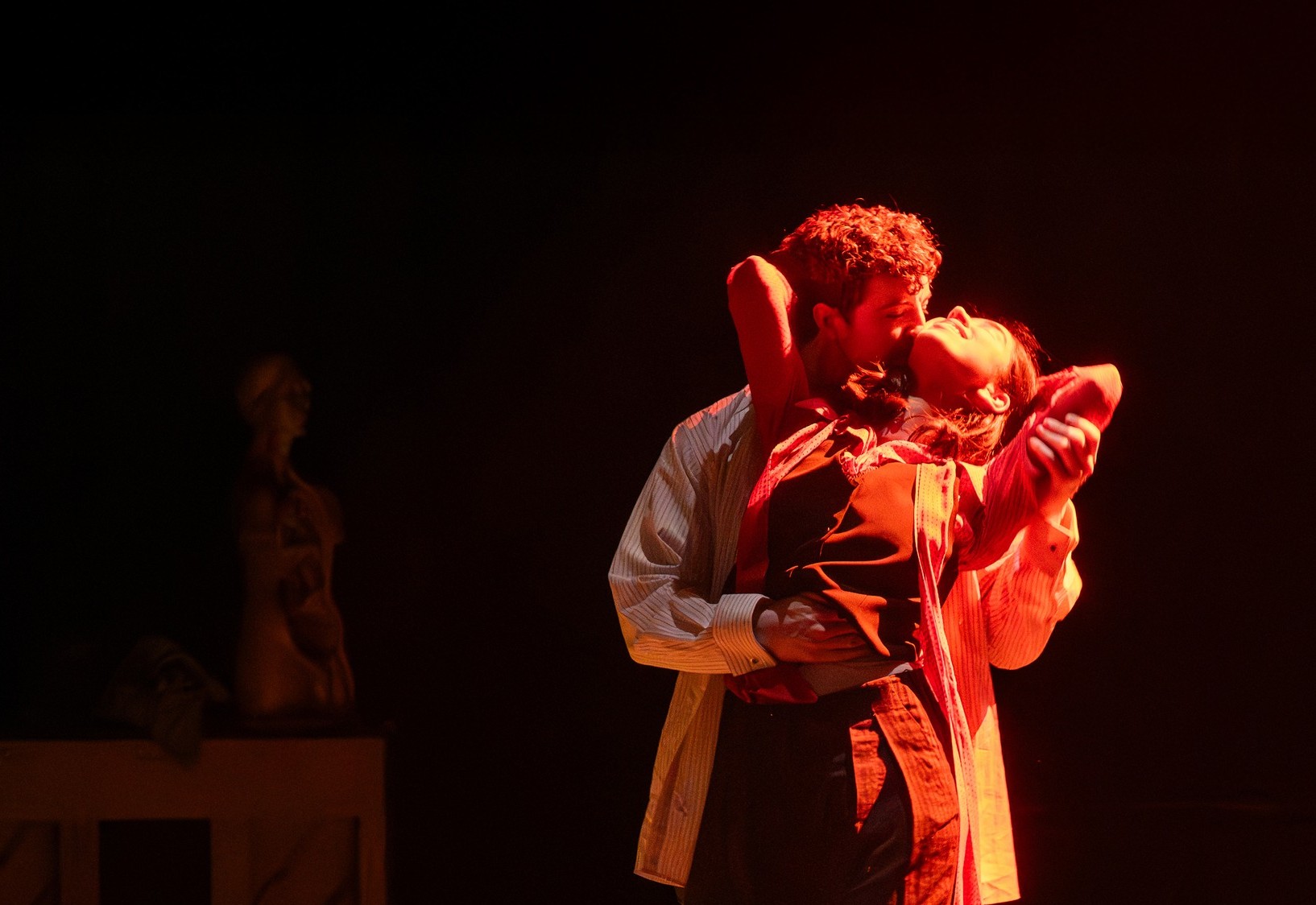
What follows is a sensual push-and-pull attraction between Alma and John, sometimes rooted in both the physical and the spiritual. Alma wants a spiritual relationship, while John is fixated on the physical. Since Alma rebuffs his advances, John is interested in the local, amoral young woman, Rosa Gonzalez (Bella Reyes), for a physical connection. When John and Rosa’s engagement is announced, shocking events occur that will change the course of the young doctor’s life and Alma’s.
Summer and Smoke remains a challenging play. The text and its characters’ inherent poetic richness are lovingly captured in this smart production, under the compassionate care of Director Paolo Santalucia. Along with that richness, there’s a lingering sense of tragedy in Williams’ characters, which Santalucia adroitly captures, especially in the women who want to connect and the men who are unable to fulfil those desires.
Yet, Summer and Smoke is rarely performed, at least in my experience. Why is that?
There’s a lot in this opening night, and it’s giving me much to consider about why audiences should see the show.
Which they should, by the way.
Then it dawned on me why the play might be rarely performed.
In his program message, Director Paolo Santalucia explains that the pressing, bearing-down of time is at the centre of the play while the world keeps going. Twenty-first-century audiences are most definitely aware of this harsh fact today. The Doomsday Clock is ticking down on our world, and time is running out. In the play, Alma and John are keenly aware of the pressing nature of time and the fact that it’s ticking down. They experience missed moments, a lack of synchrony, and a gap between readiness and opportunity.
Santucia’s statement makes sense. Our twenty-first-century world seems to tell us that time is of the essence and that we should not waste it, no matter what.
Yet there’s a far more important element for me as a theatre-goer, along with the pressing nature of time, as to why the play might be rarely performed.
It’s both fearful and tragic that the characters lack an understanding of the human soul’s capacity to connect those moments of readiness and opportunity to others.
From an audience standpoint, that’s a lot to take in.
From a faith perspective, the soul is understood to be the spiritual essence of the human being that will never die when the body does. Although it’s intangible, the soul can connect with others. Early in the play, Alma tries to explain this to John in a way that makes sense to her—it’s like a Gothic cathedral reaching toward heaven. She wants him to understand this fact. The young John doesn’t see it that way. He’s more fixated on the physical medical dummy and its dissection to explain how people react, think, and feel.
Instead, a series of unfortunate events leads to Alma’s nervous collapse and John entering a relationship with the sultry Rosa, and the tides reverse, bringing about a major change. Alma begins to recognize the physical side of a relationship, while John recognizes the spiritual side.
Visually, the theatre-in-the-round Guloien setting lends itself well to John and Alma’s gap between readiness and opportunity. The suspended, headless, and feetless angel in the garden during the pre-show, as the audience enters, becomes an impactful reminder that all’s not right. Lorenzo Savoini’s shadowy lighting aptly reflects hidden, undisturbed, and unreleased passions. Thomas Ryder Payne’s pre-show sound design hauntingly conveys a stasis of musical sound, just as the characters find themselves in that stasis.
The musical interludes and the singing, softly yet effectively, heighten the dramatic intensity of time passing, with no one able to do anything about that hard reality. Kudos to Music Supervisor Beau Dixon for creating haunting work.
Performances are stellar to watch as these actors take us through the highs and lows of families and individuals at the end of their tethers.
Beau Dixon and Stuart Hughes are resolute as parental figures to their adult children, yet vulnerable when confronted with the passage of time and what is likely to happen. Hughes’ sadness at recognizing that his son is not like him is believable. While Dixon offers a protective religious influence over Alma, his growing exasperation with his wife’s deteriorating mental condition hits him hard, and the audience sees it in the way he deals with her. As Mrs. Winemiller, Amy Rutherford commands the stage when she appears in her pathetically sad condition.
Bella Reyes is sultry and sexy as the passionate Rosa and offers an effective contrast as the good girl Nellie (one of Alma’s singing students) near the end of the play. That moment between John Jr., Nellie, and Alma is heartbreaking. Kaleb Horn’s Roger Doremus (one of Alma’s suitors) and the travelling salesman in the closing moment add to the tragedy of the play.
Dan Mousseau and bahia watson are the reasons to see Summer and Smoke. Intensely passionate, the two capture the power dynamics with a life-force vitality that simmers, bubbles, and boils over, leaving emotional scars that can never be healed. watson’s singing voice becomes ethereally eerie as it echoes throughout the Guloien auditorium. While secure in his manly virility in his conversation with Alma and Rosa, Mousseau’s John is marvellous to watch in the final conversation he has with Alma, prior to Nellie entering with news to share.
Magnetic, raw and passionate performances make this Summer and Smoke memorable.
Recommended to see it.
Running time: approximately two hours and 45 minutes with one interval.
The production runs to March 8 in the Guloien Theatre at Crow’s Theatre, 345 Carlaw Avenue, Toronto. For tickets: crowstheatre.com or call the Box Office at (647) 341-7390.
CROW’S THEATRE, SOULPEPPER THEATRE AND BIRDLAND THEATRE present
Summer and Smoke by Tennessee William
Directed by Paolo Santalucia.
Set and Lighting: Lorenzo Savoini
Costume Design: Ming Wong
Music Supervisor: Beau Dixon
Sound Designer: Thomas Ryder Payne
Performers: Beau Dixon, Kaleb Horn, Stuart Hughes, Dan Mousseau, Bella Reyes, Amy Rutherford, bahia watson