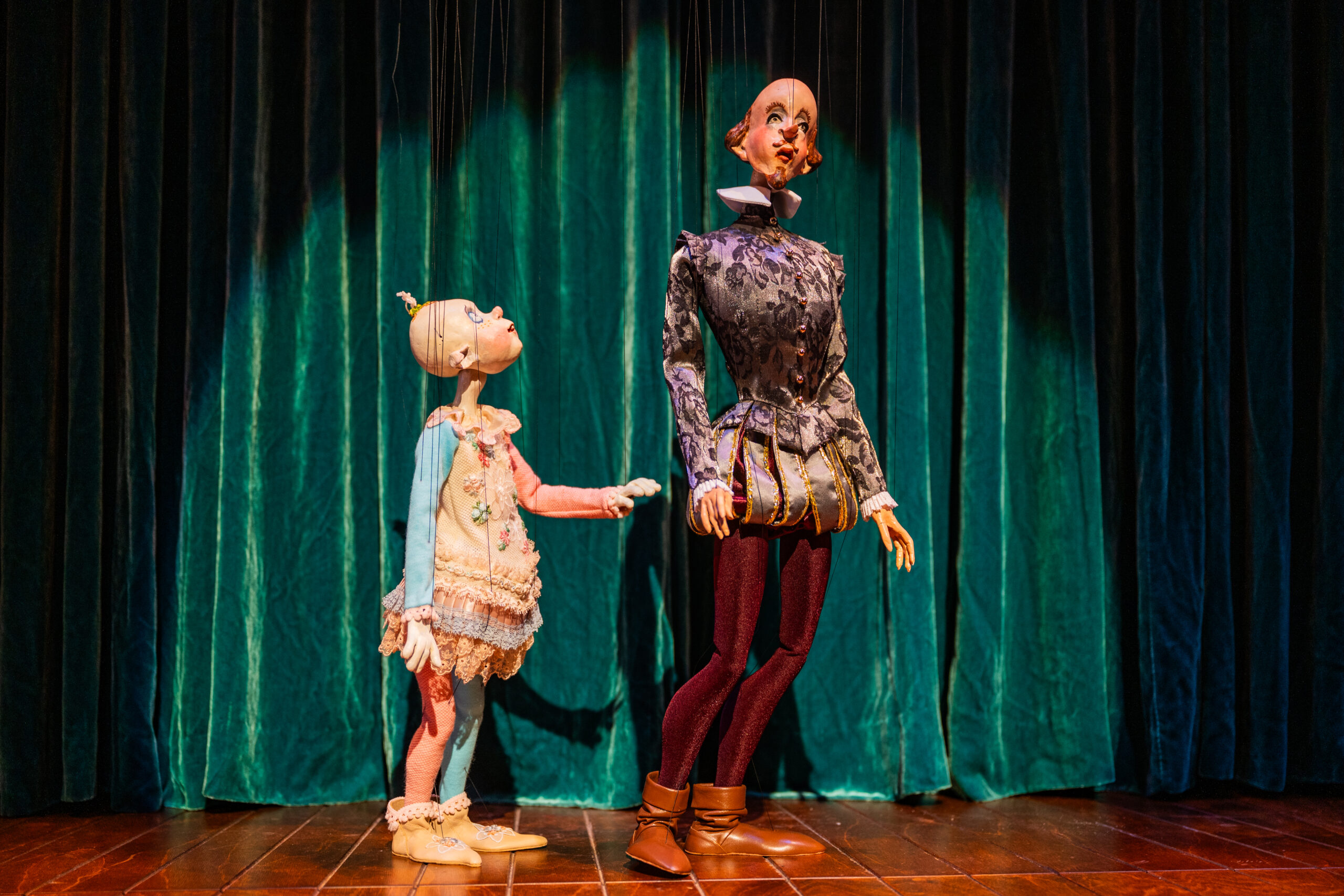



In 2023, Judith Thompson’s Queen Maeve had its world premiere at Stratford’s Here for Now Theatre. Clare Coulter delivered a riveting outdoor performance that earned a standing ovation. Absolutely incredible.
Directed by Artistic Director Mike Payette, Queen Maeve returns to Tarragon, and I, for one, am ecstatic to see the production again.
A brief plot synopsis from the theatre website. Mrs. Nurmi (Coulter) is in her twilight years and has seemingly made no impact on the world. From her bedroom, she confronts her past, the losses she’s suffered and the mistakes she’s made, all in the name of love. Mrs. Nurmi’s secret is that she is actually the great Irish Warrior, Queen Maeve, reincarnated into one of many deceptive forms.
To further whet the playgoer’s appetite, Tarragon bills the story as blurring the line between magic and reality, mirroring how memory, regret and resilience co-exist in real life. While Queen Maeve may feel mythical, it will also be human, fierce and aching, with a production that makes every act of defiance deeply resonant.
Judith and Clare conversed with me recently over a Zoom call. Our conversation about the play led me to dig deeper into understanding the text. There’s a layer underneath that I hadn’t even considered when I saw Queen Maeve in 2023
Thompson confirms that some changes have been made to the script. Time and space gave her clarity and vision, which she didn’t have immediately at Here for Now because she was so bowled over and thrilled by the production, along with: “the setting, the tent, the thunder, mosquitoes and rain…it was all so magical but hard on the actors, I’m sure.”
This time, Judith wanted the script to be in a day. She wanted the beginning to be as the end, with the relationship between the personal support worker Siobhan and Mrs. Nurmi framing the piece, remaining its centre. Thompson credits Clare once again with much of this insight.
With a smile on her face, Clare added, “It’s okay if I don’t even get it [that the play runs in a day] because the play runs beautifully whether I understand the timeline or not.”
Coulter says it’s a completely new experience revisiting the story and Mrs. Nurmi again. The environment at Tarragon, plus the new aspects of the script Judith has added, has made a complete revolution when she says, “I feel I’ve never done this before.” The thoughtful, meditative presentation of the space under the tent at Here for Now is inappropriate to the grander stage at Tarragon’s Mainspace.
What now has to happen, and according to Clare, is: “the expanding to embrace the size of the space and auditorium and the needs of that on the actors are very clear and very exciting.””
The two are both complimentary about Mike Payette’s direction. Thompson believes he has extraordinary insight into the work that aligns with her because she says with a laugh, “I can be an absolute brat if a director’s insight doesn’t.”
But Thompson says she hasn’t had to be a brat at all, and neither she nor Mike has had to put their foot down. Judith adds that Mike has a real artist’s musical and rhythmic feel for the dialogue and the technical elements of light and sound. He brings incredible insight and connection to her work, and she is really excited to see the final product.
While Clare has never worked with Payette, she does see a very strong connection to theatre in its very style. Mike is a fastidious designer in his head and mind. He brings a translation of the natural truth to the script and allows the performers to access another level through style, inviting them to imagine Judith’s work in this manner:
“ Where Judith and I have worked for decades, I’ve suddenly, for the first time, realized that she is musical. I think Mike has helped me to understand that…Once you have moved from the natural reality of the thoughts in the script and moved into this other area that I call style, the music begins to play in your head and takes you into areas you’ve never been before.”
Judith says there are two ways of looking at Mrs. Nurmi. The first: She needs to inhabit Queen Maeve to find the courage and power she has never had as a woman in this misogynist society and in her life, to face her regrets and questions about her past, which is the substance of the play.
The second – who’s to say Mrs. Nurmi isn’t Queen Maeve? She’s courageously survived many things; channelling that power is a necessity. Many people believe in God, and Jesus Christ was the son of God. Many believe in transubstantiation and a virgin birth. Why wouldn’t Mrs. Nurmi or anyone want to believe that she is actually the incarnation of Queen Maeve?
Clare believes without a doubt that this woman in a nursing home is not displaying dementia when she enters into the reality of the Irish warrior that she believes she is:
“What this is is an invitation to anybody, and Mrs.Nurmi, to believe that there is another level of reality other than the one she is given to survive here. There is another level of reality to help you overcome and survive the conditions of your human existence right now.”
At some point, when Mrs. Nurmi’s human existence becomes impossible, and she can’t go any farther, she has the advantage of being able to launch into a reality she is welcome in – the reality of the ancient Irish warrior, where she can live it out.
The problem in the play for the person experiencing this in the nursing home is that she is alone and feels alone. Mrs. Nurmi is going to die, and there is a longing to be reconnected to her family, who are no longer here and will not be here. Mrs. Nurmi has to understand that her family will not be coming back to forgive her for everything that happened and to have those moments at the end of life that resolve conflicts within the family. That is not going to happen, and Mrs. Nurmi understands that.
There’s something about the era of the Irish warrior that has left Mrs. Nurmi in a condition she has to accept. The person who will grant her forgiveness and enable her to enter the next world is her PSW, not her family. But Mrs. Nurmi does have that. She does have forgiveness, and she can go into the next world, which is the world she has always loved – the Irish warrior.
As we concluded our conversation, I asked them both how they’re feeling about the state of the Canadian theatre/ performing arts industry. While both are aware of ticket prices and that there has to be a commercially driven profit element, there’s more.
Judith acknowledges how difficult it is for young people to break into the industry. She acknowledges there’s a lot of great talent out there, but says sometimes it’s luck. She tells her students that, for the most part, we have the best English-speaking theatre in the world. While there are exceptions compared with London and New York, the Canadian and Toronto industries are supported by a real diversity of voices (Kanika Ambrose, whom Judith calls magnificent) and casting styles that are welcomed and embraced, which is very exciting.
Clare was candid in her response. She says she knows nothing about the theatre at this point. In Montreal, where she has done some plays, there seems to be a shift toward another type of theatrical presentation that does not favour the kind of work she does. Clare hasn’t done much theatre in Montreal or Toronto, saying: “It’s been twenty-five years since I’ve been at Tarragon Space (1997).”
Coulter has been exploring the possibilities of film, which she was always afraid of and dismissive of, but she is now involved in films in which we are a colonized people. Actors who would like to work in film are considered second-rate unless they go to California and become American citizens. Yet Canadian actors seem to accept they will do small background work for the American films being made up here. Even the Canadian films being made here must always have American names in order to get the investment and American distribution which is owned wholly in Canada by the Americans.
Her next statement makes me think further:
“What the technology of the camera offers the actor and audience is something I always longed for in theatre, but which was inappropriate for theatre. I understand that now. I wanted a very, very quiet, meditative, thoughtful presentation for the stage. Theatre is about style.”
Performance dates for Queen Maeve are March 3 – March 29 on the Mainstage at Tarragon Theatre, 30 Bridgman Avenue.
Visit www.tarragontheatre.com for further information.
To get tickets for Queen Maeve, visit: https://purchase.tarragontheatre.com/EventAvailability?EventId=2002&ref=bookNow&scroll=timeAndDates