

With confidence in co-direction by the playwright Yolanda Bonnell and Carmen Alvis, White Girls in Moccasins frequently resonates with humour, touches on dramatic moments, and radiates humane gentleness. Most importantly, the script smartly captures and artistically highlights the atrocities of colonial whiteness that Bonnell feels compelled to share with audiences in an honest, genuine manner.
White Girls in Moccasins remains an important production for all theatre enthusiasts to see. Through the three characters, the audience connects with them and the playwright as we work towards reconciling with the pain, hurt, and shame.
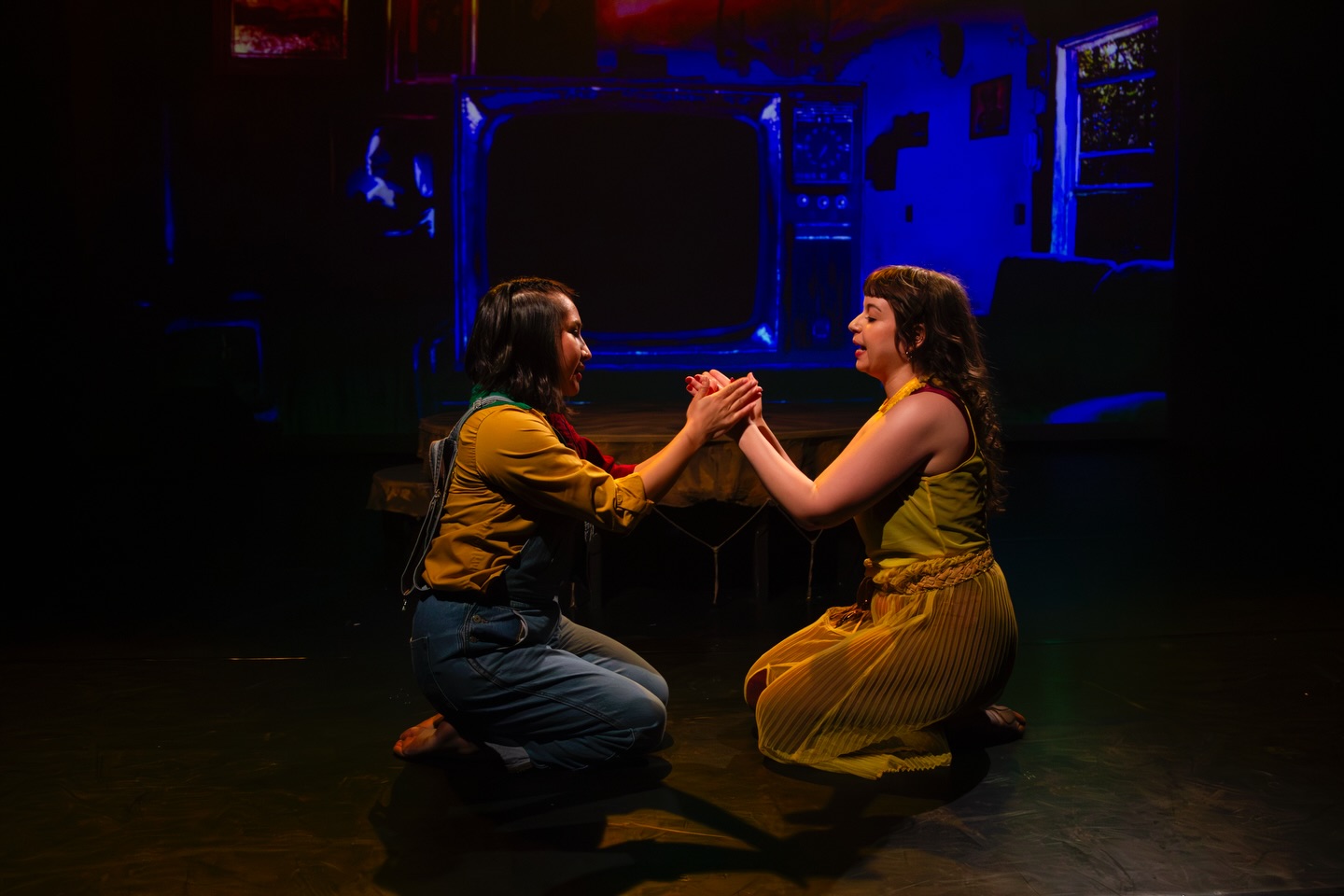
Miskozi (Katia Ferderber) feels lost. As an Indigenous woman, she struggles to confront the truth she carries and the horrific injustices of colonialism. She’s definitely having a tough time. She shares her thoughts with the audience and with her inner white girl Waabishkizi (Elizabeth Staples). Trying to understand who she is, Miskozi feels she must negotiate her identity and her place in a world determined to erase her Indigeneity through the dominant whiteness of the society in which she lives.
Amid this struggle, an ancestral river, Ziibi (Ravyn Wngz), appears, striving to answer Miskozi’s questions. Ziibi follows the protagonist as she takes a few steps forward and a few steps back toward understanding her true self.
There’s something uniquely different about the production I attended that makes me pay close attention.
Upon entering Aki Studio at Daniels Spectrum, the space feels sacred and holistic, dedicated to healing. Carmen Alvis tells us just before the performance begins that this is a relaxed show, reinforcing that sense of calm and peace. The creative team effectively contributes to this atmosphere. Co-video designers Trevor Schwellnus and Rihkee Strapp have thoughtfully created a striking projection at the back of the auditorium that is calming to watch. Schwellnus’s set design, which resembles a ceremonial drum at centre stage, is effectively lit by Echo Zhou’s craftsmanship. Maddie Bautista’s sound design and composition appropriately highlight key moments with humour, drama, and pathos.
Performers Katia Ferderber, Elizabeth Staples, and Ravynn Wngz each enter separately about 15 minutes before the performance. By the five-minute call, the actors are at centre stage, having broken the fourth wall to acknowledge and greet the audience as they enter. From an audience perspective, that’s reaffirming and an excellent choice. This decision reinforces the audience’s presence. We, too, are part of this story.
Performances stay true to the moment’s intent. While the dialogue may seem straightforward at first, don’t be fooled by that. The layers of meaning and subtext remain complex, especially regarding the violence and hurt inflicted by colonial whiteness on a people who are undeserving of what occurred.
Ferderber, Wngz, and Staples form a highly skilled trio of actors who tell the story with authenticity. Their approach is varied; for instance, the comedy styled after a Wheel of Fortune game show initially amuses but gradually shifts to a more serious, direct tone as the performance progresses.
Thanks to Rachel Forbes and Asli Ozuak’s costume designs, Ravyn Wngz’s Ziibi exhibits a remarkable tone in voice, physical movement, and presence, becoming a reassuring guide in the ongoing search for truth before anything else can unfold. Katia Ferderber convincingly portrays a character trying to understand what’s happening inside her, both as a child and as a young adult. Elizabeth Staples moves with deliberate intent and purpose, always listening intently.
As I left the Studio and reflected on the show the following day, one thing kept coming to mind: the mutual, deep respect shown and returned for the careful work that shaped this unfolding story of humane individuals who are part of Canada’s mosaic. I felt appreciated and respected as a valued audience member for listening to and understanding a story that, as Carmen Alves states in her Programme Note, is a “celebration of Yolanda Bonnell’s distinct movement and poetry inspired by a specific time and place.”
White Girls in Moccasins remains an essential production for all theatre-goers to experience and to progress with, alongside the playwright, through the pain, hurt, and shame.
Running time: approximately 95 minutes with no interval/intermission.
The production runs to April 12 at the Aki Studio in the Daniels Spectrum, 585 Dundas Street East, Toronto. For tickets: (416) 531-1402 or visit nativeearth.ca.
Native Earth Performing Arts and manidoons collective co-production present
White Girls in Moccasins by Yolanda Bonnell
Directed by Yolanda Bonnell and Carmen Alvis
Set Designer and Video Co-Designer: Trevor Schwellnus
Animation and Video Co-Designer: Rihkee Strapp
Lighting Designer: Echo Zhou
Costume Co-Designer: Rachel Forbes
Costume Co-Designer: Asli Ozuak
Sound Designer and Composer: Maddie Bautista
Technical Director: Steph Raposo
Video Operator: Seb Marziali
Stage Manager: Dylan Tate Howarth
Performers: Katia Ferderber, Ziibi Ravyn Wngz, Elizabeth Staples