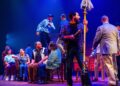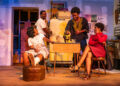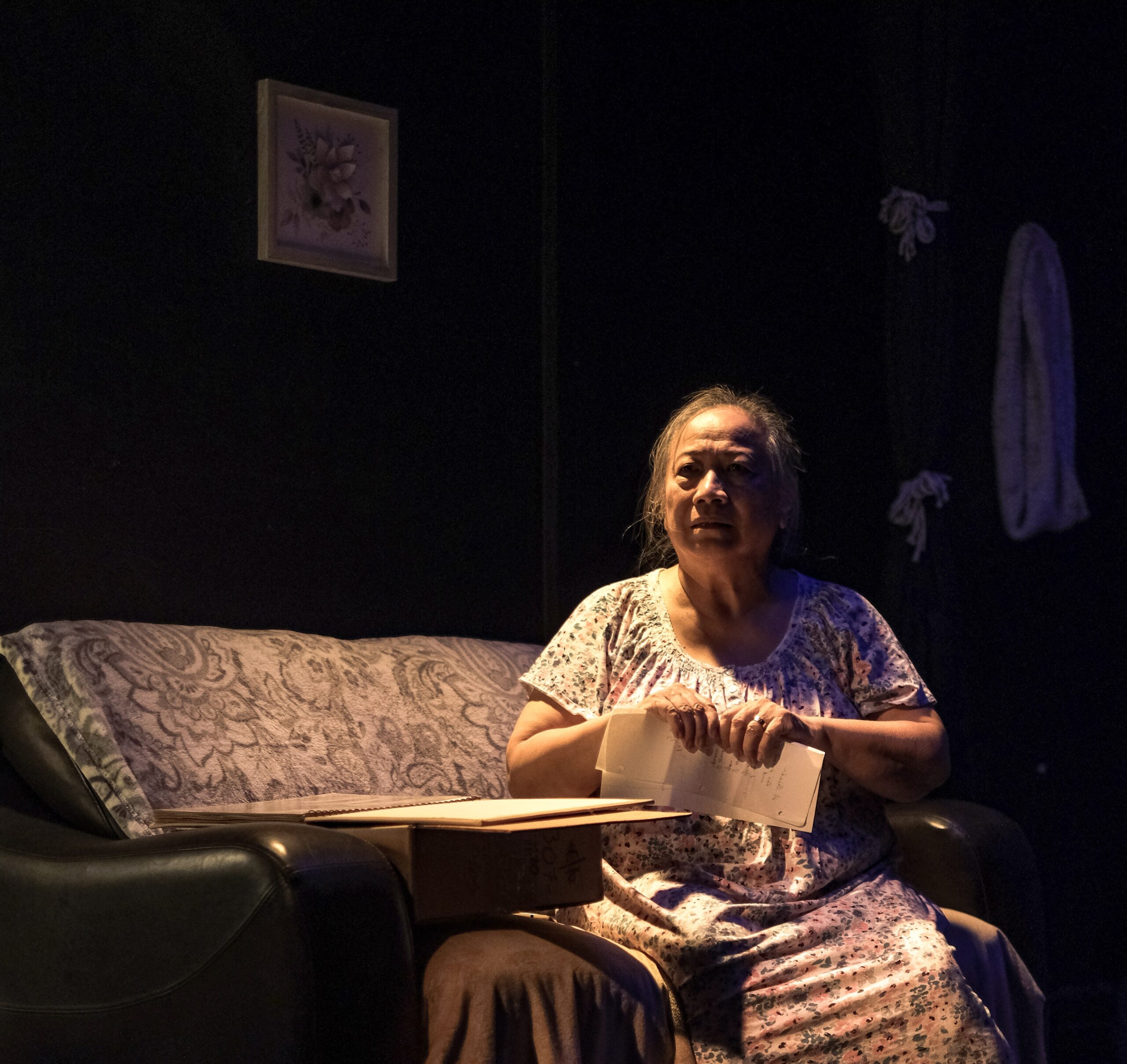


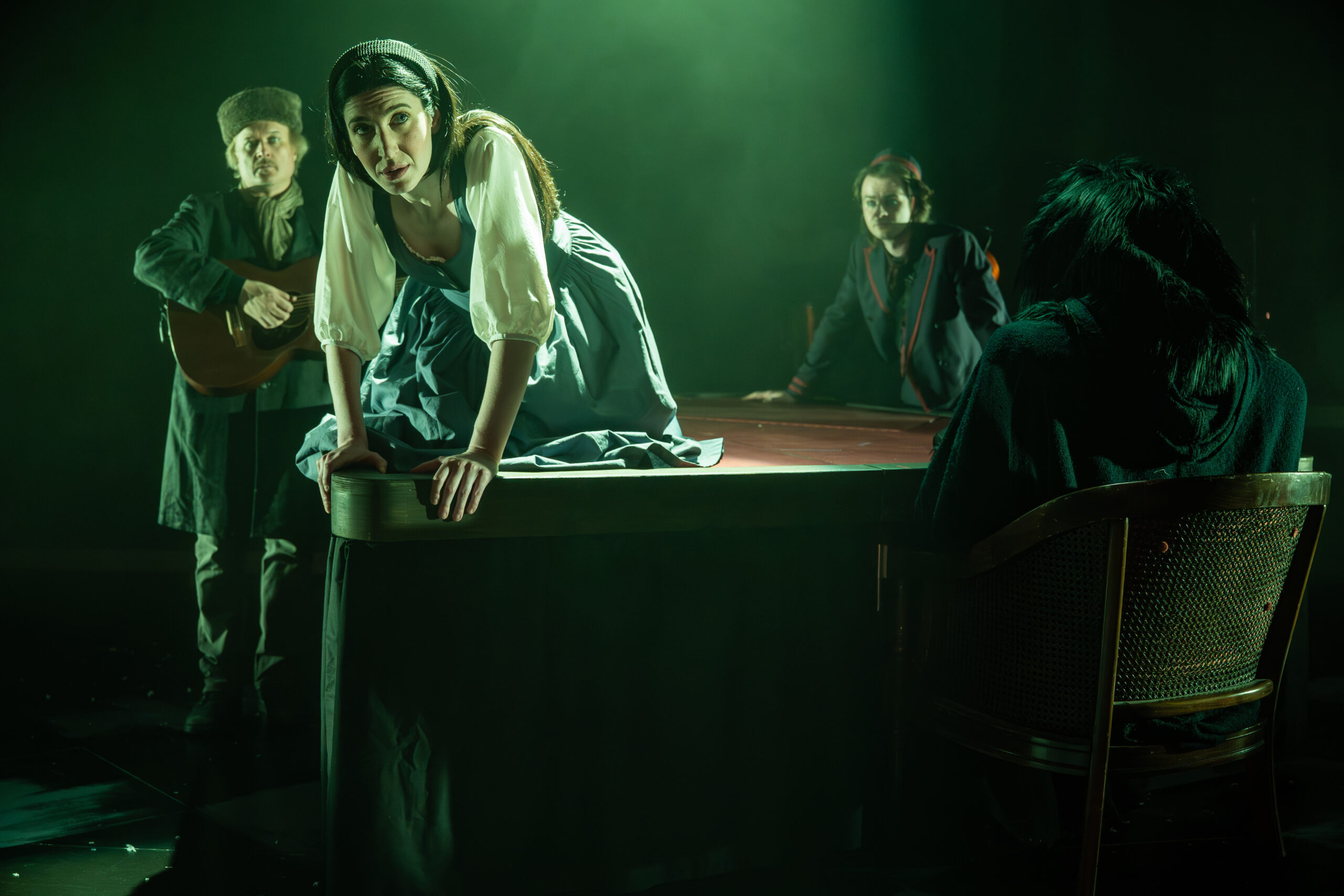
Before anything else, dear reader, start with the image. Pause over the proshot I’ve selected for this review. Notice the stark chiaroscuro of Frank Donato’s lighting design – the grazing beam slicing through macabre darkness, much like the threatening illumination in Michelangelo Merisi’s Calling of Saint Matthew. Feel the Caravaggesque charge.
That shadow-drenched atmosphere is precisely what distinguishes Soulpepper’s new production, Tiger Bride. This gothic musical is anything but limpid. Its structure is erratic; its lyrics unfold through elliptical metaphors. The whole project opens a labyrinthine passage into an adventurous theatrical hybrid. Daring and powerful, the show can become elusive and not fully legible. But it rejects familiar expectations in favour of a feral, risk-taking theatricality.
In a remote Italian village, a beast – la Bestia, if you prefer – imprisons a young woman in his palace after her father gambles her away in a card game. Such a premise inevitably conjures Disney memories – namely, Beauty and the Beast. Except the animated film dates from 1991, while this musical draws on Angela Carter’s 1979 gothic short story The Tiger’s Bride. Carter’s title uses the possessive case, but the show drops the apostrophe. Ownership disappears, and bewilderment becomes the point. Torn from village life and locked inside the Beast’s palazzo, the Girl enters a captivity that is also an inner transformation.
In the show, this happens chiefly through music, the plot unfolding as a maze-like song cycle. Under music director Andrew Penner, the score branches into several winding paths at once. Rock, punk, and indie rock blend with stranger textures, including a Russian lullaby. Each number circles around repeated musical phrases, giving the production an obsessive edge. It is an impressive exercise in musical virtuosity, with narrative becoming Ariadne’s thread – at times, hazardously on the brink of fraying.
The show’s adapters – Penner, Hailey Gillis and Frank Cox-O’Connell – focus heavily on preserving the gothic magical realism of Carter’s story, whose first-person narration lends a lucid self-consciousness to the fairy tale. The lyrics move through evocative metaphors. The performances, though, are strikingly concrete.
On stage, instruments lie scattered, ready to be seized: classical and electric guitars, percussion, ukulele, piano and more. Gillis and Penner, alongside Landon Doak, are nerve-jangling theatrical presences and remarkably versatile musicians. They sing, play, shift roles, and, above all, function as cantautori: singer-songwriters who seem to compose the world as they move through it. During the gambling sequence (“Winning & Stealing”), even the cards, slapped against a large table, become percussion, driving the scene into a relentless rhythm while the father, undone by his own hubris, wagers and loses the Girl.
As both Father and Beast, Penner pushes the voice into a full-throated roar – a grandiose sound that breaks into flamboyant falsetto leaps in the techno-like Luxury. Gillis offers a striking counterpoint, lending the Girl’s songs airy, breathy high notes. Piano arpeggios ripple through her numbers, while the electric guitar becomes the sonic emblem of the Beast’s dangerousness.
Doak offers a way out of that binary. As the butler, he is ambiguous and grotesque, an eerily off-kilter servant impossible to pin down. At times, he can even be funny, injecting a sardonic humour that cuts through the tension without deflating the scene’s menace.
Cox-O’Connell’s direction is meticulous and faintly unreal, giving the show a touch of Wes Anderson-esque stylization. There is something of The Grand Budapest Hotel in the melancholy geometry of its distorted tableaux. Height becomes a visual game of power and danger: the Girl always seems held in elevation, one step from falling. Shannon Lea Doyle’s scenic design sharpens that precarious effect. The black-and-white marble chessboard floor suggests an impending checkmate; the enormous, distorted games table delivers a perceptual jolt.
But the production’s strongest visual idea lies in its recurring motif of doors opening. A cabinet becomes a gate. A mirror turns into a portal. Even the dining table conceals a trapdoor. This reaches one of its smoothest expressions in “What We’ve Won”, a number that turns the palazzo into a maze of passages, entrances and escapes.
Not every corridor the show opens leads out. Some are blind alleys. But they are passages all the same: ways of breaking open the old, corroded track. Oh heavens, imagine if every musical obeyed the prescriptive architecture laid out in Jack Viertel’s textbook: an “I Want” song following an “I Am” song, an Eleven O’Clock Number arriving just in time to make sure the audience is still awake.
Tiger Bride is more unruly than that. It trusts the evocative power of music and the undeniable talent of its creators. They build a powerful, labyrinthine world – one so intricate that the audience can sometimes lose its way. The show does not need to hand us a map. A compass would do.
And, for the record, the Italian pronunciation passes with flair. A solid A minus to Landon: Ten o’clock at the Palazzo, capisci?
Tiger Bride runs to June 14, 2026, at Soulpepper Theatre, 50 Tank House Lane, Toronto, ON M5A 3C4. Tickets are available at soulpepper.ca/performances/tigerbride.
Running time: approximately 80 minutes, with no intermission.
Credits: Based on the story by Angela Carter, adapted by Frank Cox-O’Connell, Andrew Penner and Hailey Gillis, directed by Frank Cox-O’Connell, with music direction by Andrew Penner. The cast features Hailey Gillis as the Girl and others, Andrew Penner as Father and others, and Landon Doak as Valet and others. The creative team includes set and costume designer Shannon Lea Doyle, lighting designer Frank Donato, sound designer Brian Kenny, dramaturg Joanna Falck, stage manager Arwen MacDonell and apprentice stage manager Evan Reid.