


At times, playfully theatrical; at others, reflective and poignant life lessons for everyone, including the audience.
Set in Darren Burkett’s meticulously detailed gifted-education classroom, Steve Ross’s Early Genius follows a long-term substitute teacher (Kevin Kruchkywich) assigned to a Grade 1 class of four highly intelligent students. Percy Simmons (Aidan deSalaiz) is a musical-theatre enthusiast who quotes show tunes with considerable bravado. Harriet Gray (Naomi Ngebulana), who has had a heart transplant, must remain indoors. Beatrice Fielding (Madeline Elliott Kennedy) is a voracious reader drawn to demanding philosophical writers such as Søren Kierkegaard. Anthony Moldano (Andrew Perun), described as having the highest IQ in the class, is articulate but bullied by an unseen student from another class.
The substitute teacher is quickly outmatched in this classroom. He realizes he may have to win them over somehow. He tries his best, even by purchasing ducklings to instill responsibility; however, the students challenge him by questioning and scrutinizing everything from his education to his personal and family life. Without revealing a key running joke, the name the students use for the substitute shifts over the course of the play from an irritant to something he is ultimately prepared to accept.
To keep the highly articulate children engaged, the substitute proposes that they film a documentary about their education within this unique learning environment. The students agree, and the assignment produces comic results alongside more reflective and poignant lessons for both the characters and the audience.
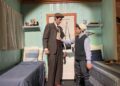
Burkett’s design establishes the classroom with careful specificity, from the manipulative materials and costume wear to the four cubbyholes marked with the students’ names. Bristle board posters line the back wall, suggesting completed research assignments, while a whiteboard sits prominently at the front of the room. Four red desks are angled to support the production’s shifting classroom dynamics. Burkett’s lighting design creates a striking visual image as the audience enters the Rose McQueen Theatre while Adam Campbell’s pre-show music selection helps frame the play within the world of children. Jennie Wonnacott’s costumes are appropriately practical, with easy slip-ons and off, reflecting clothing that young students might plausibly wear.
Ross’s script is clever and perceptive, with a structure that allows its humour and observations to deepen over time. Director Sheila McCarthy gives the production a playful theatricality while maintaining a grounded sense of classroom reality. The actors’ precisely timed movement of set pieces, particularly the rearrangement of desks, adds visual rhythm. That imaginative staging is balanced by moments of behavioural consequence, including a scene in which the substitute sends a student to the office for disrespectful conduct toward an authority figure.
deSalaiz, Elliott Kennedy, Ngebulana and Perun avoid turning the gifted children into caricatures, giving the production a strong ensemble foundation. Kevin Kruchkywich balances the substitute teacher’s comic vulnerability with enough restraint to prevent the character from becoming a figure of simple buffoonery, particularly as the play introduces more serious notes about the unpredictability of ordinary life.
The five performers combine adult technical control with the physical and verbal impulsiveness associated with young children. deSalaiz gives Percy bursts of musical-theatre bravado while drawing out the play’s satire of contemporary educational language around identity. Elliott Kennedy’s Beatrice, initially resembling a classroom know-it-all, is played as a child whose corrections appear genuinely intended to help, particularly as she interprets the classroom’s social dynamics for the substitute. Ngebulana’s Harriet is more reserved in her exchanges with him, but remains observant and attentive, suggesting a child who values each moment in the classroom and within her unseen family life. Perun’s Anthony is presented as an alert listener, closely watching the others and absorbing a piece of advice from the substitute that later backfires. The final scene gives Anthony’s conflict with his unseen bully a measured sense of closure.
Ross’s Playwright’s Note asks audiences to listen closely to the back-and-forth rhythms of classroom conversation and to follow the play’s shifts in time. That emphasis is reflected in a production attentive to the way teachers and actors can overlap: both depend on responsiveness, timing and the ability to manage strong personalities often in close quarters.
While he credits his niece, Shannon, a teacher herself, for being a sounding board along the way, Steve would have also made a fine teacher himself if he decided to go that course. The life and career of the teacher and actor remain forever linked to intense and fiery relationships, anger, resentment, love, loss and doing it all over again the next day.
And all for the love of the chosen career. I get it because I was a teacher for 33 years.
Early Genius offers an engaging, carefully staged Here for Now performance that balances theatrical playfulness with a credible sense of human behaviour.
Running time: approximately 75 minutes with no intermission.
The production runs to August 12 at the Rose McQueen Theatre, 24 St. Andrew Street, Stratford. I hear tickets are sold out for the run; however, you can take a chance on cancellations or returns by calling (519) 272-4368 or visiting www.herefornowtheatre.com.
HERE FOR NOW presents the World Premiere
Early Genius by Steve Ross
Directed by Sheila McCarthy
Lighting and Set Designer: Darren Burkett
Associate Lighting Designer: Sam Snyders
Sound Designer: Adam Campbell
Costume Designer: Jennie Wonnacott
Stage Manager: Charlotte Peters
Performers: Aidan deSalaiz, Madeline Elliott Kennedy, Kevin Kruchkywich, Naomi Ngebulana, Andrew Perun