

There are moments in Coal Mine Theatre’s production of David Mamet’s American Buffalo (written in 1975) when the audience sits in hushed silence, listening intently to every word exchanged by three hardened characters. The mounting tension demonstrates the enduring power of Mamet’s dialogue and the psychological complexity beneath these seemingly ordinary conversations.
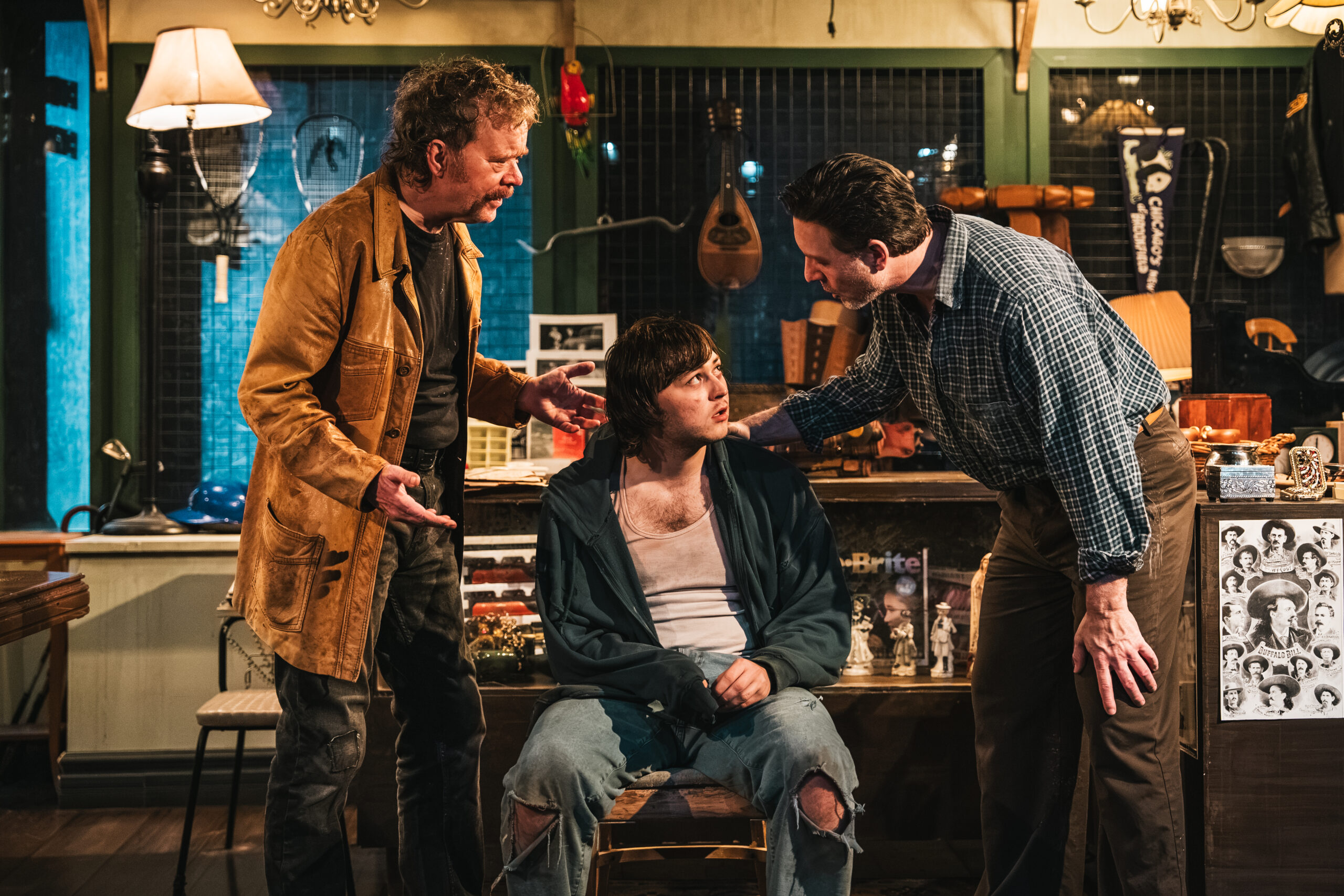
Set in a rundown junk shop in a Chicago suburb during the 1970s, Ken Mackenzie’s remarkable set makes effective use of every inch of Coal Mine’s intimate stage. Every conceivable object seems to have found a home here, from children’s toys (a Lite Brite occupies the showcase window) to tennis-racket-like objects that turn out to be old-fashioned snowshoes.
Through his gradually shifting lighting design, Steve Lucas effectively captures the passage of time, while Olivia Wheeler’s sound design introduces the distant traffic sounds of Chicago whenever the shop’s main door opens and closes.
Don (Shawn Doyle) owns the junk shop. Having sold a buffalo nickel to a customer for $90, he suspects the coin is now worth considerably more. Bob (Mackenzie Wojcik), who does odd jobs for Don and helps around the shop, joins a plan to steal the coin back. Teach (Ted Dykstra), Don’s poker buddy, learns about the scheme and attempts to convince Don that Bob is too inexperienced to be trusted with the job. Teach proposes stealing the entire coin collection instead. Don insists that his unseen poker companion, Fletch, accompany Teach, although he believes he can manage the theft himself.
What unfolds is a darkly comic, satirical and ultimately poignant portrait of three deeply bruised men whose fractured lives and shattered dreams are bound together by financial insecurity, mistrust and an overwhelming sense of failure. Each is searching for an opportunity to get ahead, yet their circumstances seem destined to keep them trapped in the same destructive cycle.
Costume designer Des’ree Gray establishes the social hierarchy and differing circumstances of the three men through their clothing. Don appears relatively presentable in his rumpled shirt and worn trousers, while Teach’s battered jacket and unkempt appearance suggest a man whose life is increasingly disordered. Bob is the most visibly dishevelled, wearing tattered jeans and a hole-ridden shirt. These distinctions reinforce the characters’ economic circumstances and their respective positions within Don’s small world.
Jordan Laffrenier directs with a sharp understanding of Mamet’s tension-filled dialogue, gradually building suspense through a carefully calibrated ensemble. The production’s strength lies in the actors’ ability to reveal the insecurities, frustrations and shifting power dynamics beneath the characters’ everyday conversations.
Key elements of Mamet’s writing include unfinished statements, uncomfortable silences and highly charged verbal confrontations. These moments make the characters’ insecurities and frustrations most apparent.
Shawn Doyle, Ted Dykstra and Mackenzie Wojcik navigate Mamet’s demanding dialogue with impressive control. Their performances let tension build naturally, with emotional outbursts emerging only after sustained verbal and psychological pressure.
Doyle’s Don establishes himself as the trio’s leader. He needs to maintain control, and both men recognize his position, although that authority is continually tested. Dykstra’s Teach challenges Don’s judgement, particularly when he tries to convince him that Bob is too inexperienced to participate in the heist. As Bob, Wojcik uses stiff body language and physical awkwardness, particularly when Teach enters, to suggest the character’s unease around him. Bob’s loyalty to Don is understandable, given his troubled personal history and dependence on the older man. Don recognizes Bob’s vulnerabilities, although he occasionally uses that knowledge to maintain control over him.
In his Director’s Note, Laffrenier asks audiences to consider what success means in the twenty-first century, particularly in a society increasingly divided by fear, economic insecurity and mistrust. The question is pertinent. Mamet’s three characters are men who want a better life but seem unable to escape the circumstances that keep them struggling. Their determination to get ahead repeatedly undermines their ability to help one another.
Laffrenier also references Mamet’s description of American Buffalo as a love story. It is an intriguing interpretation of a play often associated with masculine aggression, greed and betrayal. Beneath the verbal confrontations are three men who, in their own limited ways, need one another. Yet their instinct for self-preservation repeatedly threatens whatever friendship remains.
Under Laffrenier’s direction, Coal Mine Theatre delivers a compelling production that exposes the fragility of male friendship and the destructive consequences of mistrust. Its three accomplished performances and carefully controlled atmosphere make this a production that continues to resonate well.
A VOICE CHOICE designation seems appropriately fit for Coal Mine’s production.
Running time: approximately two hours and ten minutes with one interval/intermission.
The production runs to December 6 at The Coal Mine, 2076 Danforth Avenue. For tickets: https://tickets.coalminetheatre.com/event/330:23/
THE COAL MINE presents
American Buffalo by David Mamet
Full show credits can be found here: https://tickets.coalminetheatre.com/event/330:23/