


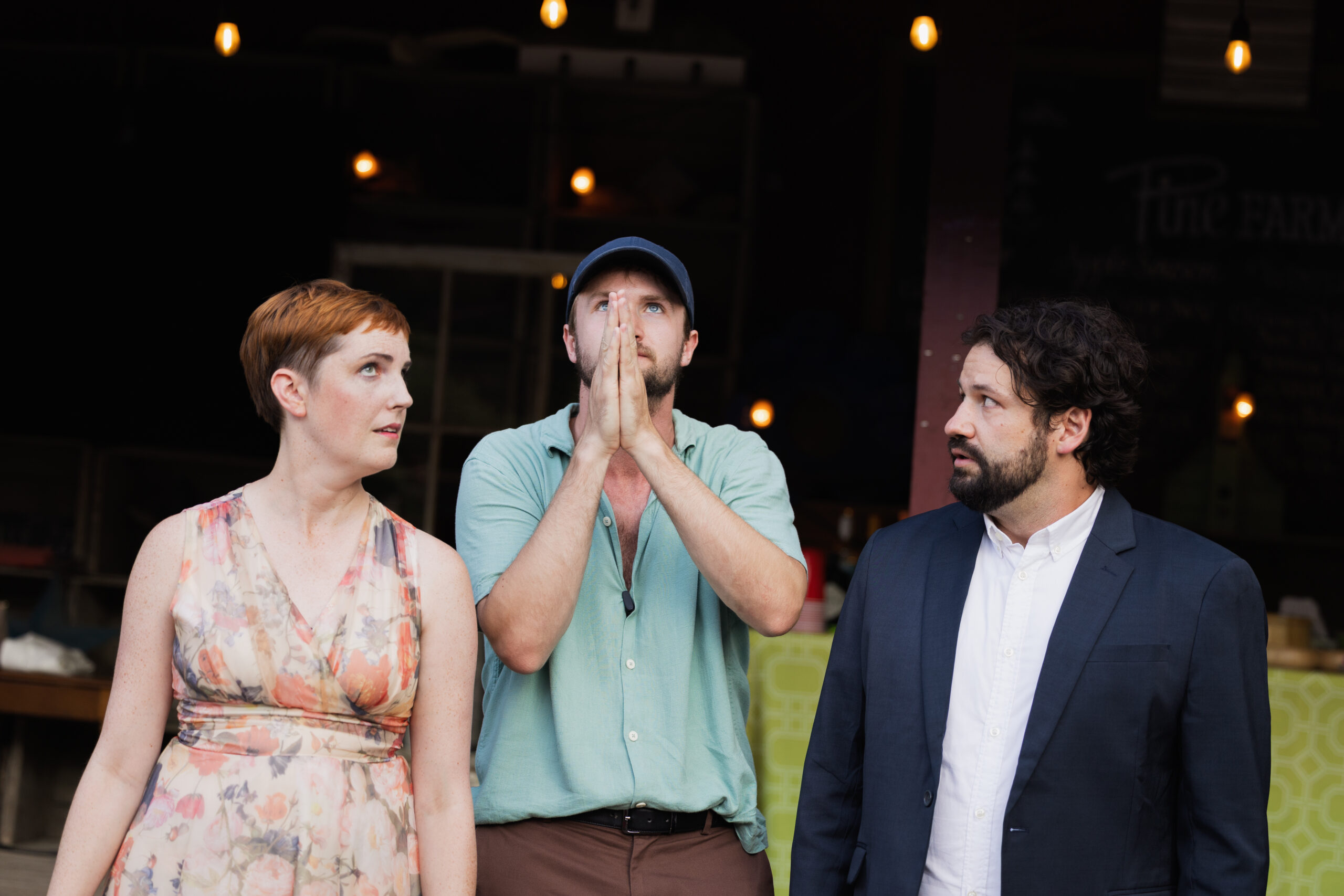
Outdoor theatre has faced its share of challenges amid rapidly changing weather patterns this summer. On an overcast opening night for King Theatre’s production of Craig Wright’s The Pavilion, the rain held off, allowing the company’s outdoor staging at Pine Farms Orchard to proceed uninterrupted.
The production introduces a play that may be unfamiliar to some audiences but offers a recognizable meditation on second chances, consequence and the long reach of the past.
The three-person ensemble play is set in a wooden pavilion overlooking a vast lake in the fictional Pine City, Minnesota, where a twenty-year high school reunion is underway. A table on the porch steps is dressed with party cups, plates and refreshments, establishing the pavilion as a familiar gathering place for generations of local teenagers. Once the reunion ends, the structure is scheduled for demolition.
Peter (Ian Ottis Goff), a middle-aged counsellor, returns to the reunion with a guitar and a bouquet of flowers intended for Kari (Alexa Higgins). The two were a couple in high school, but when Kari became pregnant at the end of Grade 12, Peter left abruptly. Kari, left to make difficult choices on her own, has since moved forward and now works at a bank. Her marriage has not become what she had hoped, while Peter’s relationship with a much younger woman is also faltering. His return is framed by an attempt to make amends with Kari, who is initially unwilling to revisit their history.
The Peter-and-Kari storyline is shaped by an omniscient Narrator (Josh Palmer), who also plays various reunion guests from past and present. The Narrator guides the performance’s events and ensures that unspoken matters are eventually brought into the open. The device invites comparison to Thornton Wilder’s Our Town, particularly in the way White’s Narrator, like Wilder’s Stage Manager, controls the frame and guides the audience through a story that moves between everyday detail and larger philosophical reflection.
King Theatre sets The Pavilion on the porch steps at King City’s Pine Farms Orchard. The choice takes a few minutes to register, since the reunion is staged as an indoor event, but director Chloë Rose Flowers uses the outdoor setting to make the audience feel like guests observing the reunion unfold around them. The staging proves effective in adapting the text to its open-air environment.
Palmer’s Narrator is central to the production’s success. Dressed in brown pants and an open-collar green shirt, he commands attention with a measured stage presence and clear command of the play’s lyrical opening monologue. His vocal modulation and pacing help sustain interest through passages concerned with time, cosmic scale and human consequence. As night falls and stars become visible above the orchard, the production’s philosophical undertones gain added resonance.
Real-life husband-and-wife Ian Ottis Goff and Alexa Higgins play Peter and Kari, with an emphasis on restraint and unresolved tension. He wears common, monochromatic colours to the reunion, while she wears a floral summer dress. Palmer’s turns as Pine City’s quirky reunion attendees provide necessary humour, often supported by quick props or costume adjustments. Goff’s musical moment at the microphone benefits from the nighttime setting, lending the scene a subdued, haunting quality.
Goff and Higgins initially and believably present Peter and Kari as people uncertain how to speak after two decades of silence. Goff’s Peter appears less intent on winning Kari back than on having her hear his explanation for leaving. Higgins gives Kari a contained reserve that suits the character’s guardedness, and the eventual confrontation clarifies the emotional weight and wound of Kari’s experience.
The production could sharpen some of its later emotional turns. Kari’s revelation carries significant dramatic weight, but the scene would benefit from a greater escalation of tension before its release. The material is heartbreaking, particularly in its depiction of the aftermath of her choices and the disappointment of her marriage, yet the full emotional sting is not always felt.
The Pavilion also recalls ensemble dramas of reunion and retrospection, including films such as The Big Chill and St. Elmo’s Fire, in which characters return to earlier bonds only to confront what remains unresolved. Flowers acknowledges a similar idea in her Director’s Note, positioning the production as an exploration of how the past continues to shape the present.
Flowers writes that the directing process involved “finding the extraordinary within the everyday lives,” a useful lens through which to view both the production and the play’s broader concerns. That idea is where King Theatre’s staging is strongest: it locates the extraordinary in the ordinary, whether it be in attempts at repair, regret or longing.
The Pavilion is a thoughtful, discussion-worthy production post-show. Its outdoor setting gives the play an atmospheric frame, while the performances and direction emphasize the lingering complexity of choices made long ago.
Running time: approximately 90 minutes with no interval/intermission.
The production runs through August 22 at Pine Farms Orchard, 2700 16th Sideroad, King City. Visit kingtheatre.ca, call (647) 622-6055 or email kingtheatrecompany@gmail.com
KING THEATRE COMPANY & PINE FARMS ORCHARD present
The Pavilion by Craig Wright
Directed by Chloë Rose Flowers
Stage Manager: Shania Scott
Composition and Sound Design: Daniel Tessy
Costume Assistance: Ella Hearn
Performers: Ian Ottis Goff as Peter, Alexa Higgins as Kari, Josh Palmer as Narrator
Understudies: Shelagh Carlini and Dillon Strasser-Einish