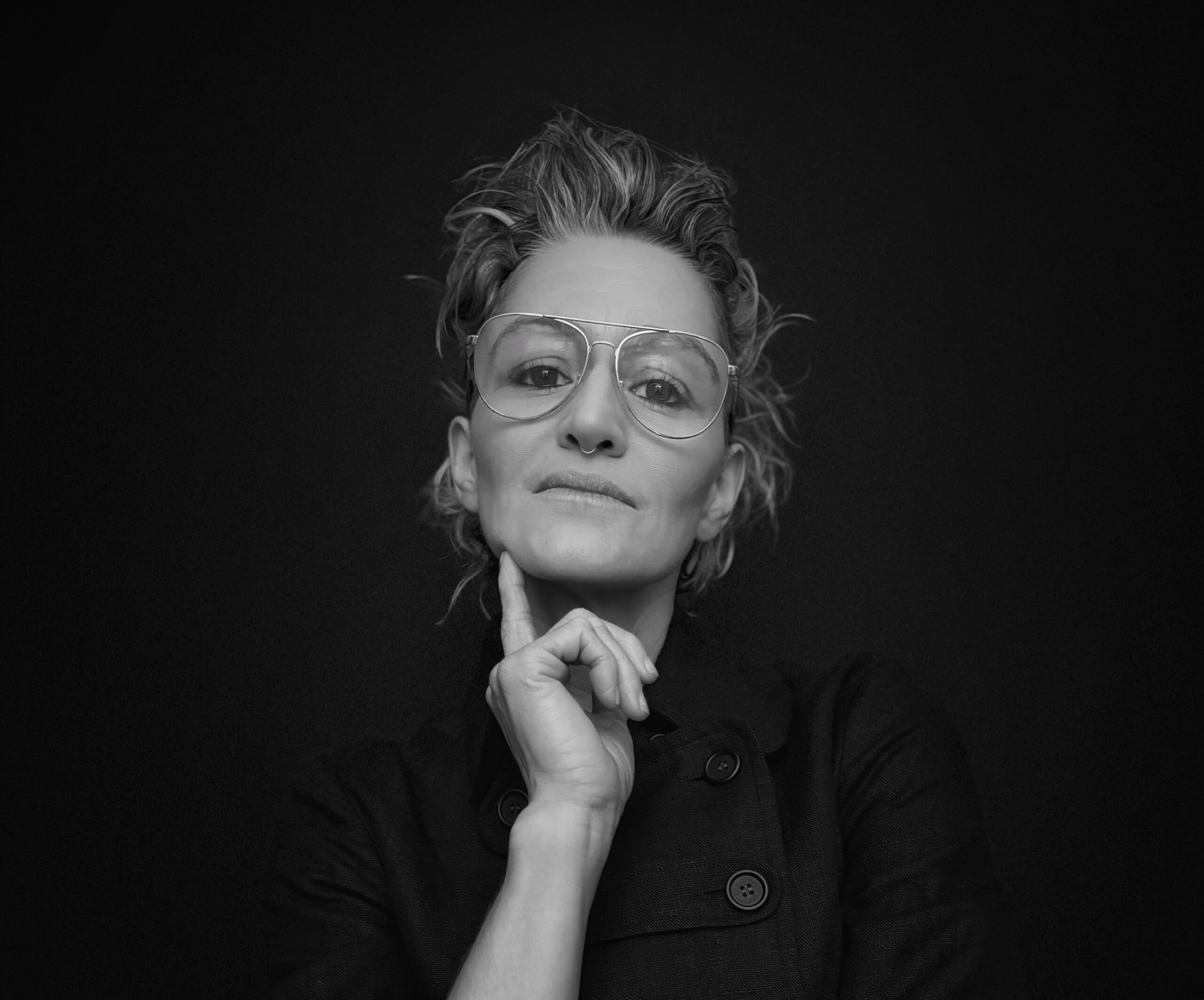


The Canadian playwright and screenwriter addresses the audience before the performance, framing the evening with reflections on theatre as a new artistic season begins.
Getting to Normal invites a timely question: what constitutes normalcy after disruption in personal life? The resonance of the play’s premiere is sharpened by the seasonal return to school, work, and routine.
Walker’s new play moves back and forth in time through sharply drawn dialogue, examining whether its characters can locate stability amid economic pressure, regret, and unresolved personal choices. Often comic on the surface, the play’s prevailing tone is dark, unsentimental, and frequently abrasive. All the good stuff Walker understands about his true-to-life characters.
At the intimate Red Sandcastle Theatre, the production establishes two distinct playing areas. Contemporary rock pre-show music situates the audience in the everyday world of four people whose lives are closely linked over time. The characters occupy a working-class milieu: they take the subway, the bus, or a cab; they seek work, hold work, or are worn down by it. The two men and two women are presented as people living on the edge of a precipice. Their exchanges carry hardness and fatigue, with sadness visible beneath the defensive edge. Whatever compassion remains among them is limited and precarious.
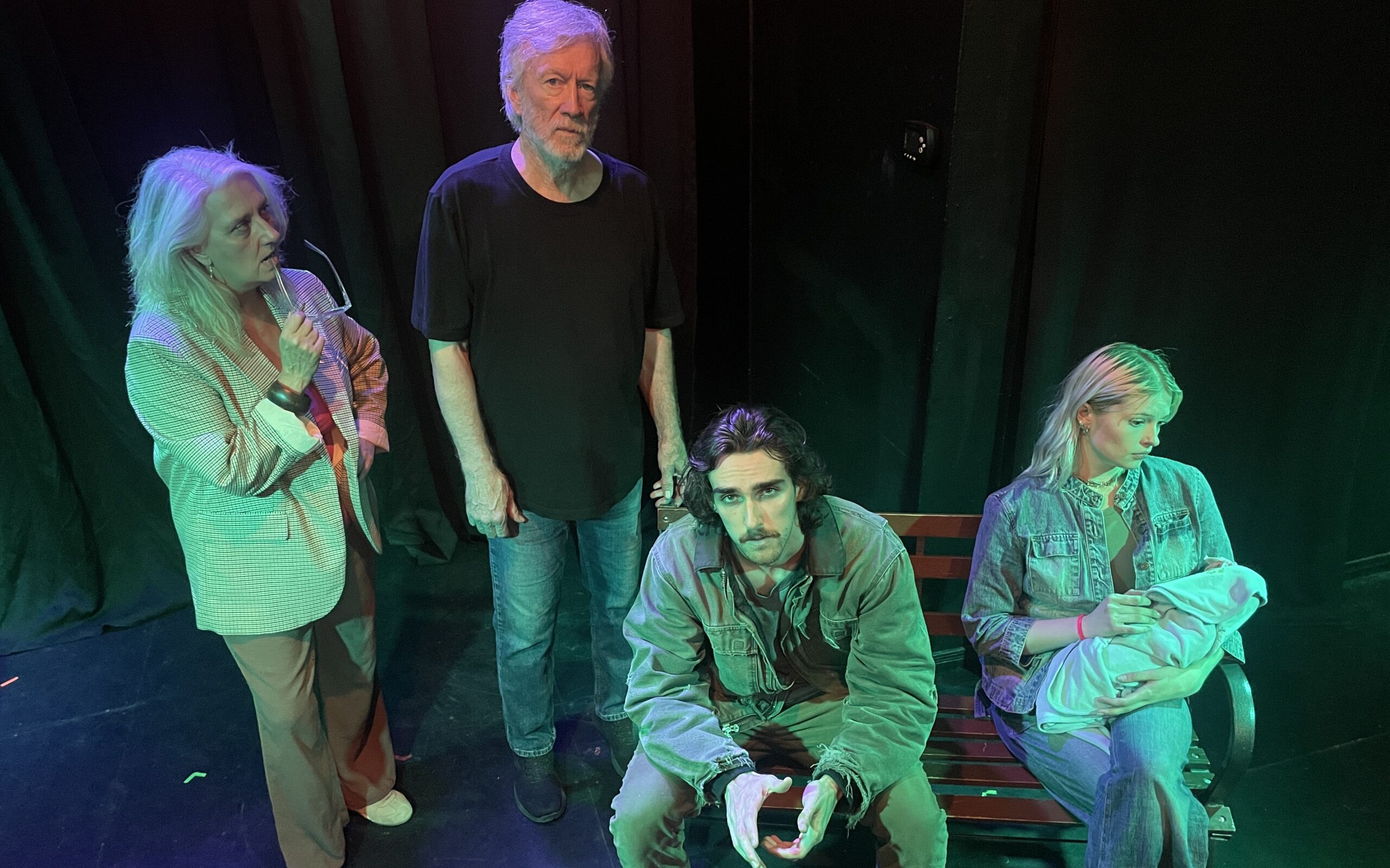
The younger couple, Amber (Kierin Clarke) and Mickie (Louis Akins), have a newborn daughter, Evie, and little money. Their arguments over parenting and finances expose a relationship strained by uncertainty. Frustrated by lost opportunities and limited prospects, Mickie clashes with Amber, whose immediate concern is whether they’ll have enough money to feed their child. In the parallel storyline, Michael (David Cairns) recounts his life to his psychiatrist, Rita (Elizabeth Friesen), while insisting he has never had a fair chance. Rita challenges that account, pressing him to consider his own responsibility rather than attributing his circumstances entirely to others.
The connection between Michael and Mickie becomes apparent as the two narratives unfold, though the production preserves enough distance between them to allow the structure to register gradually.
As director, Walker emphasizes believability over theatrical flourish. Movement is minimal, with characters often seated and shifting only slightly during extended conversations. This restraint emphasizes the language and the pressure building through what the characters reveal, evade, and repeat. Some dialogue would benefit from further clarification in the next draft, particularly around Michael’s decision to seek treatment from a psychiatrist who appears troubled herself. Even so, Getting to Normal suggests the shape of a larger, more expansive work. Walker’s side-by-side staging of the two couples is legible in the compact Red Sandcastle space; the arrangement may have greater impact on a larger stage.
Kierin Clarke, Louis Akins, David Cairns, and Elizabeth Friesen work as a cohesive ensemble, giving the production a grounded sense of people in East End Toronto negotiating work, family, disappointment, and routine. Clarke and Akins, dressed in jeans, concert T-shirts, and sneakers, underscore Amber and Mickie’s youth and unpreparedness as new parents. Cairns and Friesen provide a contrasting portrait of later-life disillusionment. Cairns’s restless physicality, unkempt appearance, and inability to sit still suggest a man under strain. Friesen’s Rita, in a neatly pressed, colourful outfit, projects professional order, yet her blunt language and impatience suggest a practitioner nearing her own limits as she tries to keep Michael from harming himself or others.
The opening-night address by Walker also formed a notable part of the evening.
In his remarks, Walker discussed the evolving Toronto and Canadian theatre landscape, contrasting earlier opportunities in larger venues with the practical realities of making theatre in smaller spaces with fewer resources. His comments placed the production within a broader conversation about persistence, scale, and artistic commitment within the theatre community. This context gives Getting to Normal an additional frame. Presented in a modest venue, the play reflects the practical and artistic economies of small-theatre production while continuing Walker’s interest in characters pushed to the margins.
As the theatre season begins, the World on Fire Theatre Collective’s opening 2026 production offers a tough, dialogue-driven account of people trying, with limited means, to define what normal might still mean.
Go and see what’s going on.
Running time: approximately 90 minutes with no interval/intermission.
Performance dates: September 10-11 and 15-18 at Toronto’s Red Sandcastle Theatre, 922 Queen Street East.
For tickets: https://www.eventbrite.ca/e/getting-to-normal-tickets-1995023588257
WORLD ON FIRE THEATRE COLLECTIVE presents The Premiere
Getting To Normal, written and directed by George F. Walker
Produced by Elizabeth Friesen
Stage Manager/Lighting and Sound Technician: Robyn Shepherd
Eventbrite Manager: Madeleine Rosenberg
Program/Graphic Designer: Natalie Ira-Gould
PR/Social Media: Marianne Sawchuk
Performers: Louis Akins as Mickie, David Cairns as Michael, Kierin Clark as Amber/Evie and Elizabeth Friesen as Rita