

Guest Writer Keilantra Huang
In 2026, houses in the City of Toronto cost just over one million dollars on average. It’s a far cry from 2000, just one generation earlier, when families could buy a starter home for approximately $250,000, a fourth of the current price. While Toronto may be an extreme case, it is no exception; housing and the cost of living are among the biggest issues for young people.
Written by playwright Philip Ridley in 2015 for a British audience, Radiant Vermin becomes increasingly evident as universal and necessary. This 2026 adaptation by theatre company Riot King is no different; with immersive designs and captivating performances, director Sebastian Biasucci delivers a striking call to action for Toronto.
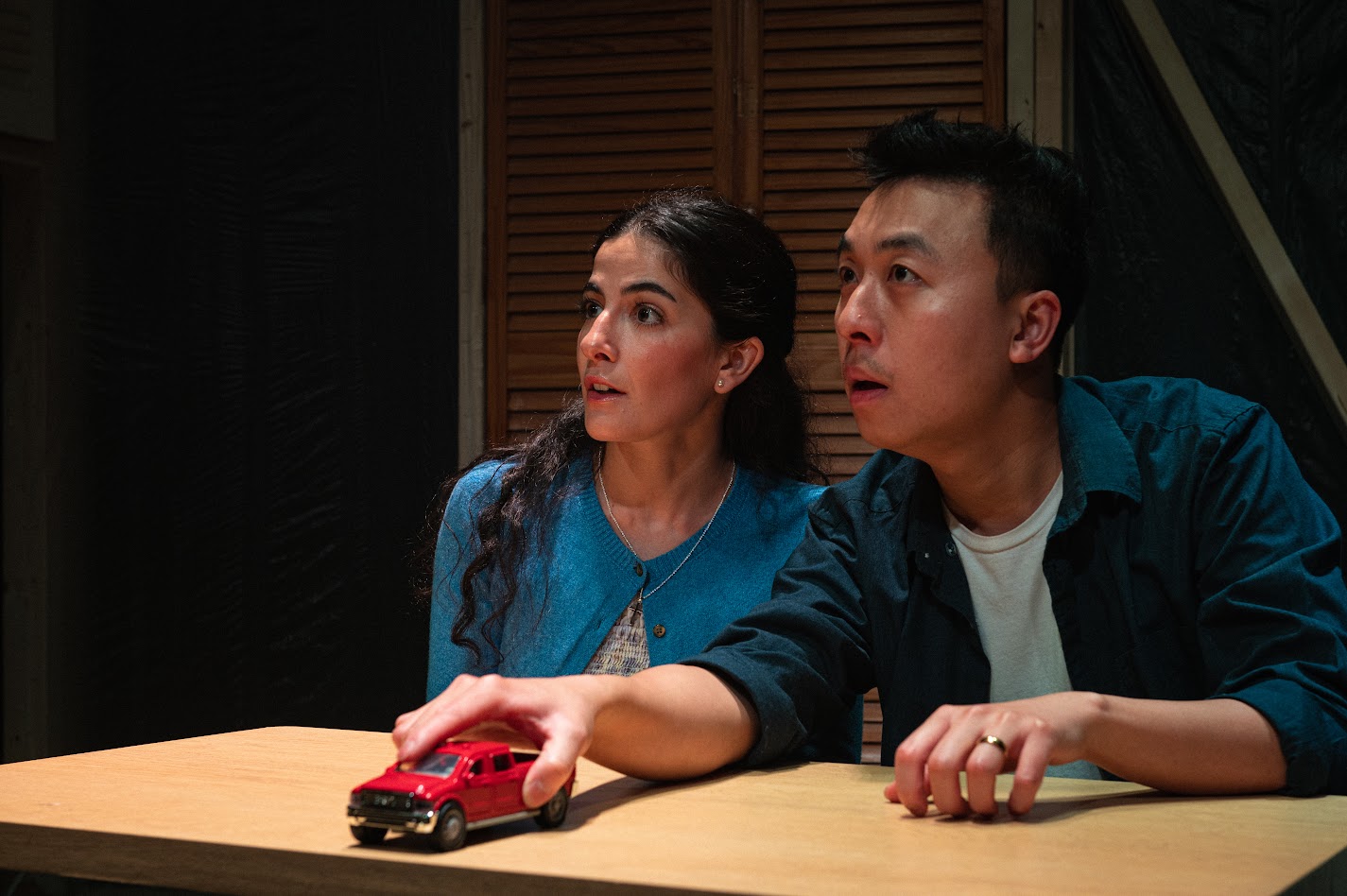
It’s no wonder then that Jill and Ollie, the protagonists of Radiant Vermin by British playwright Philip Ridley, are scrambling to make ends meet at the beginning of their story. From working-class backgrounds and now preparing for a new baby, Jill (Katherine Cappellacci) and Ollie (Ziye Hu) are presented with a tantalizing offer from the mysterious Miss Dee (Lisa Horner)—a free fixer-upper to call theirs. The only catch is that they have to renovate it themselves.
Biasucci weaves a clever creation, making Radiant Vermin depressingly real and darkly humorous. Set within the intimate black box of Toronto’s Red Sandcastle Theatre on Queen Street, the audience is fully embedded in the performance. The breaking of the fourth wall recurs, continually challenging our perceptions and questioning whether Jill and Ollie’s actions are justified.
While their chosen method of renovation is over-the-top murder, there’s a clear commentary on the weight of Jill and Ollie’s actions. After all, the people they kill are all homeless. In their effort to ameliorate their own lives, Jill and Ollie massacre their most vulnerable neighbours, showing how their materialistic desires come at the exploitation of the people most on the periphery of society. The couple’s attempt to selflessly justify their actions through the lens of their unborn child’s future speaks to the way that morally corrupt people exercise their power under the guise of selflessness. Their halo of righteousness shines so brightly that it blinds them to the brutality of their actions, hence the play’s “radiance.”
The staging of the various doors emphasizes the escalating nature of Jill and Ollie’s violence. As the couple continuously flows in and out of the main stage, there is a growing seamless blending of their public and private lives; while they are shocked by their first accidental killing, Jill and Ollie become increasingly adept at strategizing and adapting, to the point of actively scheming new ways to lure in victims. They appear happily domestic on the outside, while hiding cycles of violence, greed, and guilt behind closed doors.
One excellent way the play underscores Jill and Ollie’s violent frenzy is in their religious convictions. While Jill in particular was always religious from the start, she and Ollie increasingly use their faith as a coping mechanism to glorify their own actions; with the help of costume designer Amelia Mielke-O’Grady, they literally portray themselves as holy priests and nuns while the homeless people they kill become martyrs for the noble cause that is their child’s future.
Here, the play is not shy in highlighting the couple’s hypocrisy. The masterful lighting and blocking of the stage hide their killings behind closed doors and bursts of light, which strip their victims of their humanity. The Bible preaches the importance of love and service. Yet, the light of Jill and Ollie’s righteousness literally blinds them to their crimes.
Despite the heavy subject matter, Radiant Vermin still manages to tread the line of dark humour, particularly through its use of incongruous props and language. The couple say that they’re going out for a drive, only to roll a toy car across their tables; when electrocuting victims, they refer to their weapon as a “magic wand.” This performance’s humour excels because it’s never at the expense of Jill and Ollie’s victims. In every scene, it emphasizes the couple’s detachment from their humanity and the absurdly selfish desires they value above morals, ethics, or even common sense.
While the play’s setting creates a vivid, uncanny atmosphere, the performers truly bring the story to life. Most notably, Radiant Vermin employs doubling, meaning that every actor plays multiple parts. In the process, they embody a range of personalities, highlighting their versatility and acting prowess.
As Jill, Katherine Cappellacci is an absolute powerhouse, delivering an exuberant, ambitious performance. She challenges the audience on whether giving money to homeless people encourages drug abuse, forcing audiences to confront their biases in real time. Simultaneously, Cappellacci retains a sense of innocence and eagerness, which gives characters like Jill a dynamic nuance.
Ziye’s Hu remains more reserved and withholding, adding intriguing ambiguity to his character. While this was valuable for moments of tension and guilty uncertainty, it left me wondering what emotion he was trying to portray in silent scenes.
Where Cappellacci and Hu truly excelled was during Benji’s birthday party, where they showcased both their electric chemistry and their ability to swiftly shift from character to character through doubling. Cappellacci and Hu distinguished each new role through specific gestures and physical and vocal mapping. Each character and transition was clean at first, as they riffed off each other, before devolving into an intentionally chaotic whirlwind that suggested the couple’s inner paranoia and turmoil were growing to consume every part of their lives and surroundings, even innocent moments of celebration.
The incredible range of Lisa Horner remains grounded through her characterization of two completely different characters—Miss Dee and Kay. As a serendipitous real estate agent, Miss Dee is both dignified and warm. Yet her warmth is cloying, concealing her shadowy, coercive nature. In contrast, as Kay, the homeless woman, Horner’s performance carried a heart-wrenching vulnerability and humanity.
Despite being perpetually slumped on the ground, as if minimizing her offensive presence, Kay remained tender and kind even in the face of certain death. As Horner delivered Kay’s backstory in a quietly fierce tone, she granted Kay a humanity that Jill and Ollie denied her.
The audience is ultimately left with one burning question at the end of the play – who is actually most responsible for the couple’s actions? Is it Jill and Ollie themselves? Miss Dee? Their circumstances? Or something completely different? The play itself does not give a definite answer. Rather, to encourage audiences to make their own judgements, the play also questions why something so fundamental for protection and comfort is so difficult to acquire.
Radiant Vermin amplifies the idea that, as witnesses, we need to remember that homeless people are not obstacles but human beings who deserve compassion and support. It also reminds us that, as the audience, we must recognize the danger of Jill and Ollie’s actions and become allies to those in our community. As Riot King founder Brendan Kinnon said before the performance, being a community and supporting each other will always be the strongest approach.
Radiant Vermin runs through November 22nd at Red Sandcastle Theatre, 922 Queen Street East, Toronto, ON M4M 2J5. For tickets and inquiries: https://www.riotking.com/radiantvermin
Company: Riot King
Cast: Katherine Cappellacci, Lisa Horner, and Ziye Hu
Director: Sebastian Biasucci
Stage Management: Zarah Esmail
Sound Design/Music Composition: Zach Parsons
Producer: Lindsey Middleton
Set/Costume Design: Amelia Mielke-O’Grady
Lighting Design: Natasha Rotondaro
Production Manager: Brendan Kinnon