

Soulpepper’s Spring Awakening, adapted and directed by Paolo Santalucia, brings Frank Wedekind’s controversial examination of adolescence and repression into contemporary focus. The production marks Santalucia’s first production as the company’s Artistic Director and features a largely young ensemble whose physical and emotional commitment gives the play considerable immediacy.
Set in 19th-century Germany, Spring Awakening follows a group of adolescents confronting the unfamiliar physical and emotional experiences of growing up within a rigid educational and social system. Questions of identity, sexuality, repression, authority and self-discovery remain central to the drama, and the production demonstrates why Wedekind’s work continues to resonate with contemporary audiences.
Santalucia’s adaptation maintains the play’s period setting while emphasizing the emotional experiences of its young characters. Rather than treating their awakening simply as youthful rebellion, the production presents their uncertainty and vulnerability against institutions that provide little space for honest discussion about sexuality, desire or personal identity.
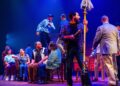
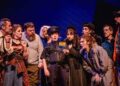
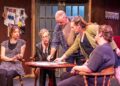
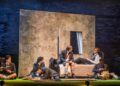
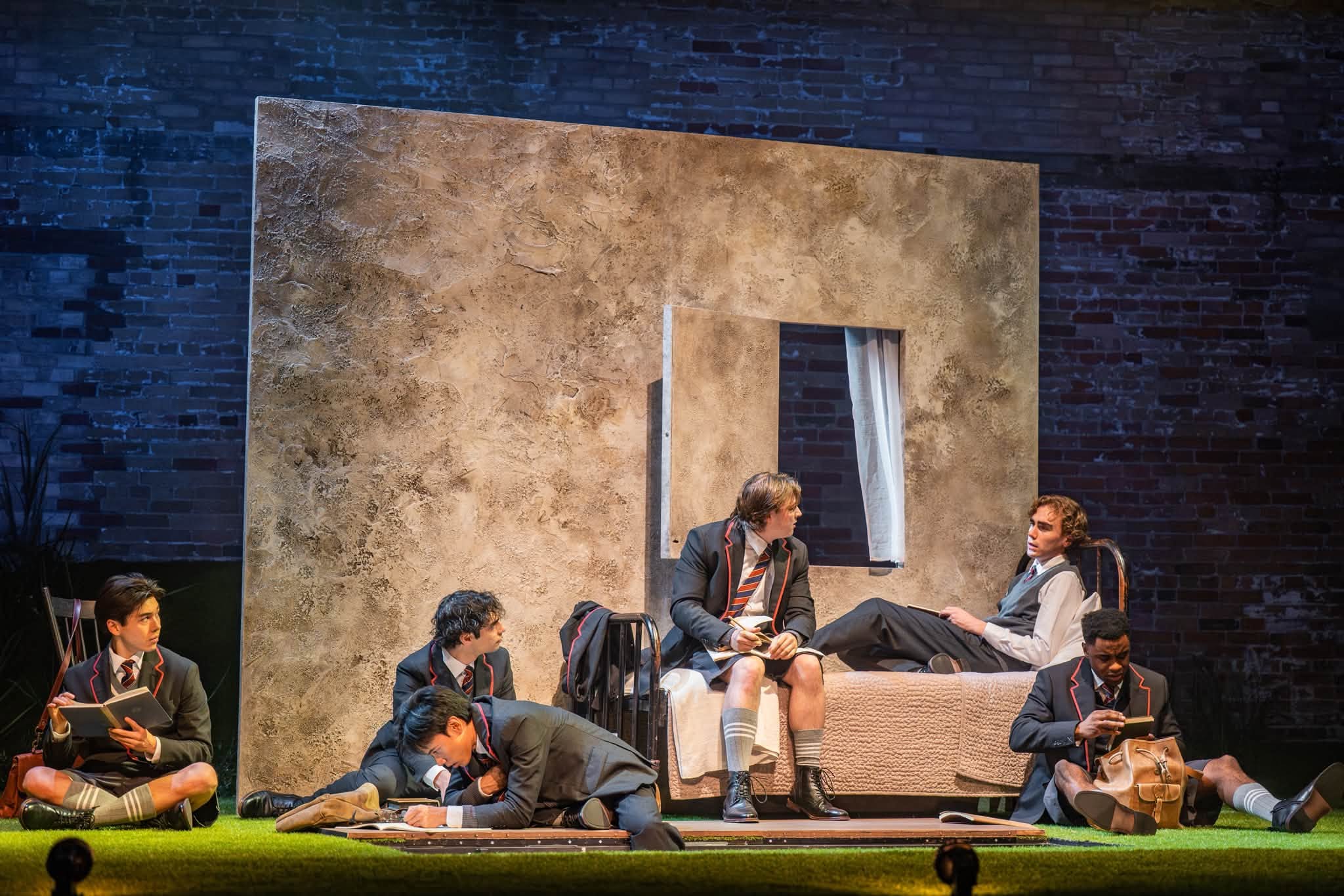
The ensemble works with considerable energy and concentration. The performers listen and respond closely to one another, creating a sense of youthful spontaneity while maintaining control during the more emotionally demanding scenes. Ming Wong’s costumes, including carefully reproduced period school uniforms, reinforce the social restrictions surrounding the characters.
At the centre of the production are Jake Bunyan as Melchior, Jake Cohen as Moritz Stiefel and Olivia Neary-Hatton as Wendla Bergman. All three give performances that develop convincingly as their characters encounter experiences for which they are largely unprepared.
Bunyan’s atheist Melchior initially projects confidence and intellectual independence. His knowledge of sexual reproduction distinguishes him from his classmates, but his growing realization that knowledge does not necessarily translate into control becomes an important element of the performance.
Cohen gives Moritz an initially tentative, almost ethereal quality. His character struggles with academic expectations, and with physical and emotional changes he does not fully understand. Cohen effectively communicates that increasing uncertainty. Neary-Hatton’s Wendla begins as an innocent young woman whose understanding of sexuality has been shaped by incomplete information and parental influence. As her circumstances change, Neary-Hatton lets the character’s vulnerability emerge. Although she may not have initially realized what has happened, the moment leaves the audience in silence, recognizing what has occurred.
The supporting performers contribute strongly to the ensemble. Noah Beemer as Hansy Rilow and Justin Eddy as Ernst Röbel portray two young men navigating their developing friendship and growing self-awareness. Their scenes are handled with sensitivity and restraint.
Anika Maharaj-Sandhu’s socially more experienced Ilse offers another perspective on adolescence and the consequences of social and familial pressures. Her performance gives the character both independence and vulnerability, particularly in her interactions with Melchior and Moritz.
EJ Candelaria, Jasmine Case, Raylene Harewood, Eric Miracle and Mackenzie Wojcik complete the group of schoolmates. A sequence in which the students gather for last-minute exam preparation captures the familiar mix of camaraderie, anxiety, and youthful distraction.
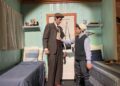
The adult characters provide a stark contrast. Diego Matamoros’s Professor Knochenbrüch embodies an education system built on rote learning, with his repetitive Latin exercises emphasizing the classroom’s rigidity. Daren A. Herbert’s Headmaster Hart-Brand is considerably more intimidating, particularly during Melchior’s confrontation with institutional authority. Liisa Repo-Martell brings complexity to Wendla’s mother, while Raquel Duffy’s portrayal of Melchior’s mother suggests a more liberal parental perspective and provides an unexpected connection with Moritz.
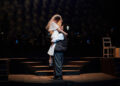
Shannon Lea Doyle’s restrained period realism in set design usefully provides the story’s varied places. Seven chairs line the front of the stage, while a crucifix mounted on the upstage wall establishes the religious and social environment in which the characters live. A window and gently moving cloth provide another strong, subtle visual detail during the pre-show.
Kevin Lamotte’s lighting plays an important role in establishing atmosphere and directing attention. A reflection of a tree near the beginning of Act 2 is particularly effective, while Thomas Ryder Payne’s sound design contributes carefully timed accents to the production’s dramatic moments.
Santalucia’s direction places considerable emphasis on the authenticity of the young characters’ experiences. The production does not shy away from the difficult material, but its strongest moments come when the performers are allowed to explore the uncertainty, excitement, and fear of adolescence. A blackout is used at one point, intensifying one moment.
Spring Awakening contains mature themes and the consequences of inadequate communication between young people and adults. For younger audiences, those subjects may warrant preparation and discussion with parents, guardians or teachers before and after attending.
The production ultimately succeeds through the strength of its ensemble and its willingness to keep Wedekind’s themes uncomfortable. The young characters are individuals attempting to understand themselves within a system that gives them little reliable information or emotional support.
The result is a production that connects the play’s historical setting with questions that remain relevant to contemporary audiences in Santalucia’s adaptation. Its greatest impact comes not from imposing a modern interpretation on Wedekind’s work, but from allowing the emotional consequences of the characters’ experiences to speak for themselves.
Running time: approximately two hours and 30 minutes, including two 10-minute intermissions.
Spring Awakening runs until October 18 at the Marilyn and Charles Baillie Theatre, Soulpepper Theatre, Young Centre for the Performing Arts, 50 Tank House Lane, Toronto. For tickets: soulpepper.ca or call (416) 866-8666.
SOULPEPPER presents
Spring Awakening by Frank Wedekind
Adapted and Directed by Paolo Santalucia
Associate Director: Luke Reece
Set Designer: Shannon Lea Doyle
Costume Designer: Ming Wong 黄慧明
Lighting Designer: Kevin Lamotte
Sound Designer: Thomas Ryder Payne
Stage Manager: Sam Hale
Performers: Noah Beemer, Jake Bunyan, EJ Candelaria, Jasmine Case, Jake Cohen, Raquel Duffy, Justin Eddy, Raylene Harewood, Daren A. Herbert, Anaka Maharaj-Sandhu, Diego Matamoros, Eric Miracle, Olivia Neary-Hatton, Liisa Repo-Martell, Mackenzie Wojcik