

Review by East Coast Guest Writer Chris Coculuzzi
(Chris has been involved in independent and community theatre for more than thirty years as a producer, director, performer, and playwright. He is also an educator, helping hundreds of students over the last twenty-five years bring their own creative expressions to life on stage. Chris resides in Cole Harbour, Nova Scotia and is a member of the Playwrights Atlantic Resource Centre and a Drama Teacher for the Halifax Regional Centre for Education)
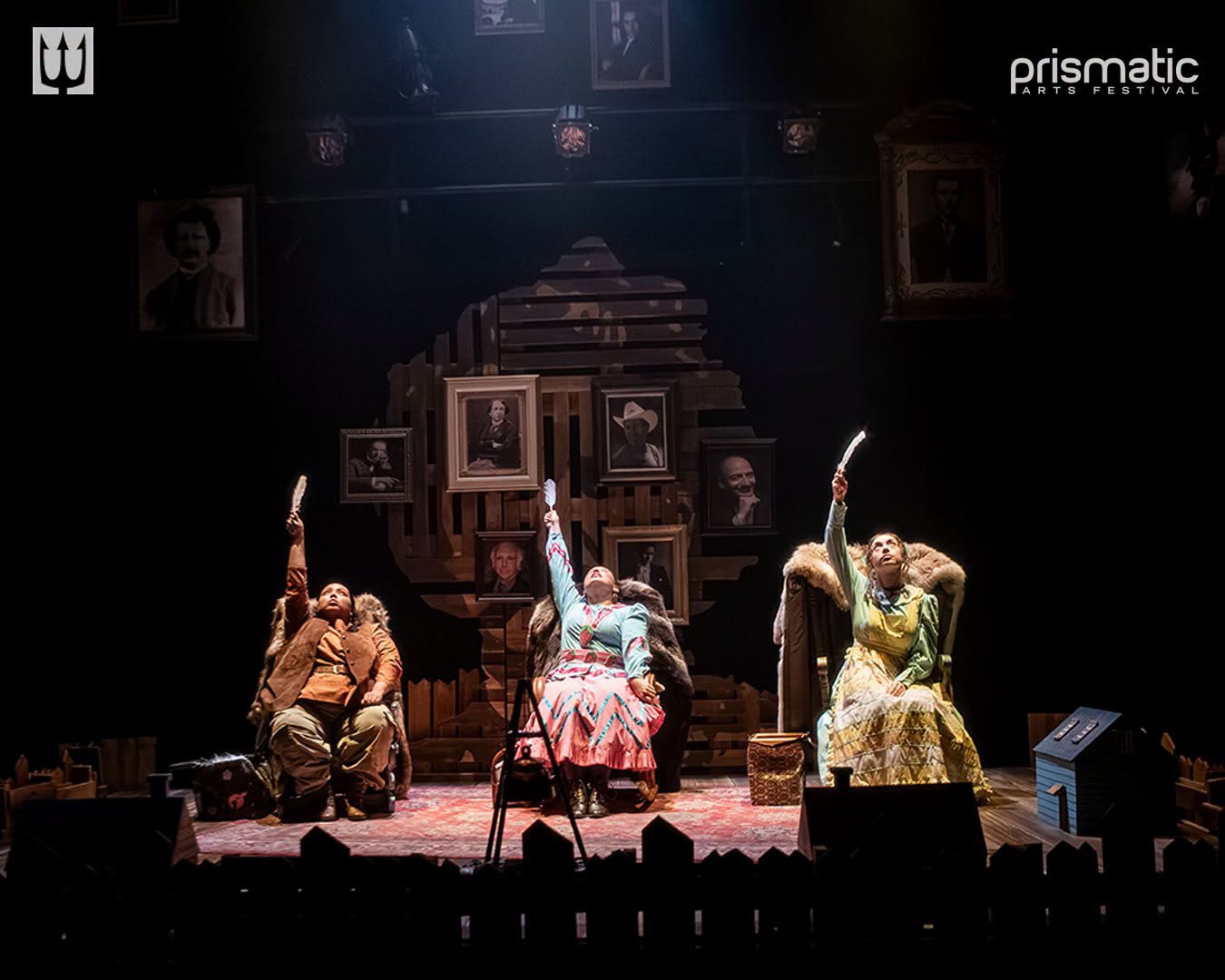
When you walk into Neptune Theatre’s Scotiabank Studio for Francis Koncan’s Women of the Fur Trade, you are surrounded by portraits: portraits of historical figures, heads of governments current and past, and even actors and artists. All men. And you can hear the audience trying to play a game with themselves, trying to identify as many as they can. When the play opens, three women emerge from their rocking chairs — the Metis Marie-Angelique (Danelle Charette), the White Settler Cecilia (Alison Beckwith), and the Ojibway Eugenia (Joelle Peters) — playing a game consisting of quoting and correctly identifying influential male figures. The impact is clear: then as is now we are all surrounded and saturated by a political and artistic culture that is dominated by men.
Jay Havens’ rustic set provides another male enclosure the women find themselves in: a fort, complete with a Government of Canada sign and painted parking spaces on the studio deck, providing an overriding satirical indictment of Parks Canada’s role in a legacy of colonialism.
But portraits and figures very quickly emerge to dominate the story: Louis Riel and Thomas Scott.
This starts with Marie-Angelique and Cecilia fangirling in 21st-century language (complete with action-figure dolls) over the respective men, and then eventually embodied through Elliot Gosh (Riel) and Eli Ham (Scott). Interestingly enough, Koncan has re-imagined the pair as a comic duo: one part Don Quixote and Sancho Panza, one-part Capitano and Pedrolino, and finally one part Cyrano and Christian, especially since Scott is given the role of being Riel’s secretary and decides to use the charismatic leader’s persona and rugged good looks to woo the enamoured Marie-Angelique through written correspondence.
It’s a bold choice to write Scott as somewhat of a sidekick, romantic victim, given the historical record of him being a belligerent and violent man whom the Metis hold responsible for the death of Norbert Parisien. But we can suspend disbelief, since Koncan plays fast and loose with history for satirical flair to center the action on the relationships between three culturally distinct women.
Asa Benally’s costumes reinforce the cultural distinctions. The grounded Eugenia wears earth tones and practical Indigenous attire for trapping, the passionate Marie-Angelique is covered in the revered Métis heart berry, and the girlish, obedient Cecilia could have walked out of a Louisa May Alcott novel. Even her fur is lighter-coloured and more stylish than the darker, more practical hues of the Indigenous women.
Kahentanó:ron Brianna Montour’s lighting provides a soothing and comforting feel in the fort, while the use of top lighting for the outdoor scenes with a touch of fog gives a sense of ethereal moonlight, often complementing the character of Riel. A favourite was the highlight of the moon (which, if I’m not mistaken, was a drum) with a special gobo effect for Marie-Angelique’s escape from the fort. The pre-show highlights on various pictures did not go unnoticed either.
Lucas Ruddell’s sound compositions were appropriately evocative, especially the coordinated choral work with the three actresses as they sent their feathers and letters to the sky. In fact, a special shoutout has to go to the Props department, from the letters falling from the ceiling to delivery by bird, to the various dolls and action figures used or placed around the set. There were clearly hidden gems that no one audience member could find, but I especially appreciated the Marvel character of Wolverine leaning against the fort.
All five performances were a delight. Charette’s Marie-Angelique and Gosh’s Riel provided entertaining melodrama as the former was obsessed with the latter and Riel was obsessed with his own sense of fate and destiny. In Cecelia, Beckwith embodied the paradox of a woman treated as a girl who played with dolls and imaginary tea, yet forced to deliver a brood of children and obey an absent husband. Ham played the grounded Scott next to the over-the-top Riel with bumbling efficiency and could hold his own when needed to add a histrionic flair. And Peters delivered her Zendaya-like one-liners with wit and lightning-speed comic timing.
Keith Barker directed the action with a mostly invisible hand, using the full space, ensuring the women weren’t confined to their rockers, and sometimes even moving the action into the audience.
In his director’s message, Barker reminds us that stories matter and just as the set informs us, the voices of women are often notably absent in history. He aptly reminds us of that women at that time were “guides, negotiators, providers, translators, makers, innovators, diplomats, environmentalists, and peacemakers.”
All true.
But that’s not the story Koncan is sharing.
In fact, it could be argued that Women of the Fur Trade is still about a man and myth: Louis Riel.
There are genuine moments of female perspective to be sure. By far my favourite is Eugenia reminding the other two not to sit in her rocker when she has to leave and then scolds Marie-Angelique for doing so. A metaphorical nod to questions of indigenous identity? Certainly, the White Cecilia raises such questions later in the play given Marie-Angelique’s heritage. But it must be said that Koncan’s script comes up a little short on the third rule of the Bechdel Test.
To be honest, I was disappointed when Riel and Scott showed up.
I was interested in how Koncan would explore a strained sisterhood between these three women, which resonates today. Much like any other classroom, two rambunctious boys divert our attention from centring the voices of girls and women, and certainly Koncan gives the comedic climax of pop-culture references and action sequences to the men. It is true that the three women have their “smash the patriarchy” moment by literally smashing through some of the portraits, although I was surprised that, given the climate of Palestinian sympathies, it was Larry David and not Jerry Seinfeld who was smashed. The moment seemed a bit superficial given that what finally connects their sisterhood is their support of a man: Louis Riel.
Unlike the brotherhood, which is often rooted in misogyny, Koncan reminds us that misandry is in fact a myth: the glue that binds women is their dedication to nurturing, growing, healing, and a deep love…and that love includes men. Even Eugenia, who seems uninterested in Scott and spurned Riel in her past, fangirls over Gabriel Dumont and receives her own action figure from Cecilia.
Ultimately, Women of the Fur Trade could be about contemporary teenage girls during a sleepover surrounded by posters of boy bands and gossiping about their favourite Beatle. Koncan takes that simple and innocent teenage girl love and adds their voice on the most scrutinized and debated Canadian historical figure while trying to navigate the colonial and racial obstacles that are still being negotiated within the sisterhood.
Koncan accomplishes this with joyful silliness, wit, and heart (berry).
The production runs to October 11 at the Scotiabank Studio Stage at Neptune Theatre, 1593 Argyle Street, Halifax. For tickets: neptunetheatre.com or call (902) 429-7070
Co-presented by Neptune Theatre and Prismatic Arts Festival
In Association with the Thousand Islands Playhouse
𝗪𝗢𝗠𝗘𝗡 𝗢𝗙 𝗧𝗛𝗘 𝗙𝗨𝗥 𝗧𝗥𝗔𝗗𝗘 by Frances Koncan
𝗗𝗶𝗿𝗲𝗰𝘁𝗲𝗱 by Keith Barker
𝗦𝗲𝘁 𝗗𝗲𝘀𝗶𝗴𝗻 by Jay Havens
𝗖𝗼𝘀𝘁𝘂𝗺𝗲 𝗗𝗲𝘀𝗶𝗴𝗻 by Asa Benally
𝗟𝗶𝗴𝗵𝘁𝗶𝗻𝗴 𝗗𝗲𝘀𝗶𝗴𝗻 by Kahentanó:ron Brianna Montour
𝗦𝗼𝘂𝗻𝗱 𝗗𝗲𝘀𝗶𝗴𝗻 by Lucas Ruddell
𝗦𝘁𝗮𝗴𝗲 𝗠𝗮𝗻𝗮𝗴𝗲𝗿 Meg Lydon 𝗔𝘀𝘀𝗶𝘀𝘁𝗮𝗻𝘁 𝗦𝘁𝗮𝗴𝗲 𝗠𝗮𝗻𝗮𝗴𝗲𝗿 Eve Rowlett
Performers: Alison Beckwith, Danelle Charette, Elliot Gosh, Eli Ham, Joelle Peters