

Drawing on Victorian Gothic horror, sound and movement, the production is most strikingly effective when its formal choices illuminate the tensions among its three central characters.
Inspired by Edgar Allan Poe’s The Fall of the House of Usher, Canadian playwright Erin Shields’ To A Flame, with an American Sign Language interpretation by performer Dawn Jani Birley, introduces “audism”: discrimination rooted in the belief that hearing and speaking are superior. The play places that power imbalance at the centre of its theatrical language, asking hearing audiences to confront barriers routinely experienced by Deaf audiences.
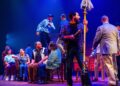
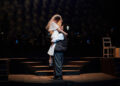
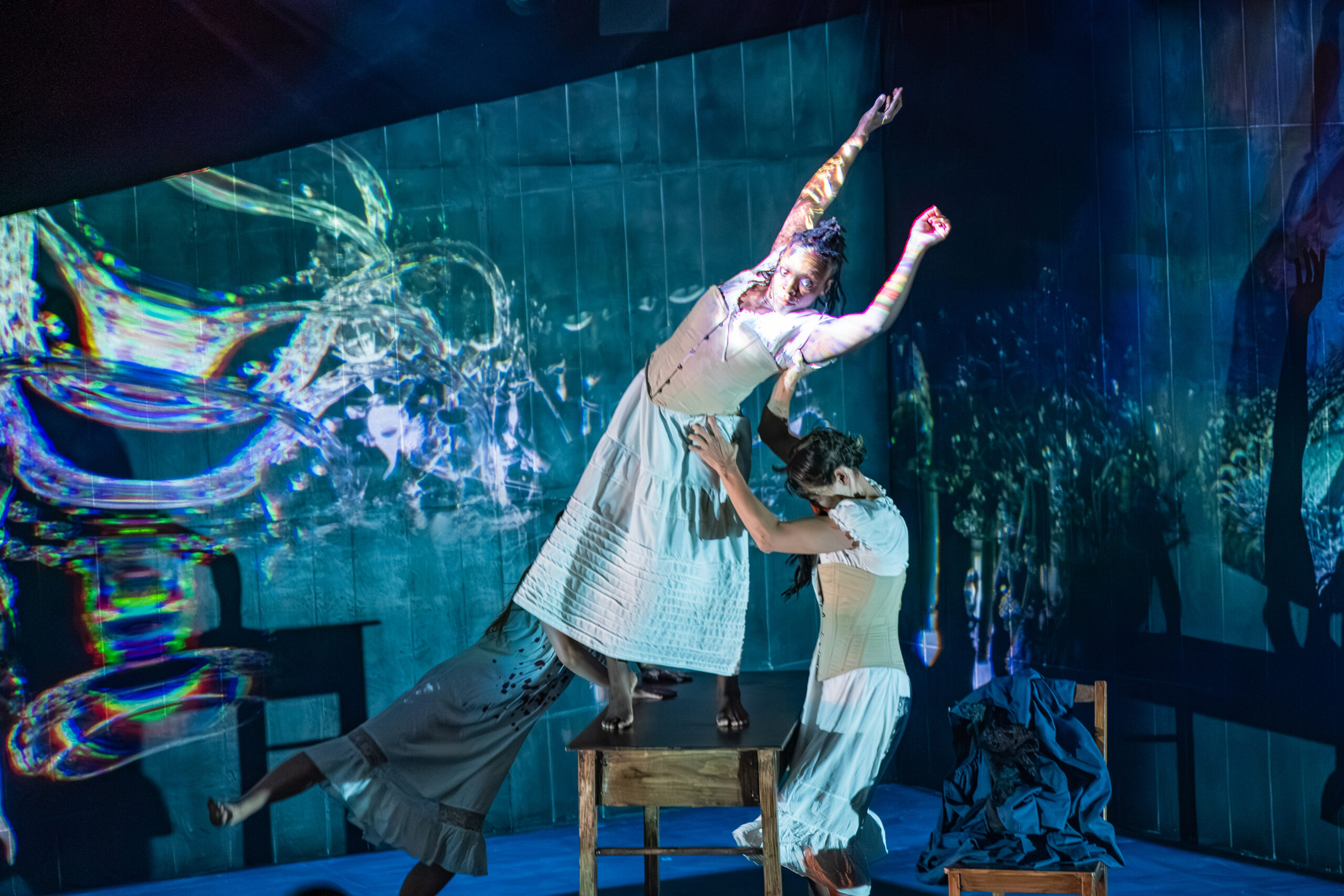
The image of a flame, alternately flickering and steady, recurs throughout and becomes haunting. André du Toit’s lighting creates shifting shadows across Jung-Hye Kim’s angular, spare Victorian set, where a table, an overturned chair, and a black top hat and coat establish a restrained visual vocabulary. The open set design arrangement also gives the performers room for fluid movement.
Three women—Dawn (Dawn Jani Birley), a Deaf actor, plays Madeline; Harriet (Nickeshia Garrick), a hearing actor; and Fanny (Juliana Monk), also a hearing actor—wait in the ancestral home of the man they call Father. The unseen patriarch shifts between apparent kindness and tyranny until the nature of his authority is revealed. As the story unfolds, Madeline, Harriet, and Fanny use speech, sound, and ASL to confront forces shaping their identities, agency, and survival. Their exchanges with one another and with the audience build toward an ending centred on sisterhood and revenge. The conclusion is deliberately unsettling, leaving the implications of what has occurred unresolved in the immediate silence that follows.
The production’s cumulative effect is forceful, although its impact depends less on surprise than on the disciplined coordination of performance and design.
The intimacy of the Jackman performance space amply supports the play’s emotional intensity. The three actors are onstage as the audience enters, silently observing the spectators in the house. Their occasional glances toward one another establish an atmosphere of anticipation before the narrative begins.
That direct relationship with the audience is central to the production’s approach.
Its strongest device is the deliberate contrast between hearing and Deaf experiences.
Deanna H. Choi’s escalating sound design gives hearing audience members an immediate aural route into scenes of oppression and internalization. The production also acknowledges that Deaf spectators may encounter those moments differently, making that difference part of the work rather than treating accessibility as an addition.
Laura Warren’s projection design extends the production’s visual language, while passages communicated only in ASL temporarily deny hearing, non-signing spectators immediate access to meaning. The reversal is pointed: rather than explaining exclusion, the production briefly makes part of the audience experience it.
Director Josette Bushell-Mingo maintains a precise, sustained pace as the story develops. Her staging keeps the focus on the three women and on the effects of Father’s control without overplaying the production’s Gothic elements.
Dawn Jani Birley, Nickeshia Garrick and Juliana Monk anchor the production with fervour and exhilaration. Cellist Beth Silver underscores wordless passages with restrained, unsettling musical selections that support rather than overwhelm the action. Birley, Garrick and Monk deliver controlled performances as women refusing silence, regardless of the language they use. Their ensemble work is especially clear in the pre-show sequence, when knowing shared looks and smiles establish both solidarity and readiness. Movement is purposeful throughout, including a demanding sequence in which all three rapidly mount the table during an emotionally charged scene.
To A Flame is a carefully integrated production whose performances and design give theatrical form to questions of language, access and authority. A post-show talkback, when offered, provides additional context for those themes.
Running time: approximately 90 minutes with no interval/intermission.
The production runs to October 4 at the Nancy & Ed Jackman Performance Centre, 877 Yonge Street, Toronto. For tickets: https://www.nightwoodtheatre.net/to-a-flame/ or call (416) 944-1740.
A 1s1 Theatre and Nightwood Theatre co-production
In association with Modern Times Stage Company and Why Not Theatre presents
To A Flame by Erin Shields with English to ASL translation by Dawn Jani Birley
Directed & Choreographed by Josette Bushell-Mingo
Dramaturg and Associate Directed by Birgit Schreyer Duarte
Assistant Directed by Andrea Donaldson
Set and Costume Design by Jung-Hye Kim
Lighting Design by André du Toit
Composer and Co-Sound Design by Deanna H. Choi
Co-Sound Design by Jenna Geen
Projection Design by Laura Warren
Assistant Projection Design by MacKenzie Cornfield
Stage Managed by Sally Roberts
Assistant Stage Managed by Michelle Soicher
Production Managed by Maya Royer
Technical Direction by Micah Champagne
Carpentry by Dale Sharp Jnr.
Nightwood Theatre Shadow Resident in Lighting Design – Dylan Carter
Performers: Dawn Jani Birley, Nickeshia Garrick, and Juliana Monk, accompanied by cellist Beth Silver