

Sometimes, musical theatre surprises more than one might expect.
The Canadian premiere and touring production of The Karate Kid, The Musical, now on stage at Toronto’s Princess of Wales Theatre, certainly does.
I don’t know why, but I went to the theatre expecting an opening night that wouldn’t cut it for me. Some pre-show seats were going for $49. Was this a sign that something wasn’t boding well for the show that was about to open?
I’m happy to say I was wrong.
The Karate Kid, The Musical is worth seeing.
Set in 1984, Mr. Miyagi (Adrian Pang) breaks the fourth wall and addresses the audience before returning to events three months earlier. Seventeen-year-old Daniel LaRusso (Gino Ochello) and his widowed mother, Lucille (Jodie Jacobs), have moved from New Jersey to Encino, California. Lucille views the relocation as a fresh start despite the family’s financial constraints. At school, Daniel befriends Freddie Fernandez (Finley Oliver) and develops a mutual attraction with Ali Mills (Abigail Amin), who has recently ended a relationship with Johnny Lawrence (Joe Simmons), the leading student at the Cobra Kai dojo run by Sensei John Kreese (Matt Mills).
After Johnny and his peers assault him, Daniel learns that Mr. Miyagi is a master of Okinawan karate. Miyagi agrees to train him in self-defence ahead of the All-Valley Karate Tournament.
With Book by Robert Mark Kamen, Director Amon Miyamoto stages the touring production with close attention to the 1984 film’s themes of tolerance, conflict resolution and personal responsibility. The production’s emphasis on dignity and reconciliation is established early and sustained through the opening-night performance. Drew Gasparini’s musical composition and lyrics are decently theatrical.
Miyamoto maintains a fluid pace and gives the ensemble a clear dramatic purpose. Peter Nigrini’s projections provide a strong visual framework, while Bradley King’s lighting distinguishes effectively between the production’s more abrasive and reflective passages.
Andrew Resnick’s arrangements of Drew Gasparini’s score give both ensemble numbers and solos a varied musical texture. In several crescendos, however, the orchestra overpowers the singers, making portions of the lyrics difficult to discern. This imbalance is a notable issue in Kai Harada’s sound design and can hopefully be rectified in future performances.
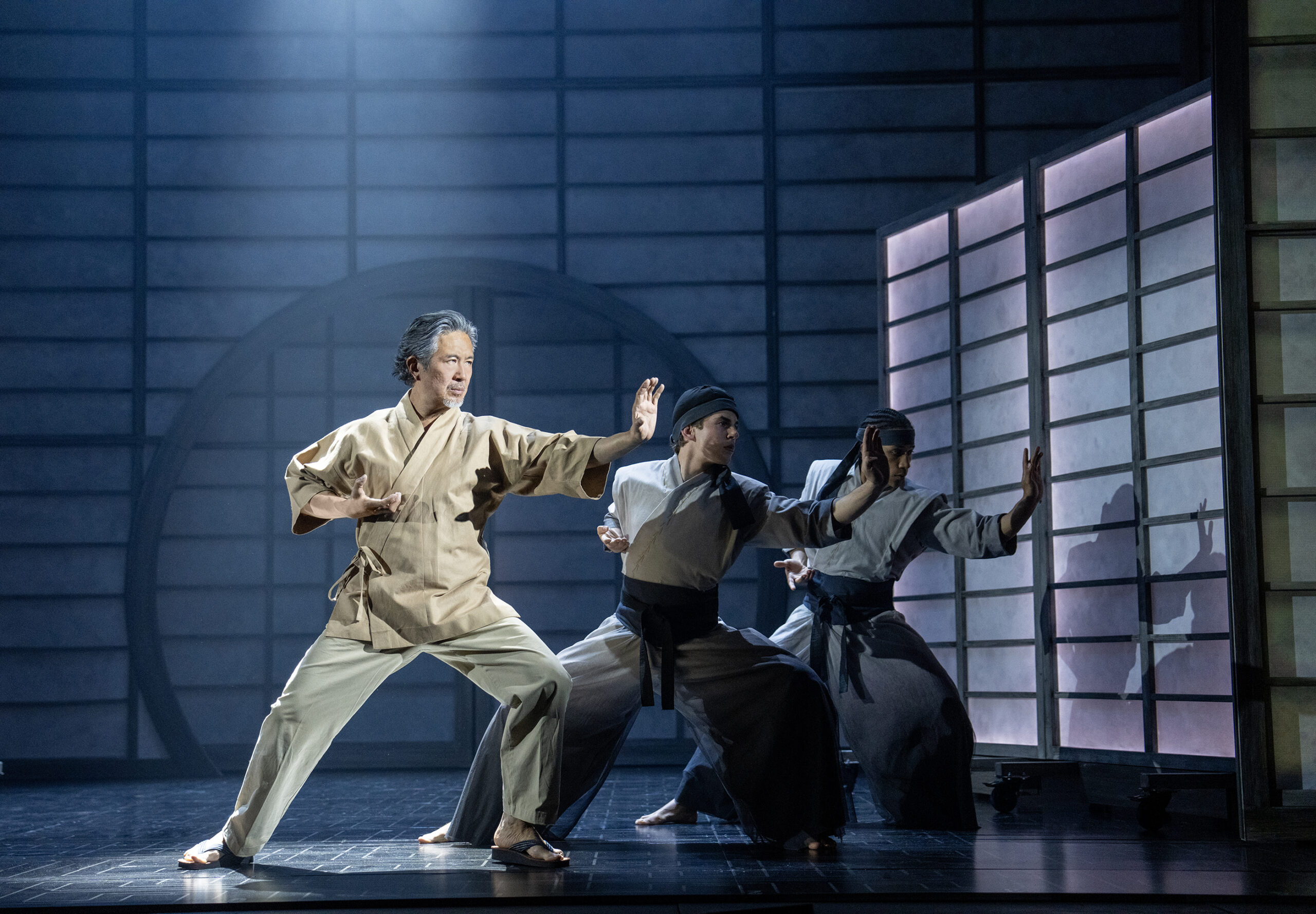
Choreographers Keone and Mari Madrid heighten the production’s physical intensity while using several ensemble dancers to represent chi, the vital life force in Chinese philosophy, during Miyagi’s scenes. Dressed in Ayako Maeda’s restrained soft-grey costumes, these performers remain visible without distracting from the principal action. The final karate tournament is staged with bright colour and forceful movement, with the chi ensemble positioned alongside Daniel and Miyagi.
In his brief onstage moments, Finley Oliver gives Freddie Fernandez an affable presence that contrasts with Daniel’s reserve. Abigail Amin plays Ali Mills with warmth while avoiding a one-dimensional portrayal of Californian upscale privilege. As Lucille, Jodie Jacobs conveys a parent focused on rebuilding the family’s life, initially unaware of the difficulties Daniel faces at school. Her performance of ‘If I Could Take His Pain Away’ provides the character’s clearest emotional turn, as Lucille recognizes Daniel’s need for independence. Joe Simmons delivers a solid performance as an aggressive, spiteful bad guy who changes significantly and ultimately sees the light.
The central performances by Mills, Ochello and Pang anchor the production.
In a jet-black costume that evokes yin, Matt Mills presents John Kreese as physically imposing and emotionally unyielding. In ‘Strike First. Strike Hard. No Mercy’, his firm vocal delivery is matched by hard-edged choreography, with Kreese and the Cobra Kai students moving in tightly coordinated patterns. Adrian Pang gives Mr. Miyagi a restrained, grounded presence, emphasizing authority through stillness rather than bravado. A second-act exchange between Miyagi and Daniel is handled with comparable understatement. Gino Ochello charts Daniel’s development from a shy newcomer reluctant to attract trouble into a more assured young man. His scenes with Amin establish the tentative quality of Daniel and Ali’s relationship.
Ochello and Pang establish a convincing rapport during the karate lessons, supported by the placement and movement of the chi ensemble. Their attentive exchanges carry into the climactic tournament, giving the action a clear dramatic foundation.
The final sentence of the director’s note states the musical’s governing idea: “Peace is not a distant ideal — but a choice we make, together.”
That aspiration is sometimes stated more directly than it is dramatized, but it gives the adaptation a coherent moral framework. As a touring production and Canadian premiere, The Karate Kid, The Musical combines assured performances and polished stagecraft with a score whose impact is occasionally reduced by the sound balance.
The result is a clear, visually accomplished adaptation that respects its source material while leaving room for technical refinement.
Running time: approximately two hours and 30 minutes with one intermission.
The production runs to November 1 at the Princess of Wales Theatre, 300 King Street West, Toronto. For tickets: mirvish.com or call 1-800-461-3333.
MIRVISH presents
The Karate Kid, The Musical
Book by Robert Mark Kamer and Composer and Lyrics by Drew Gasparini
Directed by Amon Miyamoto
Choreographers: Keone and Mari Madrid
Music Arrangements and Music Supervisor: Andrew Resnick
Scenic Design: Derek McLane
Costume Designer: Ayako Maeda
Lighting Designer: Bradley King
Sound Designer: Kai Harada
Projection Designer: Peter Nigrini
Performers: Adrian Pang, Gino Ochello, Abigail Amin, Matt Mills, Jodie Jacobs, Joe Simmons, Finley Oliver, plus the company ensemble listed in the programme.