

Shakespeare’s influence is evident in playwright Ho Ka Kei’s (Jeff Ho) exploration of language, prophecy and the power of words. As the play unfolds, a second literary reference comes into sharper focus: Edward Albee’s Who’s Afraid of Virginia Woolf?, particularly in the play’s unsettling domestic tensions and final reckoning.
The title of Ho’s play refers to a woman believed to predict future events or communicate divine messages, a definition that informs the play’s treatment of foresight, belief and interpretation.
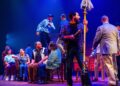
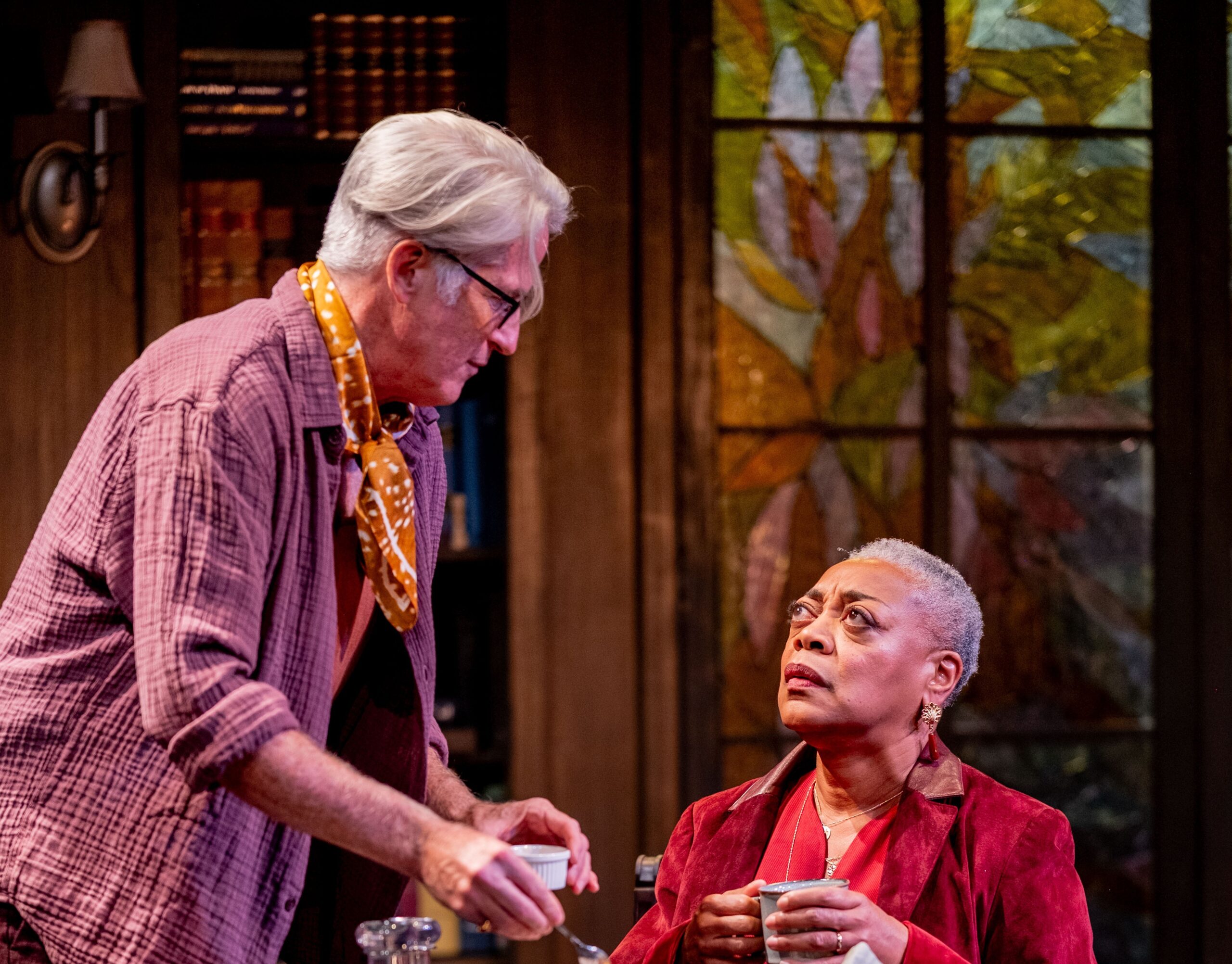
As the audience enters Tarragon’s mainstage auditorium, Logan Raju Cracknell’s shadowed lighting reveals designer Jawon Kang’s wood-panelled academic setting and stained-glass window at a fictionalized York University, lined with neatly shelved books. The efficiently detailed environment establishes a credible space for the discussion, debate, reading and critical inquiry that follow.
After the lights fade, Margaret (Karen Robinson), chair of York University’s English department, speaks from the darkness for several minutes. Her command of etymology and fascination with language emerge immediately, although the monologue’s references to Shakespeare’s history plays are not always readily accessible without further context.
Margaret’s lessons on the etymology of the word fuck provide moments of humour amid her recurring nightmares about spiders. Over breakfast, she tells her husband, Henry (Rick Roberts), that the creature from her dream has appeared in waking life. The spider speaks, growls and issues curses, intensifying Margaret’s unease and establishing the play’s unstable boundary between perception and reality. The imagery suggests stress, anxiety and entrapment without fixing those associations to a single interpretation.
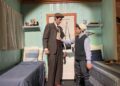
She begins the first day of term at York distracted and preoccupied. Along with her dreams from the night before, Margaret is also aware of university politics and procedures which can become rather nasty. Anne (Natasha Mumba), an associate professor of English, is also introduced on her first day. Margaret invites Anne to dinner, but their exchange takes a troubling turn when Margaret sees spiders on Anne’s face and slaps her—an evident violation with serious professional consequences.
During Margaret’s lecture, Elizabeth (Christine Horne) of York’s Human Resources department appears at the lecture-hall door to address the incident. The interruption creates an immediate confrontation, but approaching a professor in the middle of class rather than through a more conventional administrative process strains credibility.
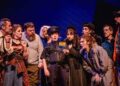
The visual design is central to the production’s storytelling. Ting-Huan (挺歡) Christine Urquhart’s contemporary costumes distinguish the characters effectively, while one of Rick Roberts’s entrances produces a clear comic response. Laura Warren’s projections contribute an eerie, unsettled atmosphere. Near the conclusion, Elizabeth’s presentation of white roses to Margaret, and Margaret’s subsequent position among them, creates a pointed visual contrast with the reason for the human-resources representative’s visit.
Prophetess is less persuasive when its references to Shakespeare’s history plays become densely layered. Extended exposition and wordy dialogue occasionally obscure, slowing the dramatic momentum. Greater compression would sharpen the distinction between the play’s intellectual ambitions and its theatrical impact.
Under Mike Payette’s assured direction, Robinson is the production’s principal asset.
She brings authority, precision and emotional control to Margaret’s shifts from humour (the door slamming in Anne’s face) to the despair of lying prostrate in the strewn white flowers, which remains haunting to watch even when the dialogue becomes overextended. Rick Roberts provides steady support as Henry before making a striking comic pivot as Dicky, while Natasha Mumba gives Anne credibility and Christine Horne brings procedural resolve to Elizabeth.
In his director’s programme note, Payette writes that Ho invites the audience into the world of academia while examining the power, origins and meanings of words. Shakespeare’s history plays provide one frame for that inquiry; the play’s domestic conflict and final reckoning also invite comparison with Edward Albee’s Who’s Afraid of Virginia Woolf?
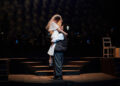
That Albee parallel becomes especially apparent in Robinson’s final moments. The closing sequence is played with enough restraint to leave a brief silence before the opening-night applause, indicating the scene’s unsettling effect.
Prophetess is most persuasive as a showcase for Robinson’s disciplined and commanding performance, even as its text would benefit from further refinement.
Running time: approximately 90 minutes, with no interval.
The production runs to October 29 on the Mainstage at Tarragon Theatre, 30 Bridgman Avenue, Toronto. For tickets: tarragontheatre.com or call (416) 531-1827
PROPHETESS by Ho Ka Kei (Jeff Ho)
Directed by Mike Payette
Set Designer: Jawon Kang
Costume Designer: Ting-Huan (挺歡) Christine Urquhart
Projection Designer: Laura Warren
Lighting Designer: Logan Raju Cracknell
Design Shadow: Owen Carrier
Stage Manager: Emilie Aubin
Performers: Karen Robinson, Christine Horne, Natasha Mumba, Rick Roberts