

Stephen Schwartz’s Pippin has always promised audiences “Magic to Do.” Bowtie Productions hopes to deliver on that promise next month at Toronto’s Factory Theatre, where director Olivia Daniels is reimagining the musical for a new generation.
My own fascination with the show began years ago, when I saw Ben Vereen perform its opening number on YouTube, backed by an ensemble that included Chita Rivera and Ann Reinking. The music—and the jazzy snap of Bob Fosse’s choreography—made Pippin a show I wanted to see live. However, when a later production arrived at Toronto’s Royal Alexandra Theatre with former Monkee Micky Dolenz as Charlemagne, it fell flat. Several people around me left at intermission.
Interest in the musical surged again with the circus-inspired 2013 Broadway revival, an award-winning production that later toured. More than a decade on, Pippin may be ready for another reinvention.
Bowtie’s production offers that opportunity. The company describes the musical as the story of a young man searching for happiness and purpose while travelling with a troupe of performers who may—or may not—have his best interests at heart. Pippin wants to find his place in the world: his own “Corner of the Sky.”
Director Olivia Daniels and W. Joseph Matheson, who plays Pippin’s father, King Charlemagne, recently spoke over Zoom about the new staging and why the show still resonates.
For Daniels, the answer begins with Bowtie itself.
She pitched Pippin to the emerging company earlier this year, seeing a natural connection between its young artists and a protagonist standing on the cusp of adulthood. In this production, the story begins on the eve of Pippin’s high-school graduation:
“Being familiar with many of the creative individuals behind the scenes at Bowtie, who better than twenty-some emerging artists to tackle Pippin’s story?” Daniels said. “These artists are going through the same experiences as Pippin—finding their corner of the sky in the industry, reaching for something bigger or making something of themselves.”
Matheson brings a longer history with the musical. He first played Charlemagne in a 2003–04 production when the Iraq War took a toll overseas. Returning to the role more than two decades later with conflict now in Iran, Matheson sees renewed urgency in a story about a young person challenging inherited assumptions:
“We need someone who refuses to accept ‘that’s how it’s always been done’ as an answer,” he said. “Pippin doesn’t always find the easy answers. There’s a sense of getting one’s hands dirty and being involved. And isn’t that how life is right now in our world? There is no easy nuts-and-bolts answer.”
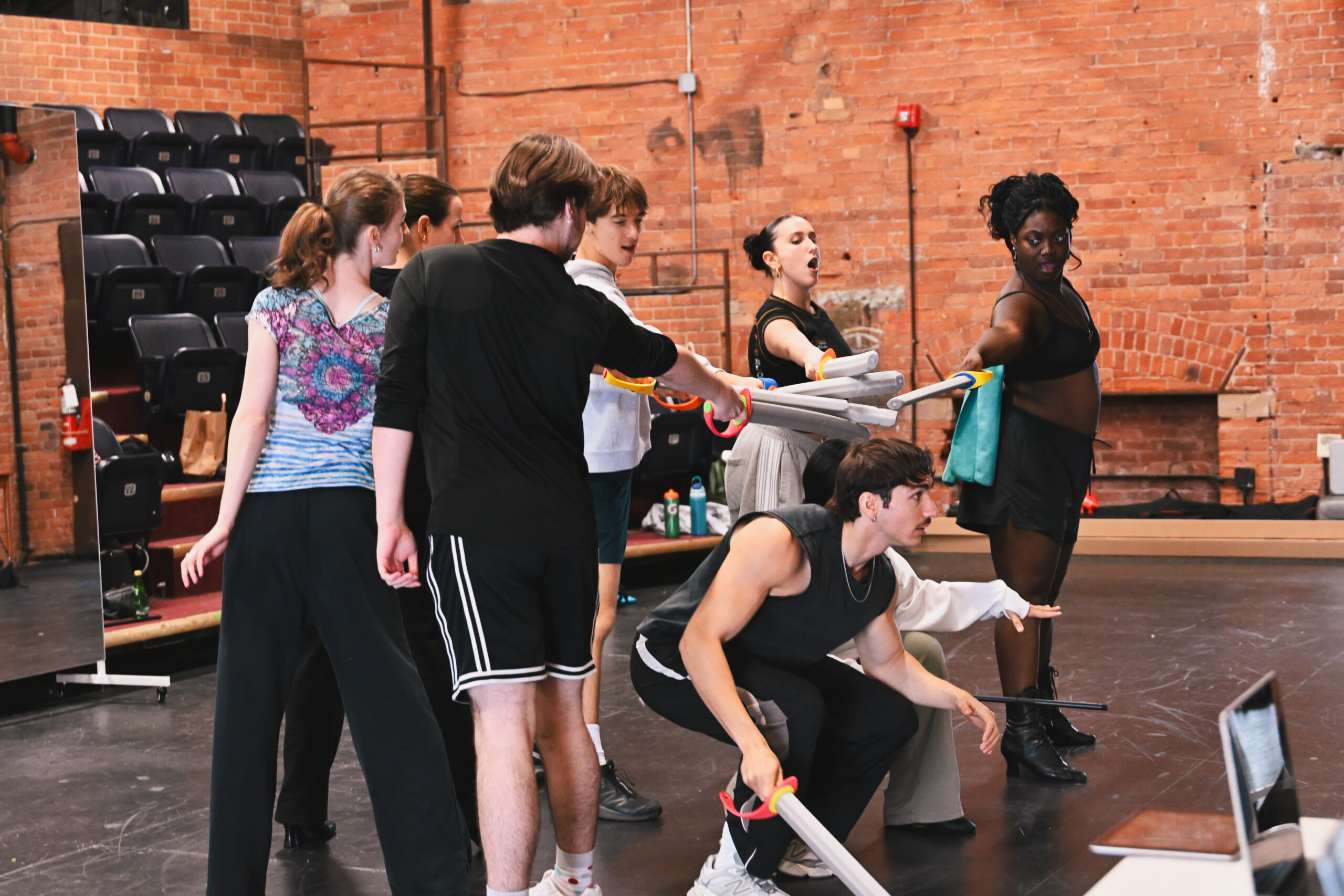
When we spoke via Zoom, the cast had completed its first week of rehearsals. Daniels said scheduling a large company had presented the expected challenges, but the creative team front-loaded the music and choreography. She was preparing to stage an intense scene with Matheson and Anthony Palermo, who plays Pippin.
Daniels said the production will emphasize Pippin’s continuing education: his effort to think for himself and learn from his mistakes. Matheson noted that the musical can be staged with stark abstraction or lavish spectacle. Whatever the approach, he said, its quieter and more detailed moments must not be sacrificed for entertainment. The jokes and pratfalls remain, but he wants audiences to experience Daniels’s interpretation.
The visual concept is central to that interpretation. Daniels plans to transform the auditorium into an abandoned church, drawing inspiration from the golden arch on Factory’s mainstage. The design will leave ample room for purposeful movement, with the band visible onstage.
The production imagines Pippin as a story told repeatedly by the same troupe of actors, setting the space’s weathered architecture against the musical’s colour and energy.
“I want to lean into the hallowed feeling of the Factory and of storytelling,” Daniels said. “For modern audiences, it’s the marriage of the old, broken-down structure with bright lights, bright music, spectacle and dance. Don’t look at the man behind the curtain. Instead, focus on the show. A stained-glass window with the sun will become a focal point.”
The show’s sexual innuendo and double entendres may land differently with contemporary audiences. The first thing that comes to mind is Pippin’s cougar grandmother, Berthe, singing ‘Time to Start Livin’. Matheson, though, points out that Pippin was conceived in the 1960s and reached the stage in the early 1970s, as social values and conventions shifted across North America amid the ‘Free Love’ mentality. He still laughs when people ask whether the musical is a little risqué.
His advice is simple: arrive with a sense of humour. Bowtie’s Pippin aims to balance the musical’s playful provocations with its enduring questions about ambition, purpose, and the difficult work of finding one’s own corner of the sky.
Producer Ian Kowalski, Daniels and Music Director Jo O’Leary-Ponzo and Choreographer Meredith Shedden can’t believe they are tackling Pippin. They continue reminding themselves they’re actually going to do this. Bowtie has taken classics over the years to perform, but the company also looks to see if there might be issues challenging the staging, and that’s what the company likes to do – challenge itself with trying something daring and different.
What message do Daniels and Matheson hope audiences will take away from Pippin?:
Matheson comes from an Irish background, and he fondly quoted what his mother would say:
“The blessing on the Irish, the men that God made mad, for all their wars are merry, and all their songs are sad.”
Pippin tries so hard to find answers in life, only to find there are none. Sometimes, keeping on and keeping going is the best one can do: loving someone, believing someone and letting someone in. These things don’t guarantee anything, but that’s the only way to be human and to embody one’s own humanity.
You can find the cast list and ticketing link here: https://bowtieproductions.ca/pippin. The production runs November 15-21 at Toronto’s Factory Theatre, 125 Bathurst Street.