

“No, I don’t think poems will save us. And yet, and yet.” So once tweeted American spoken-word poet Sarah Kay, back when X was still named Twitter.
With one sentence and two abrupt fragments, Kay raises an enormous question and refuses to answer it. Instead, she opens the narrowest of cracks between art and change, inviting the reader to peer through it. What lies beyond? That is left for us to discover.
Perhaps Kay’s unresolved “and yet” is what Jeff Ho’s buoyant Pastoral could use a little more of.
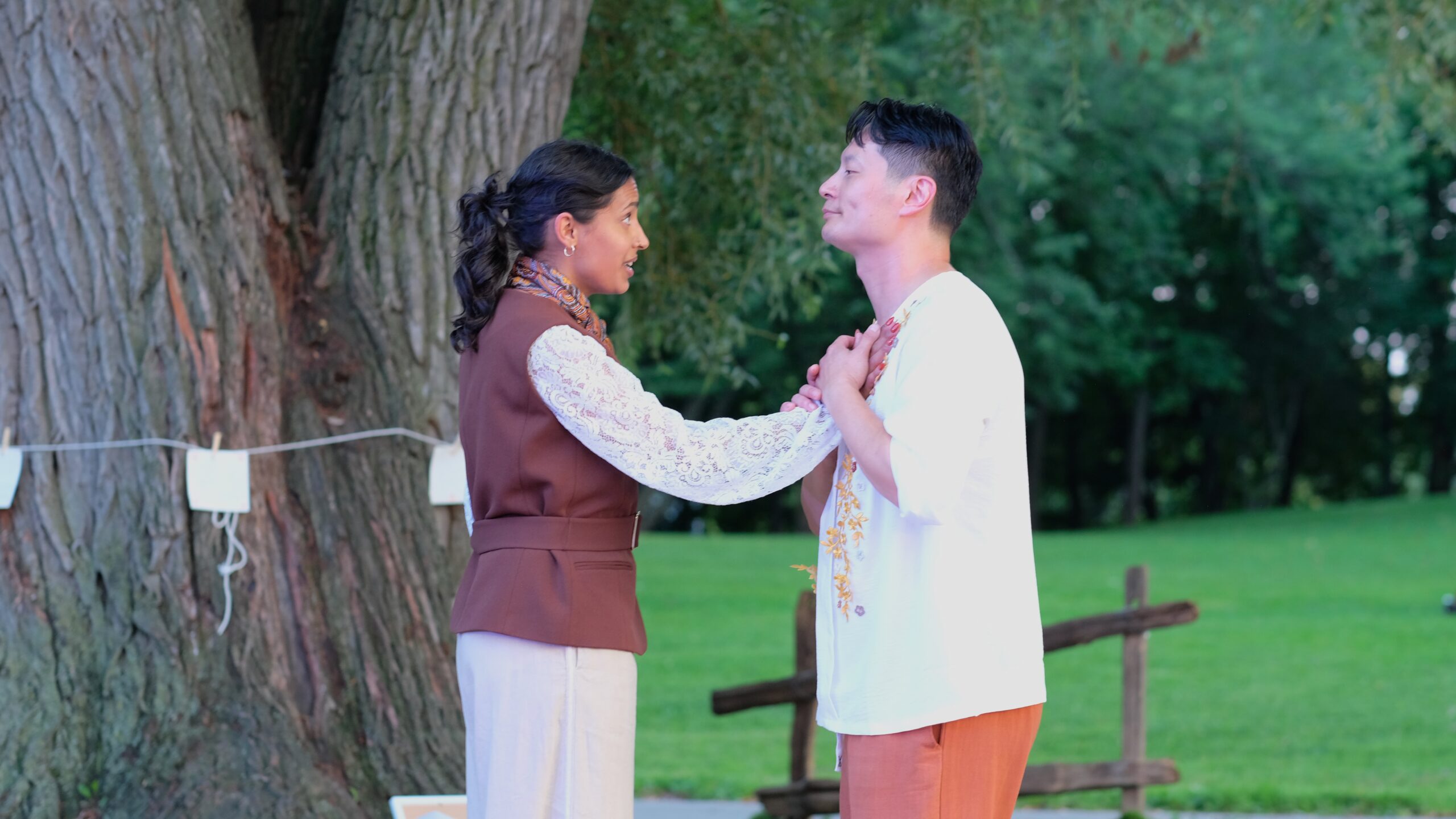
Performed amid the picturesque greenery of Withrow Park, this Shakespeare in the Ruff production brings comic effervescence to questions of environmental activism. Conceived as a sequel to As You Like It, the show foregrounds the tension between the human and nonhuman that runs through Shakespeare’s comedy, yet its political ambitions occasionally overwhelm the narrative.
Still, the show’s energetic performances fizz with comic exaggeration. There is air in Warona Setshwaelo’s low-tech direction. The first half, especially, moves like a breeze, with performers flitting like birds between the audience and the “stage” — a large sheet stretched across the ground, with two trees behind it forming a kind of natural skene.
Pastoral begins two years after Shakespeare’s play ended with its flurry of marriages and Jaques’s decision to pursue a life of contemplation rather than return to court. In Ho’s continuation of that world, the characters fall into two camps: those clinging to the past and those impatient to build the future.
Orlando (Jeff Yung) and Rosalind (Reese Cowley) are indefatigable custodians of the past, mining their relationship’s history with absolute devotion. On their anniversary, the lovebirds return to the forest to role-play the moment that sealed their union. They recite Shakespeare’s lines with syrupy intensity, filming the ritual on a smartphone. They have even conscripted Rosalind’s cousin Celia (jonnie lombard) as witness and videographer.
Celia, however, is thoroughly uninterested. lombard moves with the lightness of a butterfly, arms opening like wings as they dart across the space, barely looking up from their phone. Apparently, not everyone shares the couple’s sentimental attachment to “once upon a time.” Construction workers, after all, have taken over the Forest of Arden. Armed with chainsaws (don’t worry, they’re fake) and trailed by smoke (oh, that is very real), they prowl the trees, threatening its pastoral idyll. Modernity comes knocking, led by the business-minded Oliver (Norman Yeung).
But the forest is not empty land. It is home to animals, plant life and, for the past two years, Jaques (Asher Rose). After two years living in the forest without social contact, this once-upon-a-Duke resembles a comic Robinson Crusoe by way of Cast Away — except that, instead of a volleyball for a best friend, he has a beloved deer named Zoe. Rose captures the character’s volatile sensitivity through elastic facial contortions, their features widening and tightening with cartoonish flair. Near the end, Jaques chains himself to a tree in an act of resistance. Yet no one appears to notice — so futile does his gesture seem.
What can these characters do against the march of modernization? Very little. That sense of impotence is among the script’s most suggestive ideas.
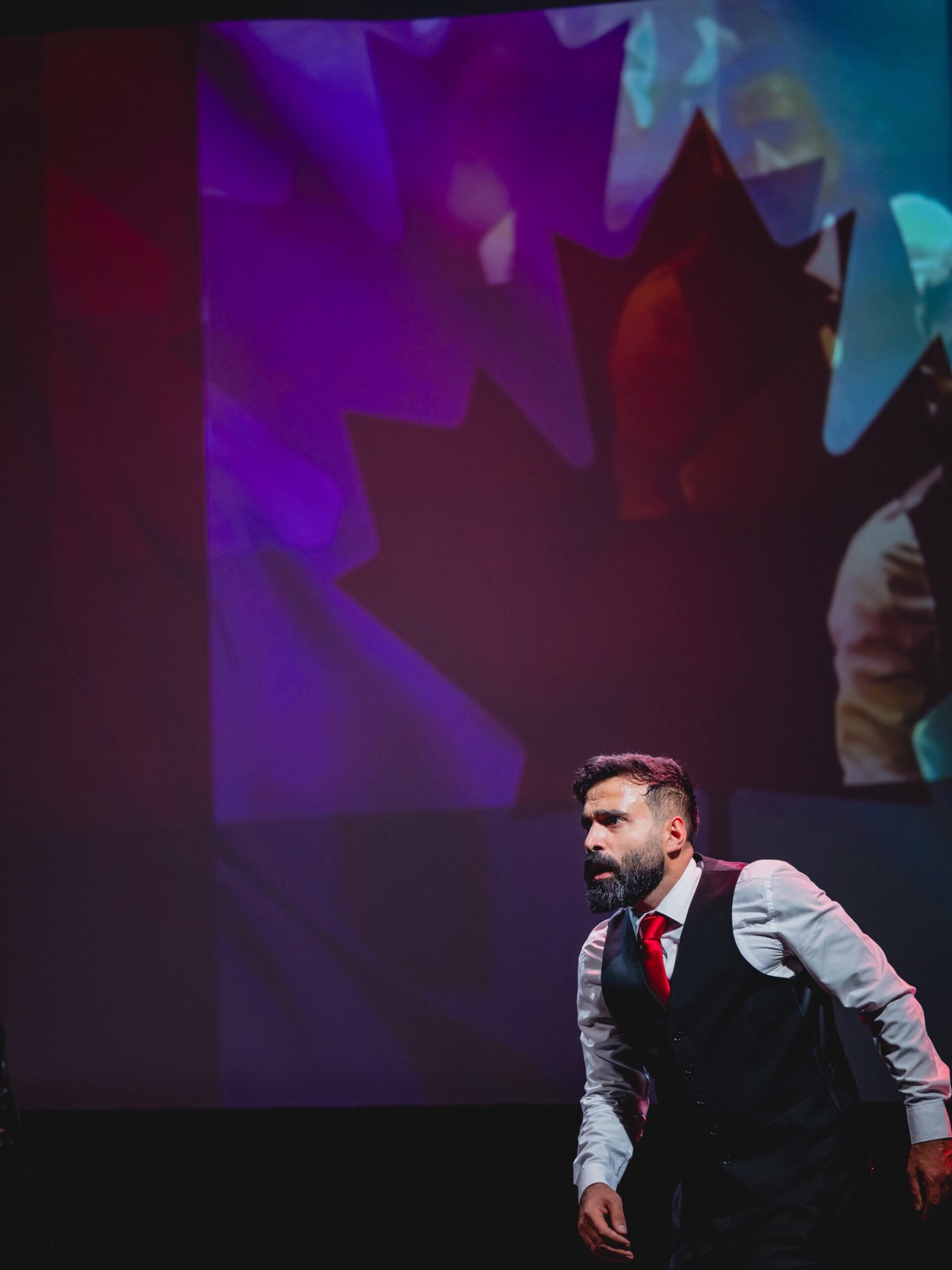
Faced with everyone’s refusal to take responsibility for what is happening in the forest, Yung’s Orlando curls up on the ground and screams into the grass as though it were a pillow into which he could smother his despair. What follows, however, is a lengthy monologue that Yung delivers with passion and dexterity but that ultimately feels superfluous. The script desperately tries to go beyond Kay’s “and yet.”
Throughout the play, past and present wrestle with one another. Ho’s language alternates between Shakespearean(ish) flourishes and sharply contemporary slang, while video calls and jokes about Doug Ford blur temporal and geographical boundaries. We are simultaneously in Shakespeare’s Forest of Arden and present-day Toronto. The instability is satirically fertile but politically diffuse, especially because the play’s sharpest barbs seem aimed at those resisting environmental destruction. Jaques is eccentric and isolated, while Orlando’s resistance is fuelled by nostalgia and proves equally ineffectual.
Perhaps Pastoral works best as a family show. Its brisk pace suits younger audiences, while its playful approach offers an accessible entry point into environmental questions. Truly, accessibility is one of the production’s most considered choices. At the beginning, performers introduce themselves and describe their clothing for blind and low-vision spectators. During the show, a screen provides live captions, making dialogue easier to follow in an unamplified outdoor production while supporting Deaf and hard-of-hearing audience members. These thoughtful measures challenge ableist assumptions about who belongs in an audience and how theatre can be experienced. Perhaps change begins with these small gestures.
No, I don’t think theatre will change the world. And yet, and yet.
Running time: approximately 80 minutes with no intermission.
The production runs until August 30 at Toronto’s Withrow Park, 725 Logan Avenue, Toronto. For tickets and other information: www.shakespeareintheruff.com.
SHAKESPEARE IN THE RUFF presents
Pastoral, A Sequel to As You Like It by Ho Kai Kei (Jeff Ho)
Producer: Janice Peters Gibson
Directed by Warona Setshwaelo
Set and Prop Design: Amelia Blaine
Costume Design: Julia Kim
Lighting and Sound Design: Chris-Liz
Stage Manager: Alysee Szatkowski
Production Manager: Jacob Beecher