

A moment near the end of Act One unfortunately bursts the illusion created too quickly.
Director Peter Fernandes describes Sleuth as a “cozy mystery,” combining an elaborate country-house setting with a contest of manipulation and deceit. The choice of a fifty-year-plus British script raises questions about whether future seasons might also make room for contemporary or Canadian mysteries.
For now, however, Sleuth remains an engaging vehicle and a carefully controlled series of reversals and shifting power
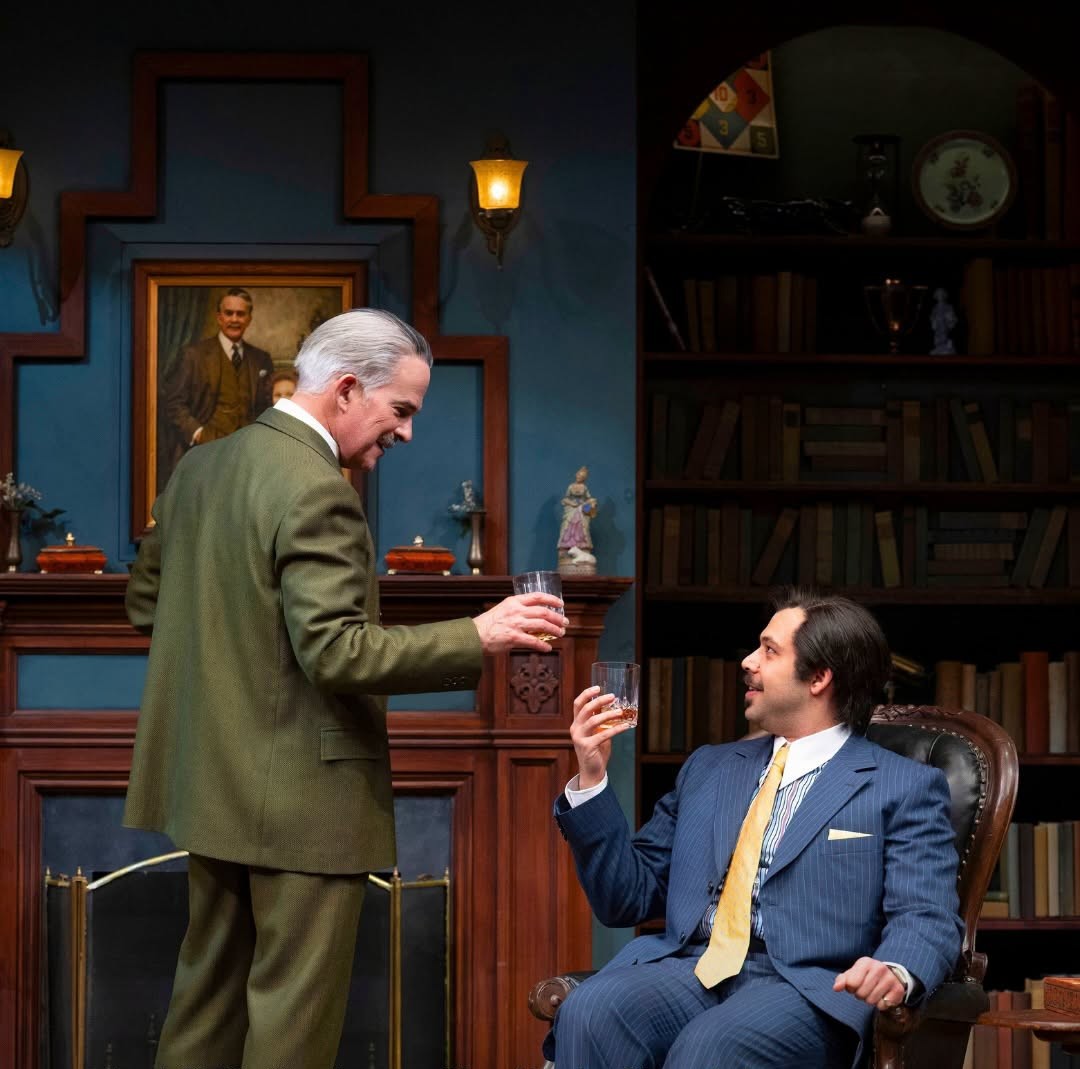
Its principal strength is the sustained tension between Andrew Wyke (Patrick Galligan), a successful mystery novelist, and Milo Tindle (Sepehr Reybod), the lover of Andrew’s absent wife, Marguerite. Their meeting at Andrew’s country estate becomes a series of psychological games with potentially dangerous consequences.
Sim Suzer’s striking drawing-room set, located in a Norman manor house in Wiltshire, fills the Fleck Theatre stage and suggests both grandeur and latent menace. The detailed room feels inhabited rather than decorative, while a sailor doll whose programmed laugh periodically interrupts the action heightens the unease.
At the opening, Andrew Wyke reads aloud from his latest manuscript before a doorbell announces Milo Tindle (Sepehr Reybod). Andrew has invited Milo to the estate to discuss the affair with Marguerite, but the encounter soon becomes a contest of wit and control. Their ensuing conversation gradually reveals the extent of Andrew’s manipulative personality and his determination to control the encounter. As the plot expands, Inspector Doppler (Philip Mayfield), Detective Sergeant Tarrant (Liam McNulty) and Police Constable Higgs (Stanley Rushton) appear to draw the conflict toward police scrutiny.
Shaffer’s script contains dark humour and black-comic undertones, but its exposition-heavy first act requires close attention. Fernandes generally maintains a crisp pace, treating the dialogue between Wyke and Tindle like a fast exchange of a tennis game volley in which each line attempts to regain the advantage. Fernandes’ staging positions the actors like chess pieces, reinforcing the calculated nature of their manoeuvres. That precision weakens somewhat in the second act with the arrival of Mayfield’s Inspector Doppler. Although the scene retains its intrigue, the performance does not consistently sustain the tension generated by the earlier confrontation. The inspector frequently avoids direct eye contact with Andrew, reducing the sense that he is closely assessing a possible suspect.
Galligan gives Andrew’s narcissism and bluster a controlled comic edge without pushing the character into caricature. His assured delivery establishes a man accustomed to exercising authority, particularly within the carefully constructed environment of his own home. Reybod initially presents Milo as hesitant and uncertain, then convincingly shifts into gleeful abandon when Andrew reveals his proposition. The transition is convincing, allowing the balance of power between the two men to shift as the encounter becomes increasingly unpredictable. Together, Galligan and Reybod establish the competitive dynamic essential to Shaffer’s play. Their exchanges sustain much of the production’s dramatic momentum, particularly when the dialogue moves between apparent civility and barely concealed hostility.
Joyce Padua’s costumes sharpen the characters’ contrasting personalities. Whether the production is set specifically in the 1970s remains unclear, but the ambiguity does not interfere with the plot.
One avoidable distraction occurs at the end of Act One, when an usher opens a theatre door before the house lights rise, prematurely interrupting the impact of an important stage illusion. Delaying the door opening would allow the moment to register fully.
The central question is whether a play written more than half a century ago can still engage a contemporary audience.
The response at the opening matinee suggested that it can. The audience received the production warmly, and several creative choices allow the familiar material to be seen afresh. John Gzowski’s pre-show soundscape is especially effective. Henry Mancini’s “The Fall Out” wittily anticipates the plot’s revelations, while Gzowski’s sudden sound effects heighten the tension a mystery requires.
As the two-theatre partnership between Harbourfront and Shaw develops over the next three years, contemporary mysteries could broaden its repertoire and provide a useful counterpoint to established works such as Sleuth.
The Harbourfront Centre season continues with A Christmas Carol and Ohio State Murders.
Running time: approximately two hours and 10 minutes, including one intermission.
The production runs to November 1 at The Fleck Theatre, 235 Queens Quay West, Harbourfront Centre, Toronto. For tickets: harbourfrontcentre.com or call (416) 973-4000.
SHAW FESTIVAL at Harbourfront Centre presents
Sleuth by Anthony Shaffer
Directed by Peter Fernandes
Set Design: Sim Suzer
Costume Design: Joyce Padua
Lighting Designer: Mikael Kangas
Original Music and Sound designed by John Gzowski
Production Sponsor: Colleen and Brian Johnston
The Cast: Patrick Galligan, Philip Mayfield, Liam McNulty, Sepehr Reybod, Stanley Rushton