

Why shouldn’t we want to be happy? Why shouldn’t we do everything possible to feel that way? There go hundreds of dollars spent on therapy sessions. Well-being workshops. Motivational podcasts. A whole philosophy of living built around the demand to stay positive. Shift focus. Breathe. Reframe. Try again.
“But what if you can’t?” asks Bowtie Productions’ Next to Normal. In Brian Yorkey’s script, every promised route back to wellness ends in failure. Fracture always wins out, just as it does in Tom Kitt’s score: wavering piano chords against the roar of drums, a jittery guitar line against a punctilious violin. Everyone strains towards cohesion. Everything threatens to split.
Shift focus. Hold. Breathe again.
The happiness mandate ticks away. It haunts each of us like an unrelenting moral duty. Somewhere inside the skull, a voice keeps repeating: “Life can upend you. Still, what are you going to do?”
(Breathe.) The Goodmans look like an ordinary family. And, as in any family, irritation is practically their love language. Dan is the textbook pater familias: devoted but permanently half a beat behind. His wife, Diana, is the family’s live wire. Their daughter, Natalie, squirms with adolescent embarrassment, while their son, Gabe, performs the usual swagger of teenage rebellion. But that is understandable: he’s almost 18.
What is there to fix?
(Fix it.) Diana has lived with bipolar disorder for years. With recurring hallucinations, she can no longer reliably separate what is real from what is not. She has tried therapy, psychiatry, medication, and even hypnosis. Nothing seems to hold.
In the close quarters of the Daniels’ Spectrum’s Aki Studio, April Rebecca plays her with glassy eyes and a wide, startled gaze. Every gesture is slow and hesitant. Even folding baby clothes becomes a small ritual held in grief’s flame. Her tight vibrato carries a tremulous delicacy; at full belt, the voice still retains a crystalline edge. When Diana erupts, the force seems to cut inward first. But if that force wounds the people around her, can she ever make amends?
(Fix it.) Natalie has spent her entire life in the shadow of her mother’s illness. She is 16. She should be the one allowed to be messy and unreasonable. Instead, she has learned to find calm inside structure. Playing Mozart’s sonatas grants her that refuge.
Aveleigh Keller is all guarded angles: a furrowed face, a body folded tightly inward, and a flinty look that pushes people away before they can fail her. She spends most of her time on the production’s only real set piece: a three-sided platform jutting out of the black-box gloom. From there, Natalie tries to rise above her family’s chaos with brittle self-determination. Her voice remains controlled and precise, as if discipline were a life raft. She is the only Goodman still expected to function. But is she supposed to fix this mess, too?
(Fix it) Gabe is. Never mind.
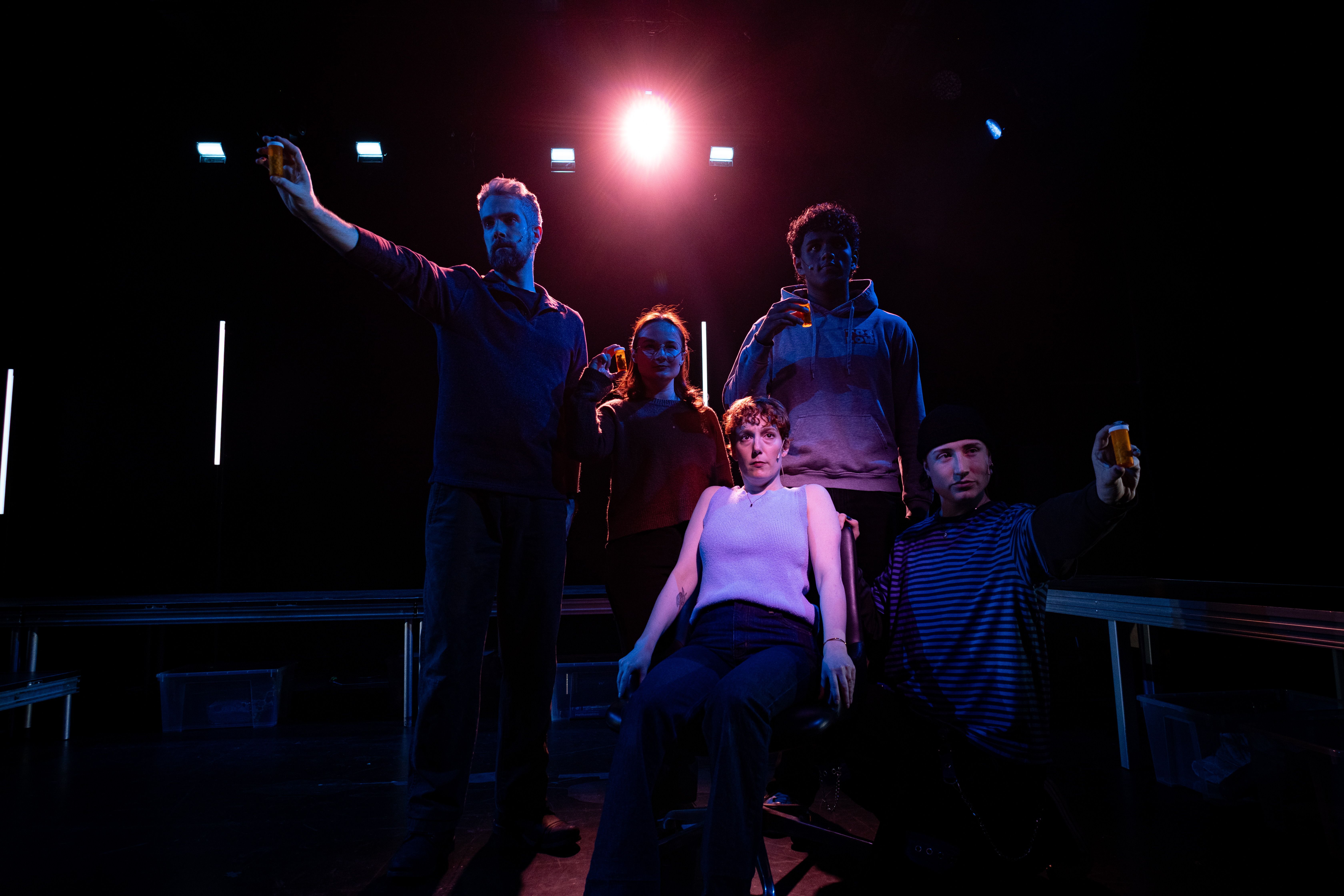
(Hold it together.) #StayPositive is Dan’s motto. He drives his wife to therapy appointments. He listens to Natalie’s complaints. And he maintains a brightness so insistent it begins to look like a strain. Taylor Long lets us see the mask through small asides to the audience: flashes of cheerfulness to bury the panic. Artificiality is his survival mechanism – much like the five vertical LED strips director Anthony Goncharov fires at the audience, their cold glare cutting straight into our eyes.
Dan is performing calm as hard as he can. It is his duty to keep the family from seeing how close they are to collapse.
(Breathe.) (Hold.) (Fix it.)
(Fix it.)
“I can’t fix what’s fucked up,” says Natalie’s schoolmate, Henry: 17, a musician, romantic, stoner, amateur philosopher, and way too idealistic. His fixations are weed, improvising at the piano, and Natalie. He would do anything for her – though Samel Sunil keeps that devotion from turning solemn. His line readings lighten the room; he deflects tension with irony and a gentle refusal to take himself too seriously.
Henry does not pretend to offer a solution. He cannot. What he offers is smaller, and perhaps more honest: presence. Persistence. Care.
(Let go.)
Can you really cut trauma off? Sever it cleanly? Can we simply live as though pain had no afterlife? As Diana’s doctors, Mich Anger supplies roof-raising vocals, but no real solution.
Goncharov’s staging moves with slowness, taking its time with denial. Characters try to convince one another that pain can be managed out of existence. Light strips flare intermittently, as if that anxious search for a cure had found a physical pulse.
Perhaps the harder task is not to solve anything, but to learn to breathe through the ache. To accept that we are hurting, and that we may never be “well” in the way we were promised.
Disappointments, farewells, and losses never really leave us.
We simply grow spacious enough to stay with them.
We learn to look at them.
In natural light.
Running from May 30 to June 6, 2026, at Native Earth’s Aki Studio, 585 Dundas St E, Toronto. Tickets available at: https://ca.patronbase.com/_NativeEarthPerformingArts/Productions/NN/Performances
Running Time: 2 hours 30 mins including a 15 min intermission.
Credits: Book and lyrics by Brian Yorkey; music by Tom Kitt; April Rebecca as Diana; Taylor Long as Dan; Aveleigh Keller as Natalie; Christopher Lyon as Gabe; Samel Sunil as Henry; Mich Anger as Dr. Fine/Dr. Madden; directed and scenic designed by Anthony Goncharov; associate and movement direction by Meredith Shedden; music directed by Michael Ippolito; produced by Ian Kowalski; costume and prop design by Emily Anne Corcoran; lighting design by Niall Durcan; sound design by Al Starkey and Erik Richards; stage management by Katie Van Bergeyk; assistant stage management by Talfryn Quiring; creative and art direction by Valentina Caballero