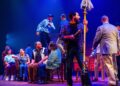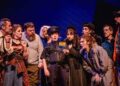


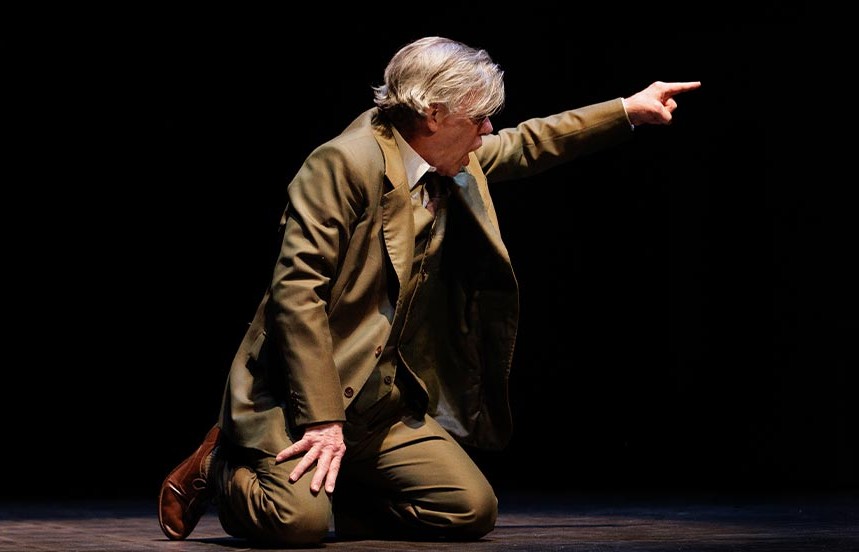
Still a fixture in many high school English classrooms, Arthur Miller’s Death of a Salesman remains a searing examination of the fragile promise of the American Dream. At its centre is Willy Loman (Tom McCamus), an aging travelling salesman whose career, confidence and sense of purpose are slipping away. He drifts in and out of memories and conversations with his deceased older brother Ben (David W. Keeley), while his devoted wife, Linda (Lucy Peacock), watches helplessly as the man she loves struggles to hold himself together.
Old wounds and unspoken disappointments haunt the Loman household. Sons Biff (Joe Perry) and Happy (Josh Johnston) stand as uneasy reminders of the ambitions Willy once held for his family. Biff returns home disillusioned and restless, and the resulting tensions between father and son make clear how thin the line is between hope and heartbreak in this play. Even its brief glimmers of reconciliation near the end of Act One feel painfully precarious.
Although the drama turns most powerfully on the fractured bond between Willy and Biff, Miller’s world extends beyond the immediate family to include Willy’s loyal neighbour Charley (Matthew Kabwe), his son Bernard (Raymond Strachan), and Willy’s boss Howard Wagner (Sean Arbuckle). There is also the appearance of The Woman (Chick Reid, McCamus’s real-life wife), who dramatically changes the course of events. Each helps sharpen the play’s portrait of success, disappointment and the cost of self-deception.
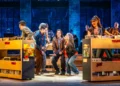
This Stratford staging earns its distinction as a VOICE CHOICE, must-see, through the assurance of its creative team. Scott Penner’s claustrophobic apartment-building facades press in on the action, reflecting the suffocating pressures inside the Loman home. Louise Guinand’s lighting moves deftly between harshness and shadow, underscoring both the story’s emotional volatility and its fluid shifts between past and present. Denyse Karn’s costumes evoke the 1940s with graceful precision, from the men’s fedoras and suspenders to the women’s vivid pastel dresses.
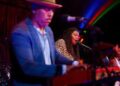
A particularly memorable touch comes before the performance begins. Michael Louis Johnson appears in costume and plays period trumpet music. The effect is sonorous and haunting, and its return later in the evening lands with quiet force. Saying anything further about when that exactly occurs will spoil the plot. That moment must be experienced live.
Director Dean Gabourie steers the production with a sure grasp of both its 1940s setting and its unspoken tensions. He reveals a world hemmed in by financial strain, the pressure to be well-liked and a brittle masculinity that leaves little space for truth. Those social performances come into especially sharp focus at Frank’s Chop House, when Happy picks up the two ‘chippies’ – Krystin Pellerin’s Miss Forsythe and Nadine Villasin’s Letta – turning the uncomfortable moment into a stage for bravado, evasion and emotional collapse that later blows up in front of Linda.
Gabourie’s staging feels historically grounded while remaining intensely immediate.
David W. Keeley cuts a striking figure as Uncle Ben, his white suit and easy poise lending the character an almost ethereal allure. As Charley, Matthew Kabwe brings warmth and quiet compassion, registering the sorrow of Willy’s decline with touching clarity. Raymond Strachan makes Bernard an eloquent counterpoint to the Loman sons, embodying the success Willy has always imagined for Biff and Happy; the mention of Bernard’s Supreme Court appearance lands as one of the production’s sharpest ironies. Sean Arbuckle is equally effective as Howard Wagner, brisk and unsympathetic, capturing the cold efficiency of a workplace that prizes usefulness over loyalty or humanity.
Joe Perry and Josh Johnston are entirely convincing as the teenage and adult Biff and Happy. Perry gives Biff a bruised, searching quality, full of anger, regret and yearning, notably evident in the Act 2 off-stage business meeting with Bill Oliver. Johnston makes Happy’s easy charm feel both attractive and troubling. Together, they illuminate the different ways the brothers have inherited and resisted their father’s illusions.
Above all, Lucy Peacock and Tom McCamus anchor the production with performances of remarkable depth and feeling. The two are giving a masterclass in acting. Their work gives this production its aching humanity — and, again, a Voice Choice designation as one not to miss.
Peacock’s Linda is deeply felt without ever tipping into histrionics. She makes the character’s worry and exasperation palpable while maintaining an impressive emotional discipline. Her delivery of “Attention must be paid” lands with such frankness and dread that the auditorium falls into a charged silence. McCamus, meanwhile, refuses the easy shorthand of decline. His Willy is never a caricature of deterioration but a man clinging to love, pride and the remnants of self-respect. That choice gives the ending its full force: the tragedy lies not only in Willy’s sacrifice, but in the cruel delusion that a life’s worth can be measured against someone else’s success.
Poignant, heartbreaking and illuminated by performances of striking emotional truth, Stratford’s Death of a Salesman will not disappoint in the least. It’s a Voice Choice designation marked by actors at the top of their game. As a retired secondary school teacher of English language and literature who has taught the play, I wholeheartedly recommend seeing this production if classes are studying it.
Running time: approximately two hours and 30 minutes with one interval.
The production runs to October 24 at the Avon Theatre, 99 Downie Street, Stratford. For tickets: stratfordfestival.ca or call 1-800-567-1600/ (519) 273-1600.
THE STRATFORD FESTIVAL presents
Death of a Salesman by Arthur Miller
Director: Dean Gabourie
Set Designer: Scott Penner
Costume Designer: Denyse Karn
Lighting Designer: Louise Guinand
Composer and Music Curator: Michael Louis Johnson
Sound Designer: Joh Gzowski
Stage Manager: Anne Murphy
Performers: Tom McCamus. Lucy Peacock, Joe Perry, Josh Johnston, Raymond Strachan, Chick Reid, Matthew Kabwe, David W. Keeley, Irene Poole, Sean Arbuckle, Michael Louis Johnson, Devin MacKinnon (at this performance), Krystin Pellerin, Nadine Villasin.