


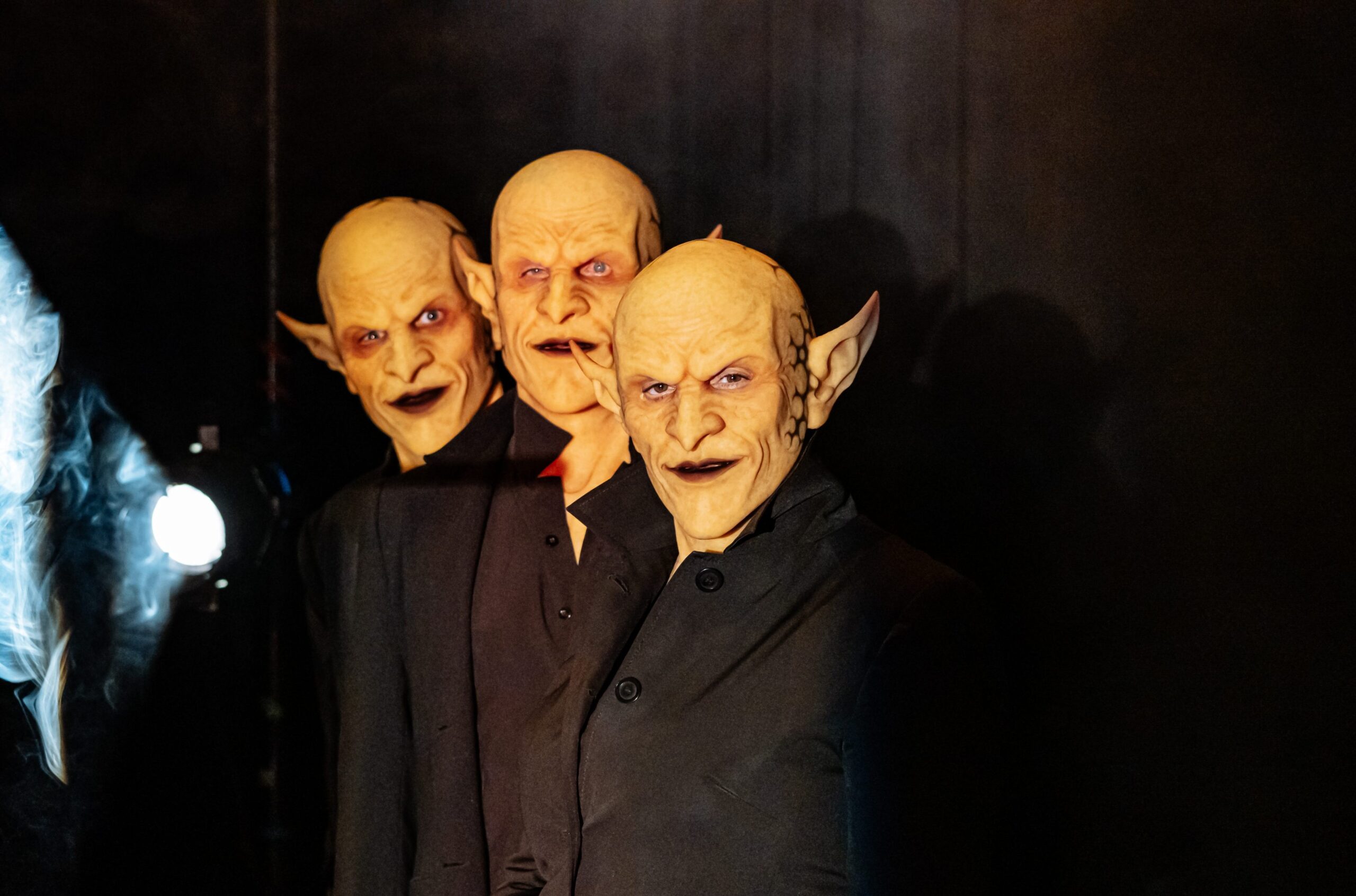
Why do I adore Wug, Kragva and Moog from Goblin:Macbeth and Goblin:Oedipus?
These impishly mischievous Goblins can appear anywhere, and I mean that literally. I saw the former production twice (in Stratford and at Tarragon Theatre), and they emerged from a Mini that wound up on the sidewalk. I saw the latter, and they were walking down the street carrying something belonging to the male species. Don’t ask me any further about it.
The Goblins perform their production of Shakespeare’s tragedy, Macbeth, at Montreal’s Centaur Theatre, beginning March 4.
Will they arrive in a Mini? Probably not, since one has unpaid parking tickets in Quebec.
Just recently, the Goblins were found online in Centaur’s Artistic Director Eda Holmes’s closet, waiting for one of them to get the key to the theatre. The third appears on camera.
A brief plot synopsis of the play, courtesy of the Centaur website: “[Wug, Kragva and Moog] stumble upon a copy of ‘The Complete Works of William Shakespeare.’ Though not entirely convinced that theatre is a worthwhile pursuit, they are deeply intrigued by a writer who seems to know an unusual amount about witches, faeries, and other non-human creatures like themselves. The Goblins decide to commandeer Centaur Theatre’s stage and cajole an audience into participating in their very first attempt at putting on a play. They choose Macbeth — because it is the shortest… and has a lot of blood.”
Director of the production, Rebecca Northan, loves the Goblins. Wug (the trio’s boss) helps keep Moog and Kragva focused. Anything they do theatrically is his idea. Northan said she didn’t know whether Kragva and Moog had a choice once Wug decided to put on a play.
Northan says the Goblins now have a profound curiosity about humans after reading the Complete Works cover-to-cover. They’re mystified about how this Shakespeare guy knows so much about witches, fairies, monsters and goblins. If Shakespeare understands humans, maybe there’s something worthwhile in trying to understand them.
She took a few minutes to chat with me via Zoom recently between rehearsals. I couldn’t tell if the Goblins were hiding off to the side, waiting to make an appearance during our conversation.
One burning question I immediately wanted to ask her came from seeing Eddie Izzard’s performance of Hamlet in Toronto recently. Izzard appeared onstage just before the performance began to let audiences in on something I still find intriguing. Do Shakespearean actors perform ‘at’ or ‘to’ an audience?
Rebecca replied: “Who likes to be spoken to when one is sitting in the audience?”
Good point.
Instead, she, an artist who has performed and directed Shakespeare’s plays, says:
“I’m going one step further and say my preference is to speak with an audience. I’m interested in a conversation. That doesn’t necessarily mean the houselights are up and the audience is directly speaking back to you, although that has happened.”
For Northan, the best, most alive theatre is a real-time, back-and-forth conversation and exchange. The Goblins treat every script as a living document and continue to experiment and play through improvisation during the run of the show. They are always listening to what’s happening, not only on stage but also with the audience. Is it a Friday, and are people tired, so they need something slightly different? Is it a Sunday, so they’ve had the weekend to sleep and are they energized?
A very different conversation is the performance for a Wednesday student matinee. The feeling in the theatre is that the production is closer to a rock concert. From Rebecca’s perspective, students might be unsettled by the Goblins. There’s no way to prepare for student response because an actor might not know what to expect (which Northan thinks is great).
While the Goblins are hyper-aware of the audience, directing them remains quite the challenge:
“They really subvert the power structure in a room, which is good. Working with them is a negotiation. The moment I declare I’m sure of something, the Goblins disrupt and question everything.”
Amid the fit of laughter I’m having as Rebecca tells me all this, she says it’s a wonderful artistic exploration to ask what else these Goblins want to do and what they’re capable of. Do they have any limits? She’s not sure.
While there are plenty of folks who might know who’s behind those Goblins masks, Rebecca, as director, states: “So what? Who cares?” She then relayed a story about when the Goblins performed at Bard on the Beach in Vancouver, where a donor told Rebecca she had heard the Goblins are different actors each performance night.
Rebecca coyly responded to the donor: “I hadn’t heard that. How amazing!”
Again, Northan’s response sent me into fits of laughter. Why am I laughing yet again? Along with the mystery of who’s behind the masks, when you know, you know.
What’s going to be amazing for the Centaur run? Several of the cafes around the theatre have been warned that the Goblins may appear in those establishments and speak la langue française.
Will Goblin:Macbeth continue past the Montreal run?
The production travels to RMTC (Royal Manitoba Theatre Centre) in Winnipeg in the fall.
While there are some things Rebecca cannot share at this time, she says Oedipus travels to Bard on the Beach in Vancouver and will play the entire summer. It will play five times a week opposite Antigone, which will do three shows a week. For Northan, that’s a nice pairing.
Two other projects are lined up that have not yet been publicly announced. Rebecca hinted that the Goblins are planning a certain winter holiday for one of these projects.
To learn more about Goblin:Macbeth’s run at Montreal’s Centaur and/ or to purchase tickets, visit https://centaurtheatre.com/shows/goblinmacbeth/
The production runs to March 22.