

I remember a post-show talk after a noir version of A Midsummer Night’s Dream at one of Italy’s major theatres. An older woman protested,
“This is not how Shakespeare did it.”
The director looked her dead in the eye and replied,
“Were you there to witness it? Are you really that old?”
It is an old debate: are we betraying a work, or simply adapting it?
With Shakespeare, thankfully, the question has worn thin. His plays have been cut, reshaped, and reimagined for centuries. At this point, who still imagines Hamlet in ruff and tights, unless it is at Shakespeare’s Globe?
Certainly not director Alex Jodi Verge.
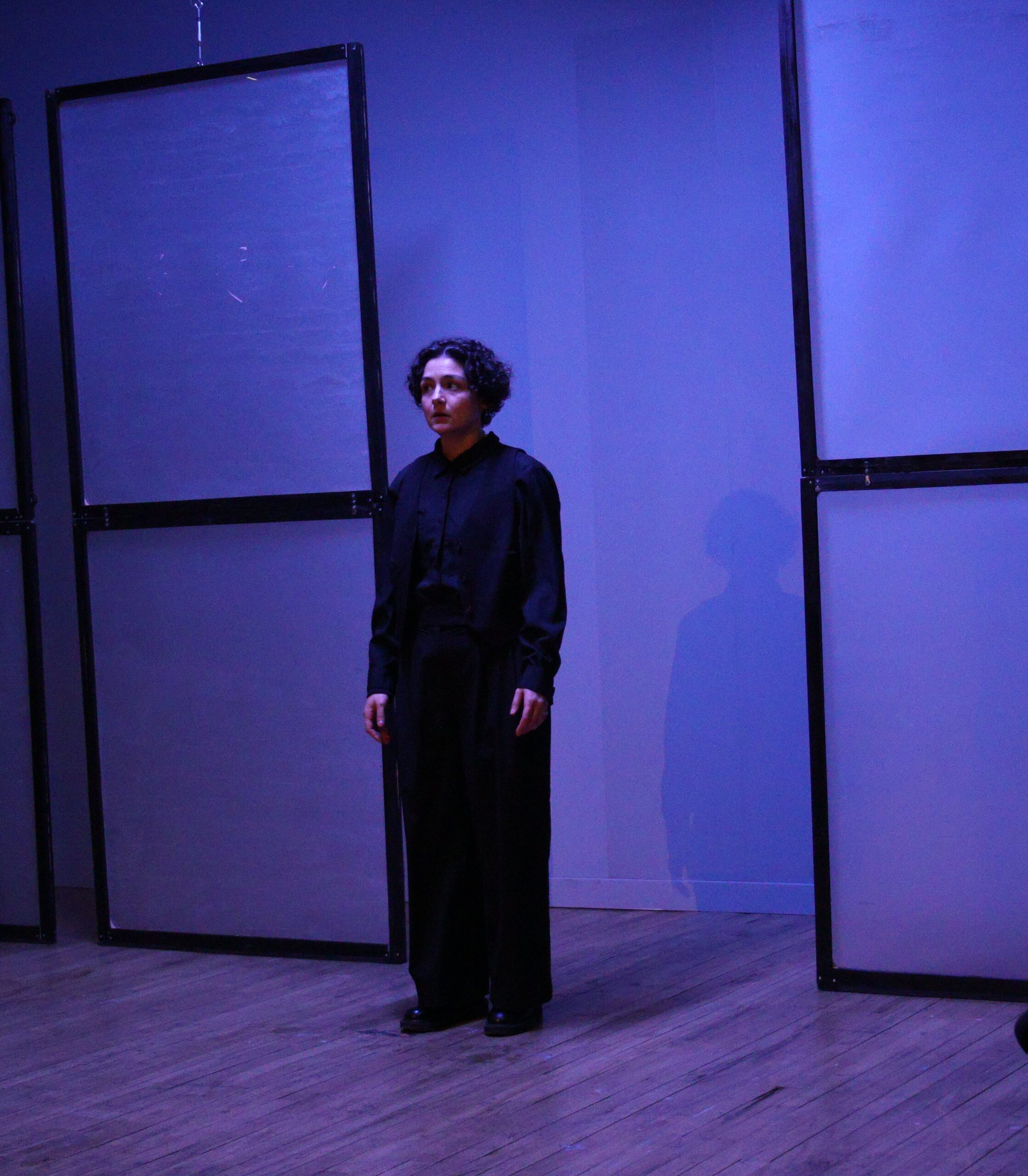
Their production, Hamlet Sweet Prince, plays on the second floor of an old building near Dufferin and Dupont. As we step into the lugubrious rehearsal room, with its darkened windows and grey palette, an atmosphere of psychological anguish is already apparent. The programme notes identify patriarchal oppression as the show’s central lens.
Accordingly, the setting becomes a modern corporate office, where CEO Claudius assumes power after the sudden death of Old Hamlet. Cold LED lighting and a geometric office design (by Kenzia Dalie) lend the space an entrapping precision. At the back, a series of semi-transparent plastic panels suggests a world of surveillance, where everyone remains under the gaze of others and privacy is scarcely possible. Lucy Ellis’s sound design and Franco Pang’s lighting sustain this sinister atmosphere. Even within the constraints of a low-budget production, slick flashes and prolonged, synthetic sounds produce an eerie suspension of reality.
Part of the allure of relocating a play in space and time lies, I believe, in the flexibility of language. It allows us to test how meanings shift, how lines resonate differently, and how much of human nature remains unchanged across centuries. On the other hand, reframing classics can unsettle and challenge inherited tradition. It can redistribute gender and ownership: from Sarah Bernhardt to Michelle Terry, the role of Hamlet has long escaped the exclusive domain of men, and Gabbi Kosmidis extends that history here.
It can also introduce new forces into the drama. Under Alex Jodi Verge’s direction, the ever-present mobile phones act as constant mediators of reality, reshaping how characters relate to one another and creating emotional distance even in moments of contact. They distract Laertes during Polonius’s advice at the beginning of Act 2, allow Claudius to spy on Hamlet and Ophelia, and later replace the two portraits shown to Gertrude in Act 3.
At times, the original Shakespearean text strains against the updated setting. In a world of phones and guns, letters and swords remain oddly out of place, and one wonders why a corporation would employ travelling players to entertain its high ranks.
More broadly, the patriarchal reading, while certainly latent in the text, never fully coheres here. The famous “Get thee to a nunnery” speech lands differently when spoken by a non-male Hamlet, its misogynistic force made more ambiguous. The gender-swapped casting further complicates hierarchy, with Polonius reimagined as a titanic female presence in the hands of HannaH Sunley-Paisley. Claudius (Paul Stafford), meanwhile, appears sly and guarded rather than forcefully tyrannical.
What struck me instead was the tenderness suggested by the title itself.
Fragility, rather than power, becomes the emotional centre of this Hamlet. Kosmidis brings troubled vulnerability to the prince, presenting a Hamlet of contemporary emotional exhaustion. Jonnie Lombard’s Ophelia, particularly compelling in the first act, speaks with intimate, almost cinematic softness. Caught inside another’s suffering, she desperately tries to ease their pain. Her presence during the first soliloquy lends the moment care, but grief resists being shared. There is little she can do in the face of death.
Uneven though it is, this production prompts reflection on how intimacy falters in mourning, consumed by defensive isolation and unresolvable sorrow.
Running time: approximately 2 hours and 30 minutes.
The production runs to April 25 at 1110 Dupont Street, Toronto. For tickets: Hamlet, Sweet Prince via ThunderTix
Hamlet, Sweet Prince
Abridged and Directed by Alex Jodi Verge
Written by William Shakespeare
CREATIVE TEAM
Directed by Alex Jodi Verge
Costume Design by Ellyn O’Keefe
Set Design by Kenzia Dalie
Lighting Design by Franco Pang
Sound Design by Lucy Ellis
Fight Direction by Paul Stafford
Intimacy Direction by Hadley Abrams
THE CAST:
Gabbi Kosmidis as Hamlet
Paul Stafford as Claudius
Ashlie White as Gerturde
Andrew Pawarroo as Ghost / Player
Jonnie Lombard as Ophelia
Callan Forrester as Horatio
Liam Brett as Laertes
HannaH Sunley-Paisley as Polonius
Madeleine Storms as Rosencrantz
Hope Goudsward as Guildenstern
Cayne Kitagawa as Bernardo / Player
Lizzie Song as Marcellus / Player
Sydney Marion as Swing
Jameson Mosher as Swing