

An extremely important twenty-first-century play about the importance of the family unit and forgiveness, Aksam Alyousef’s Karma has moments when it remains a textually poetic work, using literary devices that create memorable images. While I do get the sense that Ash Knight directs with commitment, I didn’t feel as emotionally invested in the story as I should have at the performance I attended.
Why?
I couldn’t get the sense that the actors were emotionally invested in the subject matter. This is not to say it occurred at any of the other performances so far.
Whether it was actor fatigue from the house attendance (in the very low double digits) or the theatre circulating fan that distracted me from hearing the onstage dialogue (I was sitting in the front row), Karma didn’t make me care about what I was seeing. And I wanted to care so very much about this story and these characters.
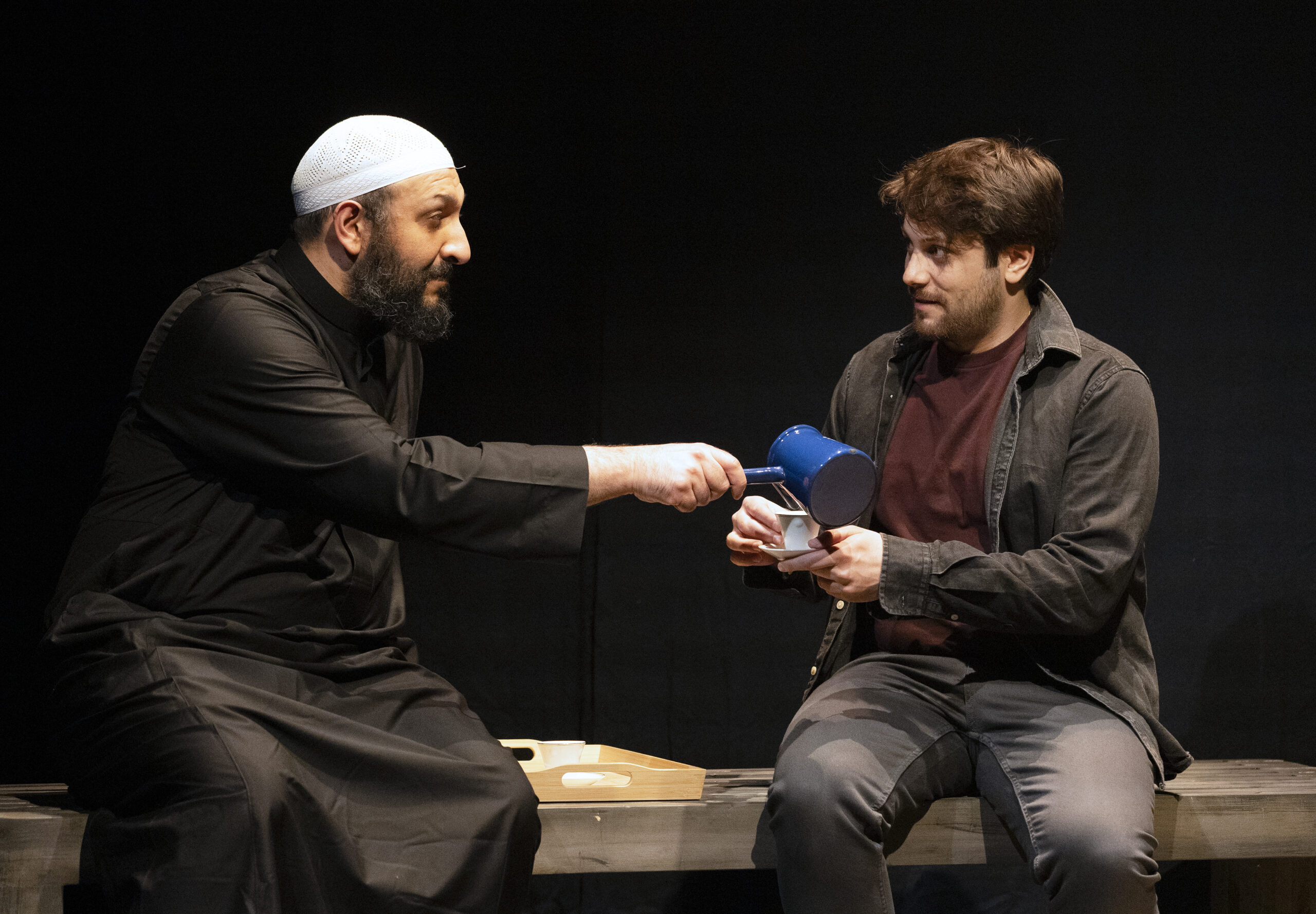
Set in 2012, Adeeb (Andrew Illes), who was born in Canada, believes he lived a previous life in Syria and that his family wants him there. His Syrian mother, Karma (a grounded and vital Christina Tannous), is extremely concerned for her son’s mental health and well-being. She continually encourages (forces?) him to dismiss this idea. But he won’t.
Adeeb travels to Syria, leading his mother and him on a journey to confront their past and uncover family secrets that have long been hidden.
Scenic Designer Lucas Arab creates a sense of mystery upon entering the Theatre Passe Muraille Main Stage. Ghostly white cloth drapes over the on-stage furniture, creating an opening scene of wonder, thanks to Logan Raju Cracknell’s balanced, shadowy lighting design. Arab’s projections help set the various scenes with extraordinary visuals. Knight uses the various levels of the Passe Muraille Main Stage to create a strong visual effect visible from the house as well. Arianna Lilith Moodie’s costume designs look twenty-first-century realistic.
The opening scene holds tremendous promise as it grabs attention.
Adeeb is asleep, appearing to be having a bad dream. The actors stealthily enter in masks and eerily looking costumes. Ash Knight’s staging of that moment is certainly eye-catching and made me pay attention.
It’s in the opening that the first sign of faltering occurs, and it continues throughout the show. The challenge is the hanging curtain that runs upstage to mask the back. While it’s used for characters’ entrances and exits, actors often struggle to find the slit, which looks awkward. This has to be cleaned up immediately for the remaining performances.
In his Playwright’s Note, Aksam Alyousef writes how Pleiades Theatre is deeply meaningful to him for his play’s world premiere because the company’s commitment is bold, thoughtful storytelling.
I wholeheartedly agree as I’ve seen other Pleiades productions that have been wonderful
I wanted so much to appreciate Karma’s messages.
Running time: approximately one hour and 40 minutes with no interval.
The production runs to May 17 on the Mainstage at Theatre Passe Muraille, Mainspace, 16 Ryerson Avenue. For tickets: https://www.pleiadestheatre.org/karma2026
PLEIADES THEATRE presents the world premiere
Karma by Aksam Alyousef
Directed and dramaturged by Ash Knight
Sound Designer: Gurpreet Chana
Scenice and Projection Designer: Lucas Arab
Costume Designer: Arianna Lilith Moodie
Lighting Designer: Logan Raju Cracknell
Music Compositions: Usef Nader
Stage Manager: Jennifer Stobart
Performers: Christina Tannous, Andrew Iles, Zaynna Khalife, Basel Daoud, Tony Nash, Yusuf Zine