

Direct familiarity with earlier film versions of Gaslight or Patrick Hamilton’s original play is not required. The Capitol Theatre’s current production (by Canadian playwrights Johnna Wright and Patty Jamieson) stands on its own as a measured staging of the well-known psychological thriller.
Port Hope’s Capitol Theatre closes its successful 2026 summer season with a handsomely mounted Gaslight that treats the familiar psychological thriller less as period melodrama than as a study of control, manipulation, and a woman’s fight to trust her own reality. Director Marie Farsi’s handsome production, stylish in design and steady in purpose, draws a clear line between the story’s Victorian setting and the contemporary meaning of gaslighting as a serious form of abuse by eroding a person’s trust in his/her own perception, memory, and sense of reality.
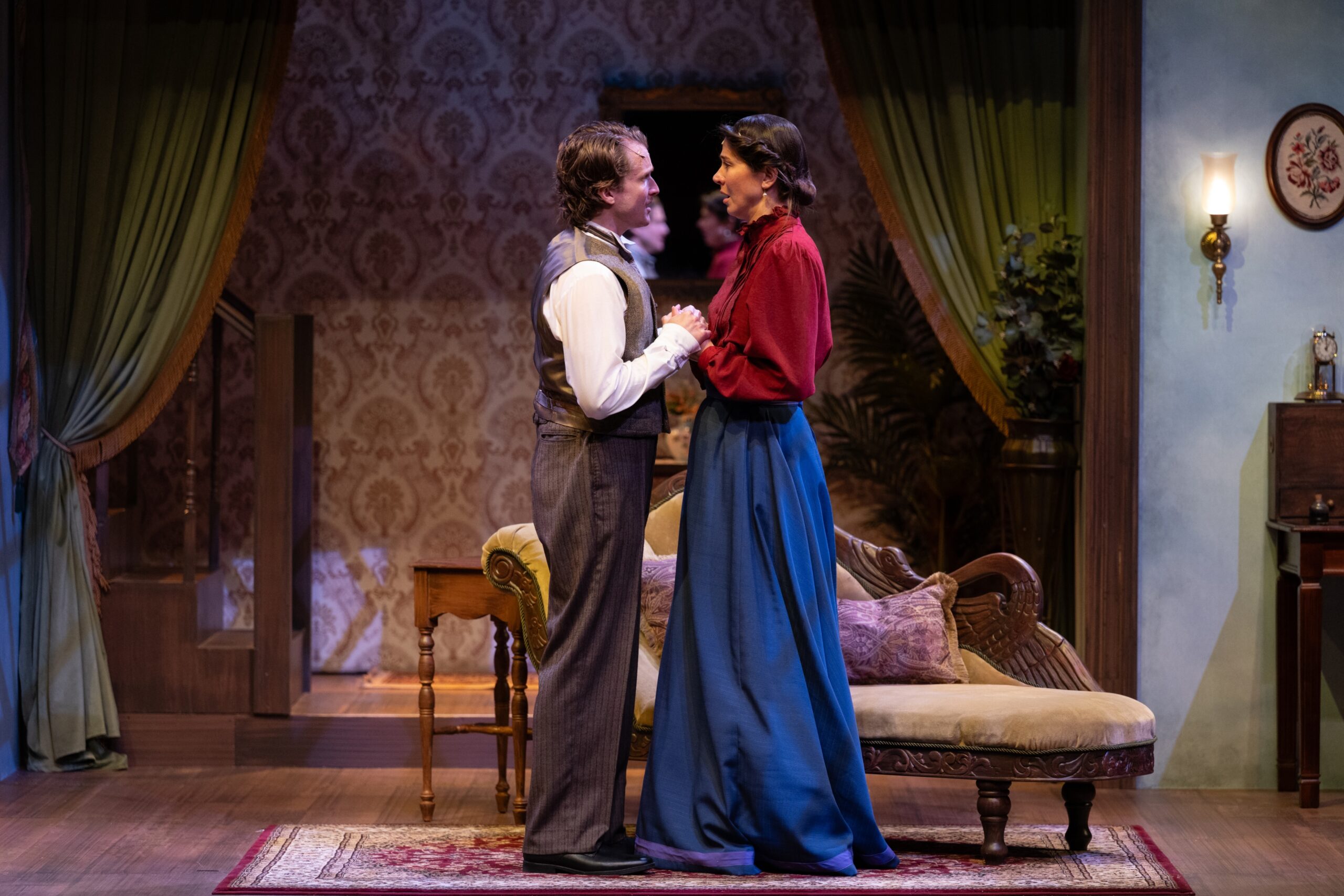
The play’s setting is London, England, in 1901. It is in the rather intimate drawing room in the upscale rented home of Bella Manningham (Courtney Ch’ng Lancaster) and her husband, Jack (Darren Martens). Bella and the maid, Elizabeth (Glynis Ranney), prepare a midmorning snack when Jack arrives home from his work in art, which keeps him out day and night. Elizabeth was employed by the previous owner of the house, and that story becomes part of the play’s intrigue. On top of the drawing room set is what I assume is the attic, with furniture covered.
The household is unsettled from the outset. Bella has been regarded as mentally fragile and spends much of the day resting. A new maid, Nancy (Mallory James), is hired to assist Elizabeth, but her appointment quickly proves disruptive. Bella hears noises from the attic and other unexplained sounds while alone in the drawing room; the gaslights dim at the same moments; objects disappear. The production steadily builds the central question: is Bella losing her grip on reality, or is another force at work inside the house?
Anika Binding’s gorgeous costume designs, with ruffles and colours, combined with Sim Suzer’s cozy upscale set design, immediately capture the eye. Minute attention to detail is evident, from paint colours to props, all carefully placed to evoke the end of the Victorian era. Jareth Li’s lighting eerily adds to the overall sense of dread that hovers throughout the house. Ashley Au’s aptly timed sound design reverberates throughout the Capitol’s Mainstage auditorium.
The stage management team, led by Craig Francis with assistant Molly Muck, securely supports the production’s precision. Tight coordination of lighting, sound, and entrances is essential to the pacing, particularly in a play that depends on atmosphere and carefully timed revelations. The first act is comparatively dialogue-heavy, but it aptly establishes the conditions for the second act’s sharper turns and late surprises.
Farsi’s direction duly emphasizes the resilience and empowerment of women in the play. Rather than treating Bella as a passive figure awaiting rescue, the production succinctly draws attention to how power is negotiated within the household and how control can shift over the course of the performance. As the story progresses in its twists, Bella learns she must survive on her own when Jack is not in the house. Or is he?
Courtney Ch’ng Lancaster gives Bella a layered restraint, avoiding an overly histrionic performance. Early scenes show Bella moving lightly through the drawing room and sharing brief ease with Glynis Ranney’s Elizabeth, but that openness changes in Jack’s presence. Lancaster’s physical bearing subtly contracts, suggesting the pressure of a dominant domestic authority. Throughout the first act, she remains grounded, listening and reacting to the production’s ominous sounds without sacrificing control. Her gradual recognition in the second act provides one of the evening’s stronger dramatic arcs.
Darren Martens presents Jack as outwardly chivalrous and attentive, while allowing unease to gather beneath the surface. His concern for Bella’s condition appears plausible, but small shifts in posture and tone complicate that impression. In one exchange, Bella asks him to remain at home, and his quick dismissal of the request exposes the imbalance in their relationship. Martens’ performance contributes significantly to the production’s pervasive sense of dread and the question of whether he has had anything to do with Bella’s delusions.
Glynis Ranney and Mallory James provide contrasting women navigating the play’s heightened psychological atmosphere. Ranney’s Elizabeth emerges as a steady, experienced confidante, offering Bella practical counsel and moments of levity as household tensions intensify. James’s Nancy introduces a more disruptive presence. Her youthful charm and calculated attentiveness around Jack suggest an additional pressure within the Manningham home. Lancaster’s Bella registers that threat clearly, and the exchanges between Bella and Nancy add a sharper theatrical edge to the production’s domestic conflict.
Farsi’s programme note about revisiting the ideas of gaslighting feeling especially important now places this opening night production within a contemporary conversation about gaslighting. The Capitol’s staging dutifully earns that emphasis without allowing the issue to overwhelm the thriller’s mechanics.
Although a few moments of heightened melodrama draw laughter and the second-act resolution arrives abruptly, these are relatively minor reservations in a production that is handsomely designed, genuinely acted, and guided by a firm sense of purpose.
After closing the Capitol Theatre’s summer season in Port Hope, Gaslight will travel to Winnipeg’s Prairie Theatre Exchange in January 2027 for winter performances.
Highly recommended for local patrons to see the Port Hope production.
Running time: approximately two hours and thirty minutes with one intermission.
The production runs to September 6 on the Mainstage at Port Hope’s Capitol Theatre, 20 Queen Street. For tickets: capitoltheatre.com or call (905) 885-1071
The Capitol Theatre presents
Gaslight by Johnna Wright & Patty Jamieson
Based on Patrick Hamilton’s play
Directed by Marie Farsi
Set Designer: Sim Suzer
Costume Designer: Anika Binding
Lighting Designer: Jareth Li
Sound Designer: Ashley Au
Dialect Coach: Alison Deon
Stage Manager: Craig Francis
Assistant Stage Manager: Molly Muck
Associate Set Designer: Joyce Padua
Associate Costume Designer: Carlyn Rahusaar Routledge
Fight Director: Siobhan Richardson
Associate Fight Director: Matt Richardson
Performers: Courtney Ch’ng Lancaster, Darren Martens, Mallory James, Glynis Ranney