

The Port Hope Capitol Theatre world premiere of novelist and environmentalist Farley Mowat’s And No Birds Sang arrives with a clear Canadian frame, partly because the story is being staged near the town where the writer was born in Belleville. Interestingly, Mowat died in Cobourg and is buried in Port Hope. The germination for And No Birds Sang began as a short play adaptation during Port Hope’s Festival of Ten-Minute One-Acts and was later developed through the Capitol’s 2024 Creators’ Unit.
The novel details how, as the Second World War approached, Farley’s father urged his son to join the Canadian army in 1939. The young Mowat hoped to enlist in the Air Force, but he was rejected because he looked younger than his age and was underweight. He later joined the Hastings Prince Edward Regiment, known as the Hasty P’s, in 1940 and led a platoon for much of his service in Italy. However, over the years, there has been discussion that not everything Mowat wrote actually happened. Mowat’s was a storyteller, and he wanted people to read one.
Playwright Dave Carley’s adaptation does not attempt to reproduce every event in Mowat’s novel. Carley takes some dramatic liberties in retelling for the stage. The Capitol production also acknowledges, implicitly, the distance between Mowat’s memoir, memory, and theatrical reconstruction. Director Rob Kempson describes theatre as an art form that is not real life but rather the greatest hits of recreating real life. That approach is evident here as Carley and Kempson sensitively and subtly shape episodes from young Farley’s life for a theatrical context. Whether those moments are veritably real is not the point, since the production has become a retelling of a retelling.
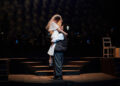
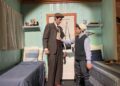
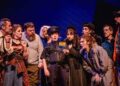
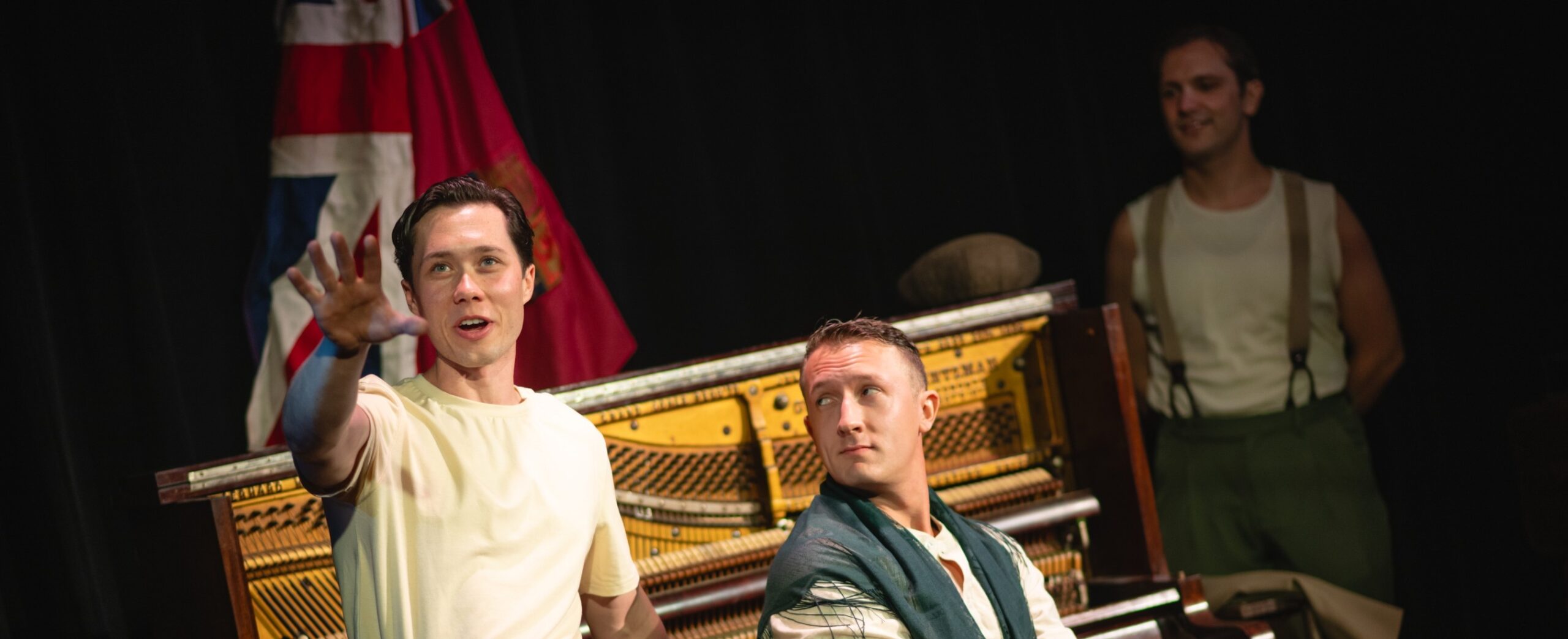
Staged in the upstairs Sculthorpe Theatre, an intimate cabaret configuration, And No Birds Sang places the actors close to the audience. That choice works well because the audience cannot look away since the action is mere feet away. The set suggests a vaudevillian atmosphere on entry, while period-inflected pieces evoke the 1940s through the music and radio announcements playing during the pre-show. Jeff Pybus’s lighting design emphasizes moments of tension through sharp spotlights and shifts into blue and red battlefield tones. Jeff Newberry’s live Foley effects, at times produced by the company, bring immediacy to the action, with several cues timed for strong dramatic impact. Carlyn Rahusaar Routledge’s costume coordination supports the mid-1940s setting.
Aaron Macpherson, Daniel Reale and Mayson Sonntag enter in costume before the performance, speaking casually with audience members rather than appearing in character. After a brief welcome and introductory remarks, the three performers immediately become the characters and shift the focus to wartime experience and its lasting consequences. Each also plays a musical instrument, adding another layer to the production’s dramatic atmosphere.
Kempson’s direction gives the production clarity and pace. Carley’s adaptation balances battlefield material with comic and conversational memories shared by the three performers. The young Farley’s first sexual encounter in Act 1 is played broadly for comedy, with later developments in Act 2 giving the scene additional significance. A conversation between Mowat and his girlfriend, Lois, also carries a tonal shift: what begins with lightness is shadowed by her limited understanding of the danger ahead.
Macpherson offers a clear and engaging portrayal of the young Farley Mowat. His youthful appearance and lanky physicality support the production’s image of Mowat as a young enlistee and help explain the affectionate terms used by those around him. The performance moves effectively between comic passages and more intense dramatic moments, maintaining a steady sense of commitment.
Reale and Sonntag play multiple supporting figures in Mowat’s life before and during his overseas service. Both handle frequent character changes with solid deftness and vital economy, often using a small costume piece or prop to mark the shift. Reale’s Kelly, Farley’s best friend, is presented as a comic opportunist in Act 1, with the character’s relationship to Farley darkening as the story progresses. Sonntag’s Doc similarly begins as a source of humour before the play’s wartime consequences move the role into more dramatic territory.
This noteworthy opening night performance certainly brings to life a subject that seems to be on the public mind more each day: war and its exorbitant cost to the individual, specifically, in this world premiere, young men who have seen the best and worst of humanity. The Capitol’s lobby display offers additional historical context, including photographs of the young Farley and examples of army attire connected to the period. Take a few moments to peruse the information, as it helps establish context.
Please see And No Birds Sang. In a recent interview, Kempson says the production: [honours] human sacrifice, the honouring of all those men who went to war, the honouring of the women who went to war and stayed behind to make other things happen.”
Honouring someone or something in the theatre is another reason we attend.
Running time: approximately 100 minutes with one interval/intermission.
The production runs to September 6 in the upstairs Sculthorpe Theatre at Port Hope’s Capitol Theatre, 20 Queen Street.
For tickets: capitoltheatre.com or call (905) 885-1071. I hear they’re going quickly.
CAPITOL THEATRE presents the world premiere
Farley Mowat’s And No Birds Sang, adapted by Dave Carley and directed by Rob Kempson
Stage Manager: Megan Specht
Lighting Designer: Jeff Pybus
Sound Designer: Jeff Newberry with the Company
Costume Coordinator: Carlyn Rahusaar Routledge
Dialect Coach: Alison Deon
Performers: Aaron Macpherson as Farley Mowat, Daniel Reale as Kelly and others, Mayson Sonntag as Doc and others