


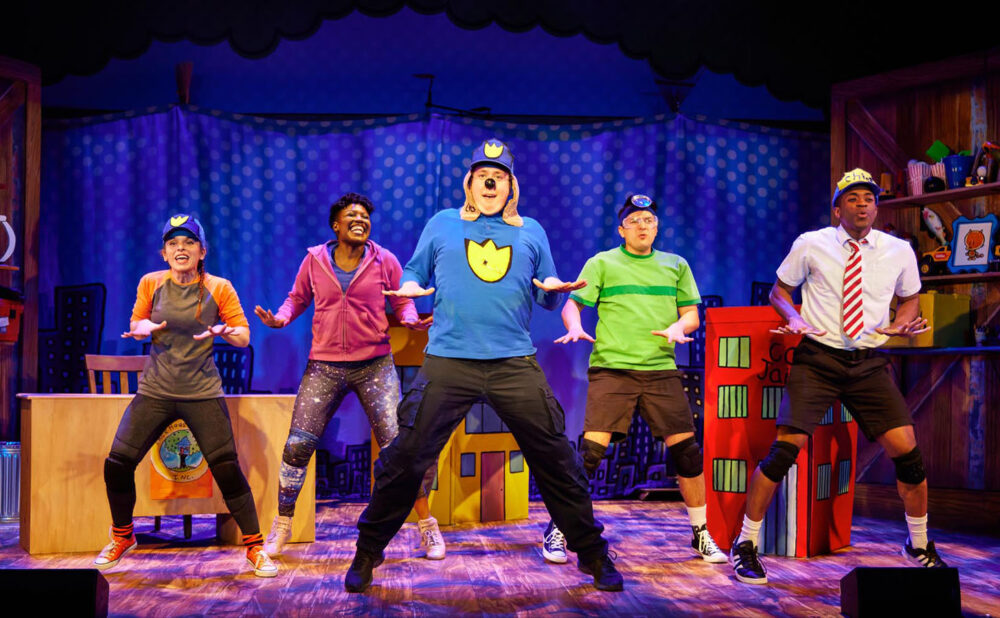
Who reads a review of Dog Man: The Musical? That was the first question I found myself asking while writing this. Probably not the show’s target audience. Though if you are between 5 and 8 and have made it this far, congratulations: your future is worryingly bright! More likely, this review is for the parent, teacher, or adult deciding whether to bring a child. It is also for the cast and production team, whose work deserves to be taken seriously even when the material is proudly silly.
Dog Man: The Musical creates a generous sense of comic absurdity. It features a cardboard-looking world, silly plot twists, and proudly ridiculous songs.
What to expect
Yes, I am about to use the word “metatheatrical” in a review of Dog Man: The Musical.
The show begins within a metatheatrical frame (warned you): George and Harold are two school friends trying to write and stage their own musical before lunchtime. Their subject is Dog Man, a hero with the head of a dog, the body of a police officer, and the self-control of neither.
From there, the story moves at full speed, one plot twist after another. Dog Man must save the city from Flippy, a cyborg fish with an army of Beasty Buildings, while Petey, the “world’s most evil cat,” plots revenge.
Style and age
Based on Dav Pilkey’s bestselling Dog Man series, and clearly drawing on the same anarchic energy that made Captain Underpants so popular, the show seems most naturally suited to kindergarten and elementary-school children – roughly ages 5 to 8, perhaps stretching to 10. Its language is speed: songs arrive quickly, rhymes pile up, and silence rarely lasts for more than a breath.
The design
Tim Mackabee’s scenic design seems to have been built inside the brain of an eight-year-old. Everything is flat, bright, and proudly fake. The set looks like cardboard, markers, and tape somehow got a production budget. Polka-dot backdrops, oversized props, and clunky cityscapes give the stage the logic of a comic strip.
Songs
The score keeps the engine running. Kevin Del Aguila’s lyrics are the stronger part: playful, fast, and full of comic self-regard, especially in numbers such as “The Evil ABC’s” and “Without Me,” where Petey throws himself into a ridiculous, narcissistic number: “I love me / Me are all I ever wanted.” Brad Alexander’s melodies are less memorable: they push the action forward, but begin to evaporate once you step out of the theatre. In a show like this, that is not fatal. The songs are built for momentum, not memory.
The cast
The cast carries this comic machine with brisk precision and clean comic timing.
The strongest performances come from Glory Yepassis-Zembrouas’s Flippy and Sadie Jayne Kennedy as Li’l Petey. Destiny gives us a villain who can barely manage to be one: more narcissistic and clumsy than genuinely threatening. Kennedy brings a welcome breeze of innocence, giving Li’l Petey sweetness without turning him into pure sugar. Both deliver some of the production’s stronger vocal moments, which matters in a musical that demands constant belting and full-throttle energy. Troi Lennoxx Gaines and Mundo Ballejos give George and Harold the right kind of classroom chaos: children whose imaginations move quickly and whose tongues move even faster. As Dog Man, Nick Manna brings the noble idiocy of a very committed good boy.
A pedagogical note
Still, one question remains: what kind of experience should theatre offer its young spectators?
The show grants children their right to silliness, excess, and the pure pleasure of laughter. Here, everything moves through constant acceleration: a joke, a song, a gag, a chase, another effect. Yet theatre for young audiences also has the power to shape attention, imagination, and emotionality.
I found myself thinking about some of the family musicals I grew up with, from Compagnia della Rancia’s Pinocchio to Christian Ginepro’s Alice in Wonderland. They, too, relied on spectacle, colour, and fantasy. But beneath the entertainment, they carried recognizable layers: Pinocchio used wonder to explore family, error, and growth; Alice turned nonsense into a way of thinking about childhood, strangeness, and the imagination’s resistance to order.
Pedagogical reservations aside, Dog Man does exactly what it promises: it entertains. For many children, it may become a joyful first encounter with theatre, sending them home energized, delighted, and still laughing.
Dog Man: The Musical runs at Toronto’s CAA Theatre from May 6 to June 14, 2026. The production runs 90 minutes, including an intermission.