

Thank you to Our Theatre Voice guest writer Keilantra Huang for attending the Hamilton Fringe and for your reviews below.
Felt Cute, Might Overshare
Deceptively simple, Felt Cute, Might Overshare Later by Kristin Boulton is a technically impressive feat of lighting, sound, and… puppet craftsmanship? While audiences are perhaps most familiar with puppets in the context of children’s programming like ‘Sesame Street’, Boulton, armed with her puppet (also named Kristin Boulton), spends an hour telling the captivating, humiliating, and melancholic personal tales, like jealousy in friendships and the violation of personal boundaries, that define our daily lives. Puppet-Boulton describes these experiences against a backdrop of impeccable lighting and sound design that amplify every embarrassing detail—like trickling water for a story about wetting herself.
Yet, while the puppet may initially appear to be a tool for escaping shame, Felt Cute, Might Overshare Later explores the power of storytelling that blurs the lines of personal identity as it explores the bravery that each and every one of us possesses deep down. After all, while Boulton and the puppet speak in different tones to distinguish them, there is an undeniable and astonishing connection between the puppet and puppeteer. Adorned with the same name, costume, makeup, and features, the illusion of the puppet’s life is captured through the precise combination of coordinated movements.
As Boulton and Puppet-Boulton synchronize their body movements and even their subtle gazes, viewers are left with the impression that these two Boultons are the same person. So, as much as Boulton may say that the human has shame and the puppet has none, Felt Cute, Might Overshare Later seems to suggest that the lines are much more blurred. In performing as both the human and the puppet, Boulton underscores the power of creative storytelling. As she galvanizes the human and humanizes the puppet, Puppet-Boulton becomes a coauthor, a second self, rather than a shield to hide behind.
1 Million Served- Years Well Waitressed
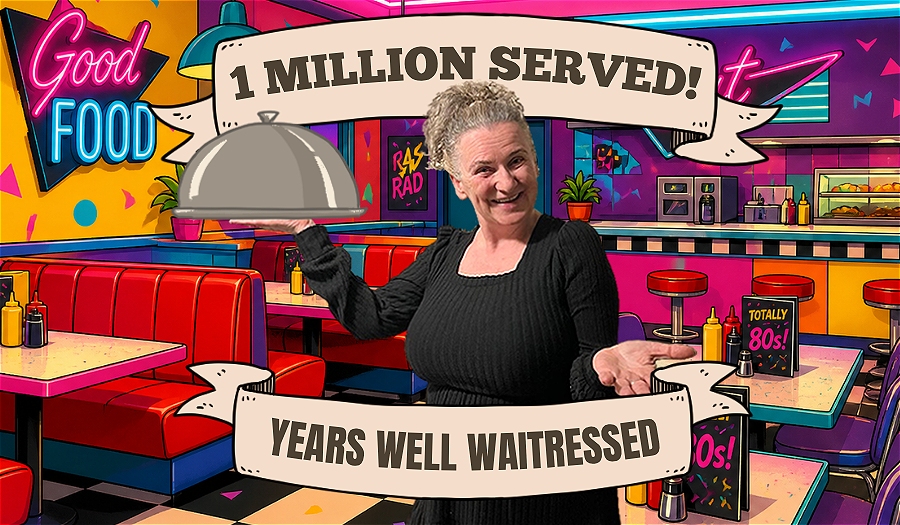
1 Million Served- Years Well Waitressed by Wanda Carroll is an impressively unique piece of interactive theatre where audience members spend an hour immersed in the world of the waitress, Wanda Carroll. Set at a simply lit table, the intimate space of Staircase Theatre evokes nostalgia for late-night talks with old friends and family. In the middle of it all is Carroll, who commands the audience’s attention with stories of unruly and unbelievable customers. As she details the lowest points of her career, Carroll speaks with the warm and steady tone of an old friend.
The intimacy of the performance is emphasized by the particularly memorable and creative use of menus, which were handed out to all audience members and contained the titles of Carroll’s stories such as “VIP,” “Moose,” and “Are You Famous?” As an interactive play, audience members can choose which stories they want to hear. Although no two nights are the same because no two audiences are the same, Carroll maintains a consistently infectious personality, telling each story with a candid tone and subtle humour. Powerful pauses and an expressive delivery captivated the audience’s attention, as we digested the ups and downs of Carroll’s life. In exciting moments, we were enraptured; in silent moments, we understood her vulnerability as she shared some of the best and most painful moments of her career. Throughout it all, Carroll’s stories come with the wisdom that she has accumulated over her lifetime—like that “shit happens” and the only thing we can do in times of struggle is move on and not worry about the things that are out of our control.
Raging Gracefully
“I didn’t know you rolled here”
Raging Gracefully by Alicia Carrick, Emily Decloux, Sam Sexton, and Jo Anne Tacorda is a rolling and meandering semi-improv play about the inevitable awkwardness of finding who you really are when you’re already an adult. Contrary to its ironic name, the production sometimes stumbles, sometimes doesn’t quite land. Yet, beneath its parts that don’t quite land is a genuinely touching examination of what coming-of-age looks like when you’re an adult still struggling with the aimless confusion characteristic of teenagers.
Being a partially improv show, the perpetual “rolling” of this performance is emphasized by the whimsical nature of many scenes, where their stories are told through clumsy dances in front of the visuals on-screen in the background. Filled with unedited social media videos of each of the 4 actresses, the screens elevate the production to a level of multimedia intrigue. The whimsy of the various sketches is amplified with consistent fade-outs with music, where sometimes the movement of actors onstage is even still visible, showing how they still “have[n’t] figured out” their life objectives yet.
As each scene is separated by character, actors like Alicia Carrick (with her seamless tonal variation between being a dad to a teenage girl) and Jo Anne Tacorda (with her loose and carefree physicality at karaoke) leave memorable impressions on the audience. However, these wonderful performances are sometimes underscored by the production’s ambiguous intent. In scenes where dances are asynchronized and line deliveries are flat, audiences are left wondering if they are watching deliberate artistic choice or weak performances. Likewise, while the various unconnected sketches sometimes meander to a successfully comedic result – like the sketch about universal dad habits, which was filled with clumsy angular dances that complemented the physicality and characterization of the characters – other times they leave audiences confused. For instance, a scene where two friends are driving to meet each other was visually confusing due to the discordance between the acting and the screen portraying a 3D immersive road.
Ultimately, this is the nature of improv; some jokes land more successfully than others. So, while Raging Gracefully sometimes falters in its execution, it is ultimately full of laughs and carries a surprisingly touching message about embracing the inevitable awkwardness that comes with figuring out who you are, regardless of what stage of life you’re in.