
*All profiles are compiled by Joe Szekeres

Qasim Khan
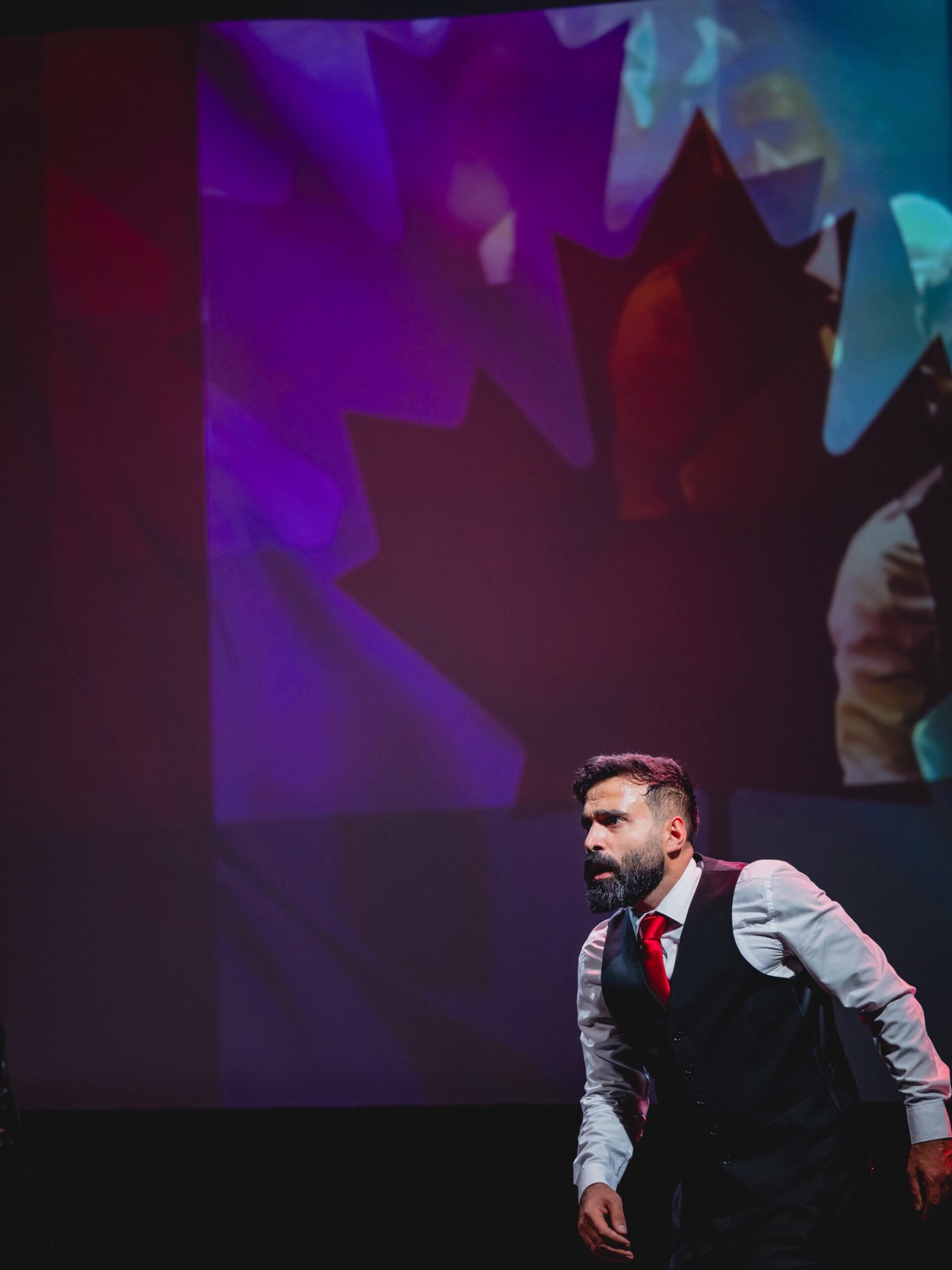
I had the opportunity to see Qasim Khan perform at Montreal’s Centaur Theatre in ‘Paradise Lost’ and wondered who this intense looking artist was on stage because he drew my focus to him immediately. When I had emailed Qasim I was very pleased he agreed to an interview, and the fact he answered the questions via email and returned them to me meant I could post his profile sooner.
According to his website (https://qasimk.com/biography/), Qasim is a 2008 graduate of the joint Acting Program from Sheridan College and the University of Toronto. In 2011, he was one of eight artists from across Canada to join The Soulpepper Academy, a performance residency with The Soulpepper Theatre Company.
Qasim’s resume includes some work with outstanding theatre companies across Canada. I encourage you to visit his website for more information. His two social media handles are found at the end of his profile.
We conducted our interview via email. Thank you again, Qasim, for participating.
It’s a harsh reality that the worldwide pandemic of Covid 19 has changed all of us. Describe how your understanding of the world you know and how your perception and experience have changed on a personal level.
Wow. That’s a real big question. On a personal level, there’s not a single aspect of my life that hasn’t changed in the last year. The day-to-day basics are different: I would normally be in Stratford at this time of year, and I have decided to stay in Toronto for the time being. It’s been nice being close to my (small, contact-traced) circle of friends in the city.
Last summer in Toronto was actually really lovely; I haven’t spent this amount of time in Toronto in years, and someone close to me sort of toured me to all these beautiful outdoor spots that I never knew existed – for someone who doesn’t normally spend tons of time outdoors, it was really magical. There’s still a few more places for me to explore this summer, so that’s a nice thing to look forward to.
The other day-to-day changes are easy: I was a bit of a homebody pre-pandemic, so staying at home isn’t the end of the world (I’ve absolutely hit a wall though – we’ve been on a lockdown since last October here in Toronto – so right now all I want to do is go to a club and kiss strangers). Wearing a mask is a no-brainer, and I don’t even mind my hands being dry from hand sanitizer. Pre-pandemic, especially while working, my only hobby was going to the gym, and I haven’t set foot inside one since the day the NBA locked down in 2020. So, where I was lifting heavy things every morning at 6am, I’m now doing what I can at home, when I can, led by an app on my phone that makes me feel sufficiently guilty if I skip a workout.
There’s a level of communication and transparency in my current relationships that is new to me because of COVID. Last November I worked on a movie and was COVID tested every 48 hours gearing up to being on set. My bubble and I had to keep extra safe so that I maintain a negative test result (otherwise I couldn’t go on set, or work). So that was a conversation with friends that I never thought I’d have: “Can you please only see me, and maybe not even go to a grocery store?”
Pre-pandemic I had been with my partner for about five years, and we parted ways a few months into the pandemic, after building a really solid friendship. So, setting up my own home has been part of the adventure of 2020 as well – it helps having an ex who’s a very good realtor! I knew that I would be spending a big portion of 2021 locked in this new place, so I let myself deck it out with stuff that I feel good being surrounded by, including a very comfy couch, and a little army of plants (that are thriving).
I guess the overall personal shift is that there’s far more calculation and mindfulness in what I’m doing, who I’m surrounding myself with, and how I’m spending my time. The need for routine comes in waves, and the routines themselves need fine-tuning as more time passes. This is probably a good lesson for the post-pandemic world: everything needs to evolve and reflect where you’re at, and I’m valuing the freedom I have right now to roll with things as they come.
With live indoor theatre shut for one year plus, with it appearing it may not re-open any time soon, how has your understanding and perception as a professional artist of the live theatre industry been altered and changed?
It’s a humbling thought that the very thing that has been so pivotal to my life, which has been essential to me as a human and professional, is so utterly non-essential in times like these. Of course, when we can have audiences again, theatre will be more essential than ever. But it has been a challenge having the largest part of my identity stripped away for over a year.
Something that has been inspiring and speaks to how hungry all of us are to get back to work is how quickly theatres and artists adapted to the situation. Within a few weeks of the pandemic, a friend had put together a small, weekly, online reading group where we read through a bunch of plays together – for no purpose but to stay connected. And within the first couple of months, I was busy being part of online readings and workshops of new plays. I don’t think you’ll find an actor in this country that isn’t now a Zoom expert. I’ve been lucky to stay busy with Film/TV work, and some writing projects that I have on the go as well.
I suppose my perception of the industry hasn’t changed, so much as the pandemic has highlighted many areas of the business that could be functioning better. We have all inherited a system of working in the theatre that no one has really challenged or questioned in a big way, partly because there is never time to reflect. It’s a beautiful way to earn a living but working in theatre has a lot of personal costs to it. We have told ourselves that it’s worth the trade-off, but what’s good about this break is that we can reevaluate how we have been working. It’s all stuff that allows artists to have a bit more agency – which will only create better work for our audiences to see.
Because of COVID, there’s now conversations happening around sick days; for example, if you came backstage at a show during cold/flu season in the past, you would see a group of over worked actors sucking back lozenges, teas, covered in tissues, and doing whatever they needed to not miss a show. I have shattered a finger, had a concussion, and gashed my head open in the middle of performances, and have prided myself on trudging forward – these all made for good stories at the bar after the show – and everyone is celebrated for being die-hard. But COVID safety protocols are forcing us to get realistic about the boundaries an artist needs to have. So, having a break from the routine of everything is necessary to get some perspective.
The murder of George Floyd and the protests of the last year have also been central to my perception of the theatre industry. What has been illuminated for many people is how unjust our current social-political setup is, and that translates to how every sector and organization has functioned in the past. It is heartening to see how keen most organizations are to return in a way that is healthier and supportive for Black and Indigenous artists, and artists of color.
Part of my professional life in the pandemic has been sitting on the Stratford Festival’s Anti-Racism Committee, and we have been working hard to identify barriers for company members that are Indigenous, Black, or of color, and strategizing a way to shift the culture of the organization to allow these company members to have a fulfilling, meaningful, and equitable experience while working there. It’s wonderful to finally have the prospect of a 2021 season of shows and artists to gear this work towards. It’s all very exciting.
I also became a member of the Howland Company in Toronto, and there’s lots of cool things in the works for us, and it’s another group of really inspiring theatre makers. So, where I would spend eight hours a day in a rehearsal hall, I now spend my day sitting on Zoom having stimulating conversations and dreaming about the theatre that audiences will see SOON!
As a professional artist, what are you missing the most about the live theatre industry?
I miss the people, the joy of creating something on my feet, the excitement I feel when a stage manager announces: “Five minutes to the top of part one, please; five minutes.” I think, most of all though, I miss the adrenaline rush of being on stage in front of a room of strangers. That is a feeling that, in 12 months of being at home, I have not been able to recreate, and it’s a feeling that is so central to who I am.
The New York Times put out an article last week that talks about the feeling of “blah” we all have at this point in the pandemic – the “languishing” we all feel – I think my “languishing” will be remedied by that specific adrenaline kick. I miss that and can’t wait to feel it again. Oh, and I really miss making people laugh.
As a professional artist, what is the one thing you will never take for granted again in the live theatre industry when you return to it?
I will never take interacting with people for granted again. I’m a bit of homebody, a loner and a hermit when I work; it’s rare for me to socialize with folks I’m working with, especially once shows are running. I will never take for granted the opportunity to build relationships with these special humans ever again.
Describe one element you hope has changed concerning the live theatre industry.
Well, to be frank, a lot of organizations have made lots of promises to the community about their focus on Equity, Diversity, and Inclusion, and I certainly hope these promises are followed through. It would be a shame to spring right back to the kind of system we had before – it would feel bizarre at this point for both artists and audiences because the world as we know it is significantly different than where we were a year ago. Cultural shifts take time, so companies that funneled resources into this work last year are in way better footing to re-open in a better way this year *fingers crossed*.
The ability to work online has presented opportunities for artists and organizations to collaborate on a national level, and that is a new thing that I hope we figure out how to bring into the off-line world. Theatres are speaking to each other, artists are speaking to each other, everyone is sharing resources and ideas, and a lot of the new works that have been developed in the last year have been influenced by folks Zooming in from around the country, and sometimes around the world.
How cool is that!? I wouldn’t want to lose that connectivity.
Explain what specifically you believe you must still accomplish within the industry.
I was on a bit of a good, lucky streak of theatre work before the pandemic, and what was exciting about that was that it felt like I was getting to the point of playing the kinds of roles I wanted. So, there are roles I dream of playing, plays I dream of working on, directors I would love to collaborate with, and theatres I want to work at. I’d list them all but that’s more interesting to me than your readers.
The only ‘agenda’ I’ve ever brought to my work is wanting young folks of color to see someone that looks like them be central to the stories they see on stage, and with the kinds of shifts I think we will see in the industry, that might be more possible than ever. That’s exciting.
Some artists are saying that audiences must be prepared for a tsunami of Covid themed stories in the return to live theatre. Would you elaborate on this statement both as an artist in the theatre, and as an audience member observing the theatre.
OH FUCK NO!
I’d rather see theatres stay shut (that’s mainly a joke) than see or work on anyone’s socially distanced, one-person, masked, plexi-glassed, piece about their pandemic sourdough starter and plant collection. Or anything about isolation for that matter.
Absolutely not.
No one that lived through this time will ever forget what it was like, and I don’t think we need it amplified in the theatre right out the gate. I think the superpower that theatre will have post-pandemic is to provide an escape and balm for what we all just went through, and to speak to the social and political shifts we have seen in the last year, in an artful way. I’m hungry to perform in something that will either make people belly laugh, cry a lot, be stunning to look at, or to be candy for my brain (or, ideally, all the above… with many people on stage…. not six feet apart).
As an artist, what specifically is it about your work that you want future audiences to remember about you?
(This feels like I’m writing my own eulogy, but here goes!) Ummm… I mean, I guess I want people to remember that the guy they saw in ‘Paradise Lost’ and ‘The Neverending Story’ was kinda weird, but kinda funny, and it turns out he’s capable of a lot.
And that his name rhymes with ‘awesome,’ but he’d rather people do the rhyming in their heads than out loud and in front of him.
Follow Qasim on Twitter and Instagram: @theqasimkhan
Qasim Khan
I had the opportunity to see Qasim Khan perform at…

Quincy Armourer
When I was in Montreal the last couple of years to review shows, I remember seeing Black Theatre Workshop’s (BTW) name on several posters around the city announcing upcoming productions. I had reviewed ‘Angelique’ at Toronto’s Factory Theatre, presented by Factory and Obsidian Theatre Company (in co-production with BTW and Tableau D’Hote Theatre), and I wanted to learn more about these two Montreal based theatre companies.
I was so pleased that, when I reached out to both companies, they have responded back in kind and have welcomed the opportunity to share their story of ‘The Self-Isolated Artist’ in their company. Tableau D’Hote Theatre Company’s profile will appear shortly.
Artistic Director of BTW, Quincy Armorer, and I conducted our interview via email. Quincy was to have appeared in August Wilson’s ‘Fences’ at The Centaur before the lock down. The On Stage Blog reviewers were really looking forward to the production as all of us wanted to attend, but only one of us would be able to review. That’s a nice feeling when you have reviewers who really want to see something.
Thank you, Quincy, for this interview. I certainly hope that Our Theatre Voice can be of service to BTW in future:
1. How have you been doing during this period of isolation and quarantine? Is your family doing well?
My family is doing well, thanks. It’s been difficult to spend so much time away from them, but luckily everyone is healthy and doing fine. It’s been hills and valleys for me, I think. When the quarantine began and we didn’t quite realize how long it would last, I tried to give myself a bit of down time. And at first, I didn’t mind the shift to working from home. Now that we’re at three months with no clear end in sight, it feels very different. Also, the recent incidents of anti-Black racism that have sparked outrage across the world in the past couple of weeks have made being stuck in isolation especially hard.
2. Were any productions in rehearsal for BTW at the time of the lockdown? Were they far from premiering? Will these productions become part of any future slate(s) for BTW?
Just as the lock down made its way to Montreal, we were about to present one show and begin rehearsals on another. We were bringing in the Toronto production of ‘Obaaberima’ produced by Buddies in Bad Times Theatre, to present it with our partners Espace Libre in English with French surtitles, but it was quickly cancelled. This was the second time that we were working with Espace Libre to bring in a Buddies show (the first was ‘Black Boys’ back in 2018) and its a great collaboration between our three companies to bring Black queer content to Montreal that is accessible to both anglophone and francophone audiences. We are definitely planning to find time in a future season for ‘Obaaberima’.
Our other project was a co-production of August Wilson’s ‘Fences’ with Centaur Theatre. We were just a week away from beginning rehearsals and, not yet fully understanding the extent of Covid-19, thought that we could save the show by simply delaying production for a month. Well, that plan wasn’t going to work either, so Centaur Theatre’s Artistic Director Eda Holmes and I made the decision to postpone the show indefinitely. We are both fully committed to seeing the project through, and as soon as we can safely and responsibly make it happen, we absolutely will.
3. What has been the most challenging part of the isolation and quarantine for you personally and professionally?
Personally, I miss my family. And I miss hugs. I really do. But I think what has been most challenging for me is also what has been the most rewarding. I’ve been very introspective lately and it’s stirred up a lot of thoughts and emotions within in a very real and profound way. It hasn’t been easy, but it’s been very enlightening and I’m grateful for the opportunity to turn inward for awhile in a way that I normally don’t. I’ve enjoyed that quite a bit.
Professionally, there are a number of things. One of the hardest parts has been the uncertainty of knowing what if anything we will be able to present next season. It’s a milestone year for us – our 50th anniversary – and we’ve been planning it for some time, so this limbo that we’ve been forced into right now is certainly a challenge for us.
I also want our artists to feel safe and confident and for them to know whether or not – or at least when – the projects they have been preparing for and looking forward to will happen. There’s also been the challenge of potentially shifting ‘online’ and deciding how much content to offer and what that content should be.
But most importantly, our Black communities need support right now. We have to ensure that we are properly providing for them, listening to them and creating space for them, which is made that much more difficult by quarantine and isolation. I’d give anything to be able to open up our doors and invite everyone in and create a safe space for us to talk, share, vent, cry, support, hug – whatever we need. We can’t do it in person right now, so we’ll do what we can from a distance.
4. What have you been doing to keep yourself busy during this time of lock down?
Working. Our office is closed, but our full staff has been working very hard from home since the middle of March. In many ways it feels like we are busier than we’ve ever been. Our 50th season was intended to be one of our most ambitious to date, although now we’re still not sure how much of that season we’ll actually be able to deliver. Preparing for our launch, exploring other artistic activities, as well as revisiting and revamping our seasons to come has kept me quite occupied.
I also jumped on the bandwagon! My folks are from Trinidad, and in our family, mom is the cook and dad is the baker. I had to try my hand at my dad’s Coconut Bake, and I have to say it turned out pretty good! I now understand that place my dad disappears into whenever he gets his hands in dough. It’s meditative. I like it. It’s been a welcome escape.
5. What advice would you give to other performing artists who are concerned about the impact of COVID-19? What words of advice would you give to the new graduates emerging from the National Theatre School?
Make lemonade! We have to work with what we’ve got, so when the world gives you lemons, that’s what you do. There’s no denying that this is the world we are now living in. What we have to do is find the opportunities hidden behind the obstacles. The work is still the work and the craft is still the craft. That won’t change.
Keep working on what you can, when you can. We’re on hiatus. Be ready when hiatus is over.
6. Do you see anything positive coming out of this pandemic?
I hope people come away from this with a greater appreciation for art in general and live performance in particular. When the lockdown began, everyone was turning to art and artists entertainment and humour and comfort and connection. We needed it. I think a lot of people didn’t realize just how important it is in their lives until they no longer had access to it. I’d love to know that in certain circles, the value of what we do now requires less explanation.
But beyond that, I just want all of us to be kinder to each other. None of us is exempt from this pandemic, and it would be unfortunate if something this global, something this devastating but potentially unifying would find more ways of dividing us rather than bringing us together. What a shame that would be.
7. Do you believe or can you see if the Quebec and Canadian performing arts scene will somehow be changed or impacted as a result of COVID – 19?
It already has. I can’t imagine that there wouldn’t be significant impact. Covid-19 has changed how we interact as a species. Our relationship to proximity and touch and intimacy isn’t what it was three months ago, and it won’t just disappear once we’re allowed to gather again at the theatre. Audiences are going to be receiving what they see on stage through a post-covid lens.
Creators and producers can’t help but be affected by our current reality either. We have to embrace it. What are the stories that our audiences will want to see? What, if anything, do we need to do differently to tell them? It’s not a question of ‘will it change’ but rather ‘how will it change’.
8. Many artists are turning to streaming/online performances to showcase/highlight/share their work. What are your thoughts and comments about this? Are there any advantages or disadvantages? Will streaming/online/ You Tube performances be part of a ‘new normal’ for the live theatre/performing arts scene?
It seems like there was a mad rush for many companies to begin producing online content to stay connected to their audience, and some fared better than others. I don’t think there should be a blanket rule because it’s not going to work for everyone. Some companies have more resources available to them and can create high-quality content in little time. Others just simply don’t have the means. I think some of the work that has been put out there is a nice complement to what we do, but there’s no substitute for the shared experience of being in the same space together. You can’t replace that.
That being said, streaming and online performances allow companies to reach a much broader audience. We have our Artist Mentorship Program at BTW that culminates each year with a live Industry Showcase in May, which this year we had to cancel. Instead, we created an online showcase which has allowed us to share the work of our emerging artists with potential engagers not only in Montreal but across the country. It’s a new initiative that we hope to make a permanent addition to the program.
9. As Artistic Director, where do you see the future of Black Theatre Workshop headed as a result of this life changing event for all of us?
Our approaching milestone anniversary has been a time of deep reflection for us. It’s made us look back on all that we’ve accomplished over the past fifty years, but also on what we want the next fifty years to be. BTW has had to fight against systemic anti-Black racism for decades, and, over the years, we have built a profound legacy of maintaining our relevance in a world and industry that are ever revolving around us. That certainly is the case now.
I want us to continue amplifying Black voices and telling our stories because, let’s face it, the current state of the world right now is showing us that we need these stories now more than ever. There are multiple voices, diverse voices, still under-represented voices within the Diaspora, and BTW will be a place where they can all be given a platform. We will continue to be an example of the open door that we ourselves have been seeking.
With a respectful acknowledgment to ‘Inside the Actors’ Studio’ and the late James Lipton, here are the 10 questions he asked his guests at the conclusion of his interviews:
1. What is your favourite word?
Kind
2. What is your least favourite word?
Bland
3. What turns you on?
Sincerity
4. What turns you off?
Crowds
5. What sound or noise do you love?
Crashing waves
6. What sound or noise bothers you?
Construction
7. What is your favourite curse word?
Fuck
8. What profession, other than your own, would you have liked to attempt?
Grade schoolteacher.
9. What profession would you not like to do?
Medical examiner (despite my name)
10. If Heaven exists, what do you hope God will say to you as you approach the Pearly Gates?
‘What’s up, Girl?”
To learn more about Black Theatre Workshop (BTW), visit their website: www.blacktheatreworkshop.ca.
You can also visit their Facebook page: Black Theatre Workshop
Twitter: @TheatreBTW Instagram: @theatrebtw
Quincy Armourer
When I was in Montreal the last couple of years…