

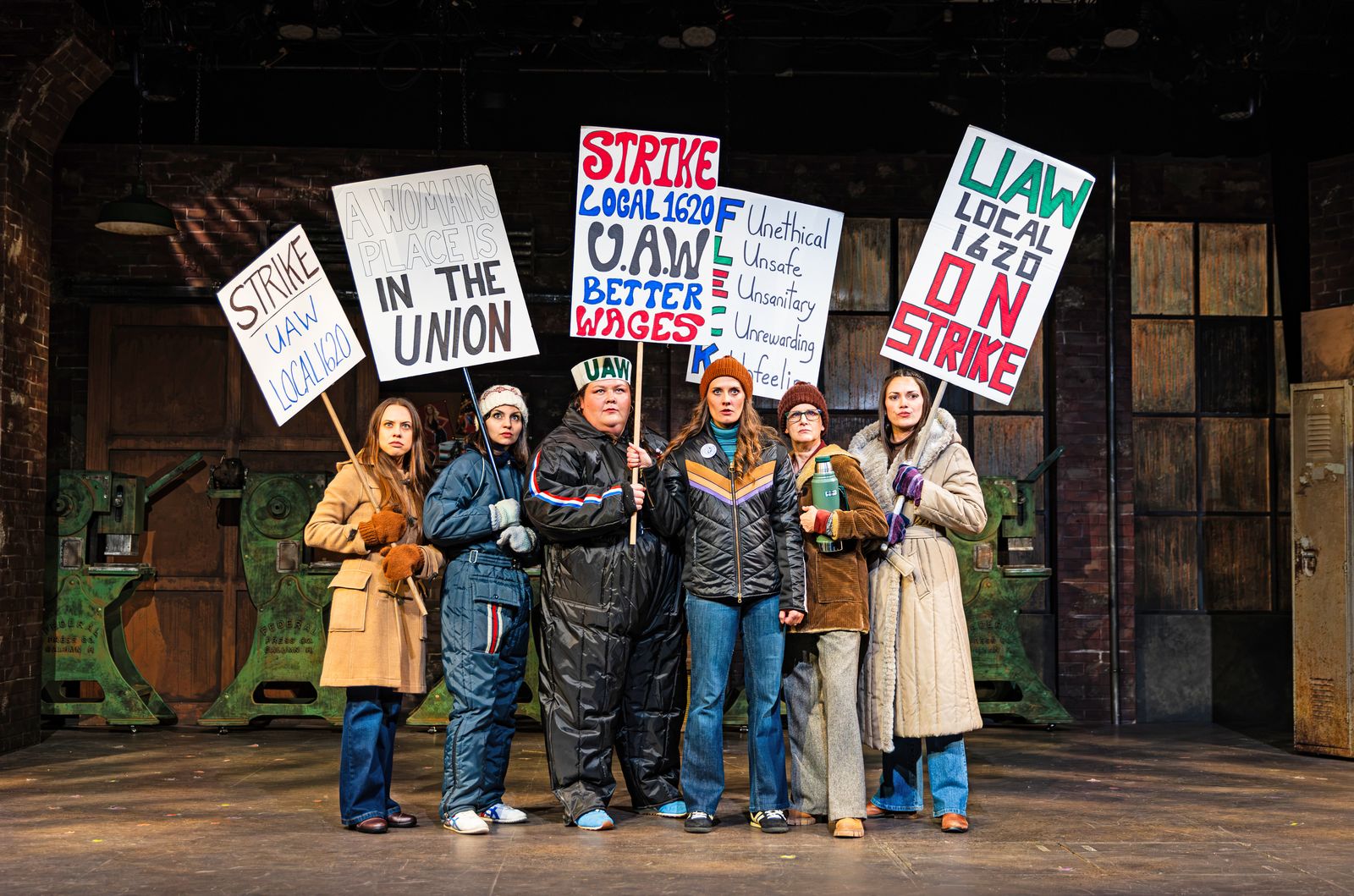
VOICE CHOICE: Under Mary Frances Moore’s decisive direction, a committed ensemble powerfully anchors Kristen Da Silva’s dramatization of the 1978 Fleck Manufacturing strike.
Kristen Da Silva’s Sisters of ’78 dramatizes the 1978 Fleck Manufacturing strike and its place in Ontario labour history. Presented by Theatre Aquarius in association with the Blyth Festival, the production centres on a six-woman ensemble and the personal and collective pressures workers faced during the dispute.
Inspired by the 1978 Fleck Manufacturing strike in Centralia, Ontario, a 163-day labour dispute led largely by women contributed to changes in provincial labour law. Da Silva’s script depicts employees at an automotive wiring factory confronting sexual harassment, low wages and unsafe working conditions, including prolonged standing and timed bathroom breaks. The women organize a union and enter collective bargaining, a decision that strains friendships and draws opposition at home and in the community. Intimidation leads some workers to leave the strike, while others remain until the dispute ultimately helps prompt legislative change.
Maeve (Madison Hayes-Crook) and her daughter Christine (Gloria Garratt) live with Margaret (Cara Hunter), Maeve’s devoutly Irish Catholic mother-in-law. Maeve’s husband, Andrew (Aiden Altow), is away on an extended RCMP posting and training assignment. With money tight and tensions mounting at her mother-in-law’s home, Maeve takes a factory job at the suggestion of her friend Laurie (Shaina Silver-Baird). There she encounters worsening conditions and a supervisor, Lumpy (Geoffrey Pounsett), who routinely harasses and intimidates the women without consequence.
Sean Mulcahy’s costumes evoke the mid-to-late 1970s through details such as Andrew’s open shirt and fitted trousers, Lumpy’s checked slacks and the pen tucked into his shirt pocket. Sound designer Lyon Smith’s selection of late-seventies period music before the show and during scene changes establishes the historical time frame.
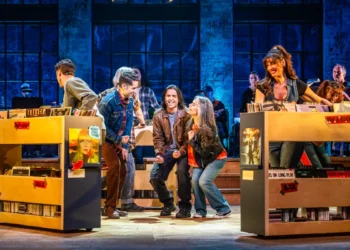
Siobhán Sleath’s lighting makes effective use of shadows and tightly focused illumination, particularly when the women appear in stark light holding picket signs. Mulcahy’s set places a deteriorating factory on stage right, with green presses that move on and off efficiently. Stage left holds Margaret’s bright yellow 1970s kitchen, furnished with a wall telephone, a long cord and an Irish cross. Smith’s recorded radio reports lend period texture to the strike sequences, while a loud factory bell punctuates the beginning and end of each shift.
Aiden Altow and Geoffrey Pounsett give credible performances as Andrew and Lumpy respectively, though both men are written largely as familiar tropes of the sexism the play seeks to examine. Their limited characterization sharpens the contrast between the male authority figures and the women challenging them.
The six-woman ensemble gives the Aquarius production its momentum, creating distinct, real characters whose solidarity develops without erasing their disagreements or individual circumstances.
As Laurie, Shaina Silver-Baird establishes an easy rapport with Maeve. When the two clash over the impending strike, Silver-Baird and Hayes-Crook make their conflict persuasive, particularly as details emerge about Laurie’s unseen husband and her daughter, Janie (Goldie Garratt). Alyssa Leclair plays strike leader Joyce with bluntness and comic timing, and gives the character’s address to the unseen strikers a clear conviction that draws applause. Kait Post charts Angie’s gradual recognition of the physical toll of factory work while retaining the character’s resolve to support her colleagues. As Natalie, Kirstyn Russelle presents a pregnant worker whose commitment to the picket line remains firm.
Cara Hunter gives Margaret’s religious certainty both comic force and severity, including a late retort regarding a comment her son makes to Maeve in the second act that once again draws audience applause. Hayes-Crook, meanwhile, traces Maeve’s growing independence as she learns to trust her own judgment and perspective, particularly after Andrew returns from training.
In her playwright’s note, Da Silva observes that the 163-day strike might remain unfamiliar to many audiences. The production addresses that gap by placing the workers’ experiences within a broader account of labour reform. Moore’s director’s note frames the story as an example of collective action beginning with one person who stands up and another who chooses to stand beside them.
Sisters of ’78 is a clearly staged, well-acted account of a consequential labour struggle that deserves to be seen. Its strongest moments come from the ensemble’s measured depiction of solidarity under pressure, even as some supporting characters remain broadly drawn. The play also invites comparison with the 1979 film Norma Rae, in which Sally Field portrays a textile worker involved in a similar effort to unionize her workplace
Running time: approximately two hours with one intermission.
The production runs to October 18 at Theatre Aquarius, 190 King William Street, Hamilton. For tickets: theatreaquarius.org or call 905-522-7529.
THEATRE AQUARIUS presents A BLYTH FESTIVAL PRODUCTION
Sisters of ‘78 by Kristen Da Silva
Directed by Mary Frances Moore
Set and Costume Design by Sean Mulcahy
Lighting Design by Siobhán Sleath
Sound Design by Lyon Smith
Stage Manager: Flávia F. Martin
Performers: Aiden Altow, Madison Hayes-Crook, Gloria Garratt, Goldie Garratt, Cara Hunter, Alyssa LeClair, Kait Post, Geoffrey Pounsett, Kirstyn Russelle, Shaine Silver-Baird