


Roll up, roll up: Thespis’ wagon is in town! The Fringe couldn’t be further from a temple of slick entertainment. Its thrill comes from the community it gathers up. For two weeks, Toronto becomes a rough-and-ready Theatre of Dionysus: democratic, unruly, and alive to its own contradictions. But with 100+ shows on offer, even the most willing spectator can feel dropped into the Minotaur’s maze. So, fancy a compass?
Covered in this article, in order of recommendation: He-r’tz, 1920’s Walking Around in a Dream; Three Descending Notes.
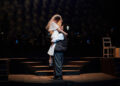
HE-R’TZ. (Tremulous.) In the early 20th century, Luigi Pirandello imagined identity as a stack of masks: one for every self we perform before others. In He-r’tz, Suki Cheung approaches the question from the opposite direction. Identity is not layered here, but fractured: a single face broken apart, its pieces scattered and struggling to reassemble. Inside VideoCabaret’s intimate theatre-in-the-round space, six dancers appear carrying fragments of the same white mask: a cheek, a mouth, a forehead, an eye, and so on. Dressed in grey – the colour of uncertainty – they move anxiously around the stage, searching for one another.
Cheung creates fleet-footed images charged with tension. Early on, the dancers share a loop of rope, loosening and tightening it until they become trapped inside. Later, holding wooden planks, they construct the outline of a house. But the promise of shelter does not last. The structure gradually turns hostile and inhospitable, and what began as a search for connection deepens into a study of dislocation. That instability is echoed in the grainy, flickering soundscape. Slippery piano phrases break through, then give way to rhythmic pulses and distorted voices. Even when the music fades, the silence remains unsettled, textured with faint crackles and radio-like hiss.
He-r’tz could use some tightening, but at its best, it understands, with real delicacy, the difficulty of recognizing oneself.
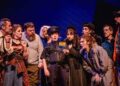
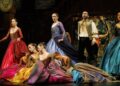
1920’S WALKING AROUND IN A DREAM. (Frothy.) The word amateur comes from the Latin amator, meaning “lover.” So when I call this an amateur production, I mean it in the tenderest sense of the word: far from refined, yet wearing its love of theatre proudly on its sleeve. Playwright Natalie Kaye transplants A Midsummer Night’s Dream to jazz-age Chicago, giving Shakespeare’s comedy a brassy, Roaring Twenties makeover. The result has a rough-around-the-edges charm.
Under Declan Meagher’s direction, actors dance the Charleston and shimmy their shoulders with undefeated energy. Cumbersome scene changes and broad slapstick become part of the evening’s homespun appeal. The concept also allows for some enjoyably cheeky reinventions. Kimberly Van Vo’s Hermia sashays onstage in a scarlet, rhinestone-studded dress, while Daytoni Raye’s moustachioed Dimitri – the production’s Demetrius – is imagined as a prizefighter. The evening’s laurels, however, go to Gareth Finnigan. He brings warmth and comic timing to Andy, the production’s Lysander, especially during “Satisfy,” a playful number in which he worries he is too inexperienced to please his lover. The reinvention exudes wit, transporting us to a sparkling age of Prohibition. But in defiance of the law, everyone here seems to carry a hip flask, taking the occasional swig to survive their romantic entanglements. As it turns out, booze makes a perfectly good substitute for Shakespeare’s love potion.
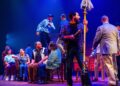
THREE DESCENDING NOTES. (Episodic.) Four mermaids, a singing bear, and a pirate enter the subway. No, this is not the beginning of a joke. They are just a few of the human and non-human figures encountered by 70-year-old Odelia. She was simply riding home on the TTC, so how on earth did she end up in a sun-drenched valley where animals hum in harmony?
This 40-minute musical attempts to draw us into the fractured mind of a woman living with dementia. By delving into her hallucinations, Robin North’s book creates intriguing and at times whimsical tableaux, enhanced by Nae Phillips’s surprisingly streamlined projections. The piece takes up a compelling subject with tenderness and imagination. Yet its loose rhythm and episodic structure ultimately leave the audience without a firm sense of direction. Rachael Cardiello’s lullaby-swaying score proves suspenseful: like Odelia, we are meant to feel lost. The problem is that the show too often seems lost, too.
Fringe runs until July 12. Tickets, passes, and full schedules are available at fringetoronto.com; tickets and passes can be bought online, by phone at 416-966-1062, or in person at the Festival Box Office.