


A production that blends comedy, drama and touches of magic, leaving the audience awestruck in its final moments, is truly exceptional.
That’s exactly what Clyde’s achieved on opening night at Canadian Stage’s Bluma Appel Theatre.
Philip Akin directs Lynn Nottage’s remarkable script with finesse, melding humour, emotion, and an enchanting touch of magic. Yet the ending may linger unsettlingly in viewers’ minds. It certainly did for me, but I won’t give it away.
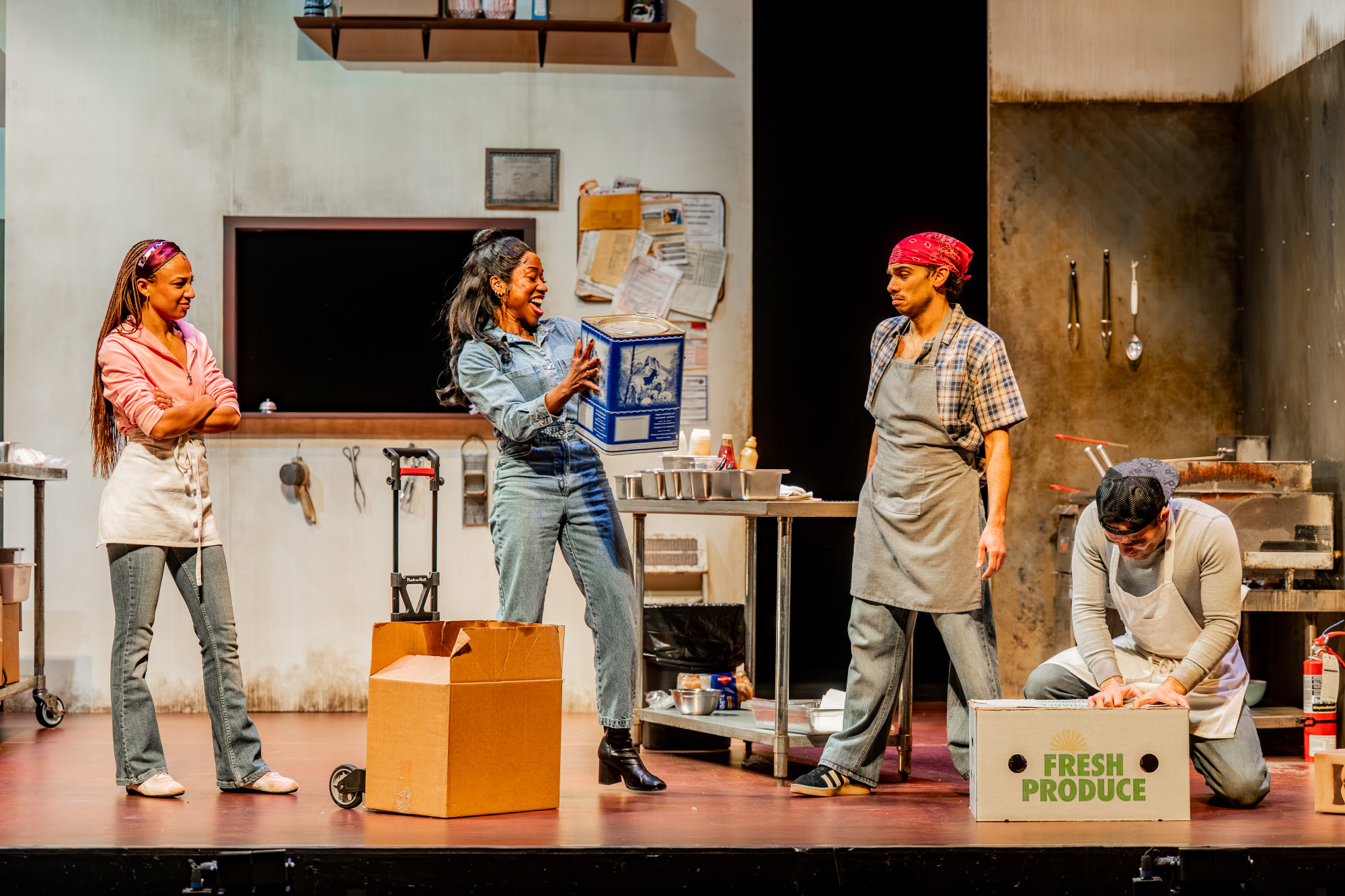
Set in the greasy-spoon back kitchen of a truck stop, Sophia Walker plays Clyde, the sultry, sexy, and downright nasty, callous owner who has hired four inmates: Rafael (Augusto Bitter), Letitia (Jasmine Case), Montrellous (Sterling Jarvis), and Jason (Johnathan Sousa), the only white person in the kitchen. There is the order window through which Clyde places the dinner tabs, but the audience does not see any hint of the dining room. It’s dark beyond the window.
The four individuals are determined to craft the ultimate sandwich, led by Montrellous (Monty), a chef admired by the rest for his conviction that perfection is possible. While one of them assembles what they consider the finest sandwich, Clyde interrupts, demanding the ham-and-cheese order meant for a customer. The audience responds with genuine laughter tinged with sadness, understanding that these four are striving not only to excel in their work but also to rebuild themselves and contribute positively to society.
There’s a tinge of friction between Letitia, also called ‘Tish’ (the single mother of a disabled child) and Rafael (SPOILER ALERT – who has a thing for his female coworker) when we first see them at work in the kitchen. The tension is very thick. As the story unfolds and the layers are peeled back, Case creates a very believable single mother. Her Tish always wonders if she’s doing the right thing for her son. Bitter’s Rafael is quick-witted, street-savvy, and smart. But Bitter thankfully does not play him solely as one-dimensional. Augusto’s Rafael is the scared and scarred boy who wants to do good in the world. Jason is a newly hired chef with major tattoos. Letitia and Rafael are not very welcoming to Jason when they first meet him. While Sousa’s Jason might be tough as nails as his employer, Clyde, Sousa is that scared and scarred young boy just like Rafael.
The production features notable stage effects, skillfully executed under Michael Kras’s direction and design. For example, diner tabs rung up in the kitchen are made to vanish into a flame, offering an impressive visual element. Additional illusions are incorporated throughout the performance; however, further details are withheld to preserve the experience for upcoming audiences.
Jacob Lin chooses fitting sounds that evoke the atmosphere just outside the rear entrance of a truck stop. Rachel Forbes, working under Leigh Ann Vardy’s institutional kitchen lighting, designs a remarkably genuine back kitchen for a truck stop diner. Some sections of the kitchen’s back walls appear to need a thorough cleaning, and the grimy window above the set reinforces the impression of a downtown location. The kitchen bustles with pots, pans, skillets, and assorted utensils. You can almost sense the aroma of grease and oil rising from the stoves. Despite the clutter, the workers have everything within easy reach at their stations, knowing exactly where each item is located.
The five-member cast shines.
Bitter, Case, Jarvis, and Sousa deliver performances marked by authenticity and attention to detail. Bitter, Case, and Sousa demonstrate respect towards Jarvis, relying on his insight throughout the production. Each of the four actors presents monologues that are both thoughtful and impactful, offering material that may prove useful for future auditions. Their interactions with owner Clyde are engaging, often providing moments of humor, such as the anecdote about ketchup on a tuna salad sandwich. The subtle sense of disappointment portrayed by Letitia, Rafael, and Jason, alongside Monty’s encouragement to embrace progress, adds a compelling dimension to their characters. The evolving relationship between Bitter’s Rafael and Case’s Tish is particularly noteworthy, contributing positively to the overall narrative.
The Canadian Stage website bills Clyde’s as “a transcendent story of second chances, rising above past mistakes and reconnecting with the world.”
Philip Akin nobly directs the production with genuine heart and hope for these individuals to return to a world where they can contribute. That’s what makes this production a VOICE CHOICE for me.
I’m doing my best not to spoil the final moment of the play, as it left me without words for a few minutes.
Worth a trip to see Clyde’s.
Running time: approximately 90 minutes with no intermission.
Clyde’s runs to April 26 at the Bluma Appel Theatre, 27 Front Street East, Toronto. For tickets: canadianstage.com or call (416) 368-3110
CANADIAN STAGE presents
Clyde’s by Lynn Nottage
Directed by Philip Akin
Set Design: Rachel Forbes
Costume Design: Arianna Moodie
Lighting Design: Leigh Ann Vardy
Sound Design: Jacob Lin
Magic Direction and Design: Michael Kras
Stage Manager: Anna Kaltenbach
Costume Design Mentor: Ming Wong
Dialect Coach: Peter N. Bailey
Assistant Stage Manager; Ada Aguilar
Apprentice Stage Manager: Frankie Bayley
Performers: Augusto Bitter, Jasmine Case, Sterling Jarvis, Jonathan Sousa, Sophia Walker