

(Guest writer: Izzy Siebert- participant in ON Criticism: The 2025/26 Theatre Critics Lab, with partners – the Grand Theatre, Intermission Magazine, Talk is Free Theatre, Tarragon Theatre, and Theatre Aquarius)
The cinematic influence of Jaws is well established. Prior to attending Theatre Aezir’s staging of The Shark is Broken in London, Ontario, I viewed the original film to gain context for my first experience with the play. While Ian Shaw and Joseph Nixon’s script is particularly resonant for those familiar with the iconic movie, the exemplary performance in The Shark is Broken merits attention from all audiences.
Even as someone relatively unfamiliar with the careers and personal lives of Jaws’ leads, I found it satisfying to recognize the nuances of their portrayals, thanks to a double-feature approach. Viewing the film and play consecutively reveals how well the actors capture their counterparts without making them feel like caricatures.
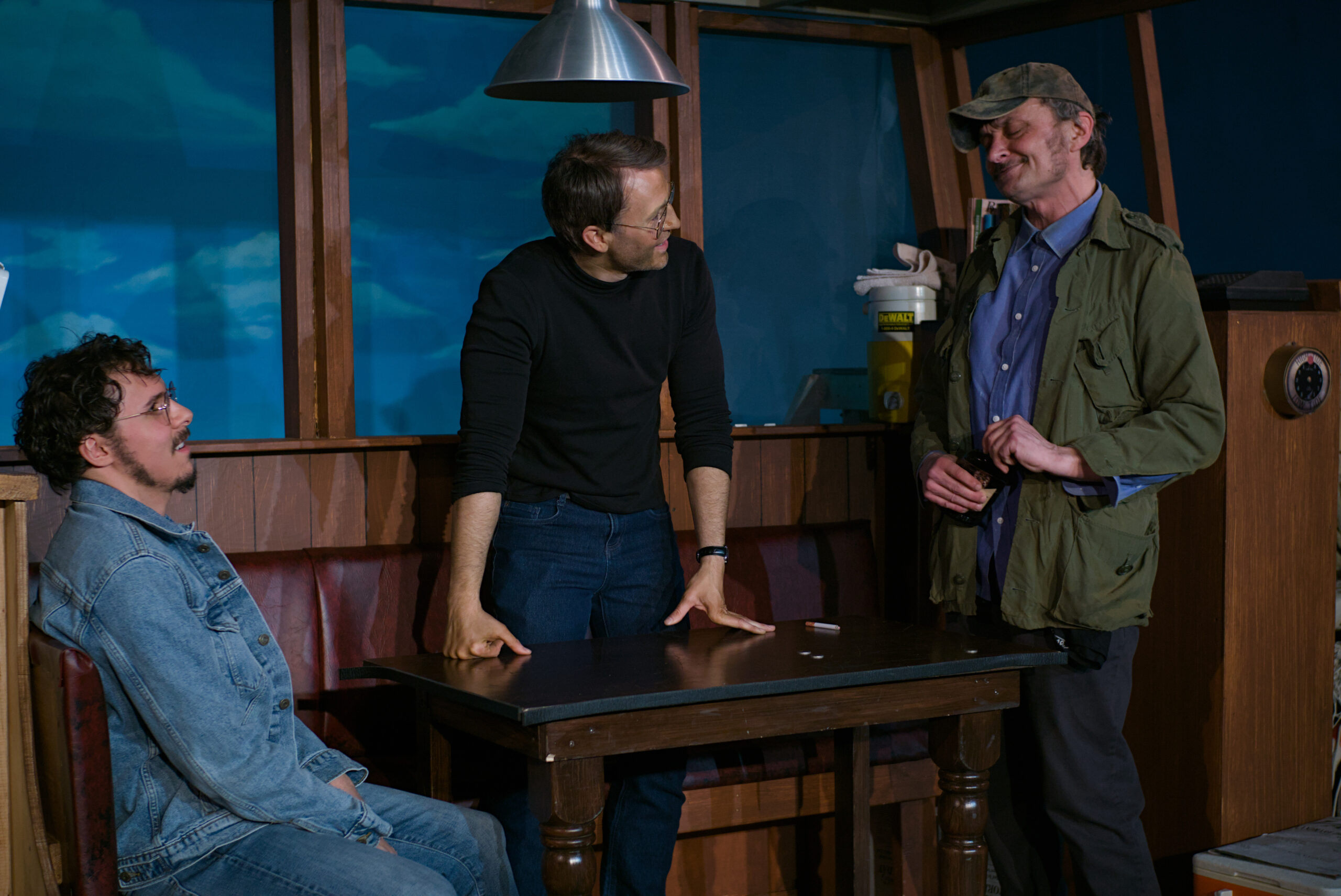
Offering a behind-the-scenes look at the filming of Jaws, the play picks up partway through shooting when actors — Roy Scheider (Andrew Dodd), Robert Shaw (Josh Cottrell), and Richard Dreyfuss (Jackson R.R. Balint) — already have a touch of cabin fever. The production is over budget and behind schedule. It struggles with broken mechanical sharks during ocean shooting. The actors spend their downtime bonding and occasionally clashing out of boredom.
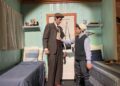
The play focuses less on the movie and more on the men behind it—three roles that are impeccably cast in this production. Elizabeth Durand’s costumes visually evoke the characters, from Quint’s beat-up baseball cap to Brody’s black turtleneck, but strong performances truly bring their resemblances to life. Balint, Cottrell, and Dodd embody vocal quirks and mannerisms, blurring the lines between the real-life actors and their Jaws characters.
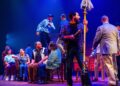
The close quarters of London, Ontario’s First Baptist Church, a church basement transformed into a black box theatre, suit the show’s claustrophobic tone. John Beverley’s set cleverly captures the infamous Orca, slicing Quint’s shark-hunting vessel down the middle. The action centres around a wooden table with red vinyl seating and an outer deck stretching out to allow more movement. Film fans will gleefully recognize Doug Cottrell’s props floating around the stage, from greasy chum buckets to big yellow barrels.
Although the characters revolve around a bench barely big enough for three, Dylan Trahan’s direction provides visual interest, and the cast’s varied performances keep scenes from feeling static. The dynamic among the three men quickly shifts in the pressure cooker of the boat, swinging between humour and heaviness.
Dreyfuss’ youth shows, while the well-established Shaw gives him a hard time. Scheider tries to hold the pseudo-family together. Stuck in proximity for an extended period, the actors’ personal lives inevitably bleed into one another. Throughout the production, serious topics surface, and we glimpse each man’s complicated relationship with fame, family, and vices.
Andrew Dodd brings steadiness and humour to Scheider’s attempts to keep things cool, whether by breaking up physical fights or delivering pointed glances to keep the peace. Although police chief Brody is arguably Jaws’ central character (despite the debates in this play about top billing), Scheider slips slightly into the background of this show while Dreyfuss and Shaw’s tempestuous relationship dominates.
Jackson R.R. Balint captures a young Richard Dreyfuss, consumed by insecurities as he plays marine biologist Hooper. Balint’s Dreyfuss is nervous and neurotic, yet sympathetic. As he struggles to hold his own on a film set where everyone seems more confident than he is, Balint’s portrayal reaches a breaking point, resonating with its vulnerability.
Josh Cottrell delivers a standout performance as Robert Shaw, the man behind the gruff shark hunter Quint. Cottrell handles Shaw’s range deftly, slipping with startling ease between brash loudness and a deep heaviness that hits like a punch when talking about his father.
Quint’s famous Indianapolis monologue, where he describes surviving a shark massacre, reappears as the only time we see active filming taking place. While the crew’s voices sound overhead, Craig Blackley’s lighting design shifts to create a starkly different world when the camera is rolling. Suddenly, we are watching actors at work as Cottrell delivers the famous speech with gravity.
Avery Brown’s immersive sound design gently sketches the world around the characters without drowning them. The soundscape reaches its peak in richness during the final take of the Indianapolis speech. Bombs quietly rumble, and planes fly low, yet never overpower the weight of Quint’s words. The result captures true cinema magic as his story comes to life.
A recurring topic among the actors is the film’s true subject. Similarly, people might wonder about the purpose of this play and, depending on how well they know the original work, find themselves drawn to different interpretations.
For a Jaws newcomer like myself, The Shark Is Broken emerges as a cinema-infused character study, buoyed by strong performances.
The Shark is Broken runs to April 19 at First Baptist Church, 568 Richmond Street, London, Ontario. For tickets:https://events.humanitix.com/the-shark-is-broken
THEATRE AEZIR presents
The Shark Is Broken by Ian Shaw and Joseph Nixon
Directed by Dylan Trahan
Technical Director: Mike Semple
Set Designer: John Beverley
Props Master and Set Decorator: Doug Cottrell
Sound Designer: Avery Brown
Sound Operator: Jessica Norrie
Lighting Director: Craig Blackly
Stage Manager: Anna Whitehead
Performers: Jackson R.R. Balint, Josh Cottrell and Andrew Dodd